


Are urban landscapes associated with reported life satisfaction and inequalities in life satisfaction at the city level? A cross-sectional study of 66 European cities
- PMID: 30898372
- PMCID: PMC6481515
- DOI: 10.1016/j.socscimed.2019.03.009
Are urban landscapes associated with reported life satisfaction and inequalities in life satisfaction at the city level? A cross-sectional study of 66 European cities
Abstract
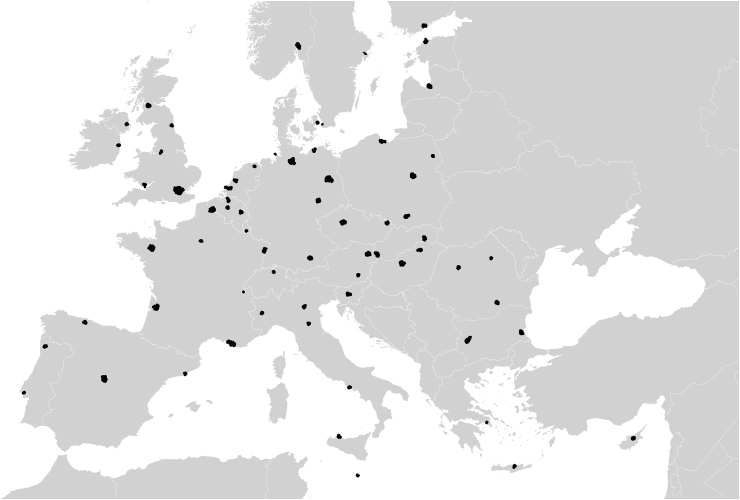
With more than half the world's population residing in urban areas and this proportion rising, it is important to understand how well-planned urban environments might improve, and reduce inequalities in, quality of life (QoL). Although studies suggest city-level characteristics hold independent influence on QoL, they generally lack a theoretically informed approach to understanding how the whole city landscape might be implicated, have paid scant attention to inequalities in QoL and often focus on small numbers of cities or countries. We applied theory and methods from landscape ecology to explore associations between cities' land cover/use, residents' reported life satisfaction and within-city socio-economic inequalities in life satisfaction. We joined individual-level responses to the European Urban Audit (EUA) Perception Surveys (2012, 2015) with city-level data from the European Urban Atlas classifying land cover/use into 26 different classes. Our sample included 63,554 people from 66 cities in 28 countries. Multilevel binary logistic models found that specific land use measures were associated with life satisfaction, including the amount of a city which was: residential (OR:0.991, 95%CI 0.984-0.997); isolated structures (OR:1.046, 95 CI 1.002-1.091); roads (OR:0.989, 95%CI 0.982-0.996); pastures (OR: 1.002, 95% CI 1.002-1.003) and herbaceous vegetation (OR:0.998, 95%CI 0.997-0.100). A more even distribution of land cover/use (β: 1.561, 95%CI -3.021 to -0.102) was associated with lower inequality in life satisfaction. This is the first study to theorise and examine how the entire urban landscape may affect levels of and inequalities in wellbeing in a large international sample. Our finding that more equal distribution of land cover/use is associated with lower levels of socio-economic inequality in life satisfaction supports the idea that city environments could be equigenic - that is, could create equality. Our findings can aid urban planners to develop and build cities that can contribute to improving, and narrowing inequalities in, residents' life satisfaction.
Keywords: Ecology; Inequalities; Landscape; Life satisfaction; Quality of life; Urban; Urban landscape.
Copyright © 2019 The Authors. Published by Elsevier Ltd.. All rights reserved.
Figures


References
-
- Academy of Medical Sciences . The Academy of Medical Sciences London. 2016. Improving the health of the public by 2040. Optimising the research environment for a healthier, fairer future.
-
- Apparicio P., Séguin A.-M., Naud D. The quality of the urban environment around public housing buildings in Montréal: an objective approach based on GIS and multivariate statistical analysis. Soc. Indicat. Res. 2008;86:355–380.
-
- Arundel R., Ronald R. The role of urban form in sustainability of community: the case of Amsterdam. Environ Plan B Urban Anal City Sci. 2017;44:33–53.
-
- Ballas D., Dorling D. The Oxford Handbook of Happiness. 2013. The geography of happiness; pp. 465–481.
-
- Ballas D., Tranmer M. Happy people or happy places? A multilevel modeling approach to the analysis of happiness and well-being. Int. Reg. Sci. Rev. 2011;35:70–102.
Publication types
MeSH terms
Grants and funding
LinkOut - more resources
Full Text Sources
Medical
