


Association between periductal fibrosis and bile duct dilatation among a population at high risk of cholangiocarcinoma: a cross-sectional study of cholangiocarcinoma screening in Northeast Thailand
- PMID: 30898798
- PMCID: PMC6475358
- DOI: 10.1136/bmjopen-2018-023217
Association between periductal fibrosis and bile duct dilatation among a population at high risk of cholangiocarcinoma: a cross-sectional study of cholangiocarcinoma screening in Northeast Thailand
Erratum in
-
Correction: Association between periductal fibrosis and bile duct dilatation among a population at high risk of cholangiocarcinoma: a cross-sectional study of cholangiocarcinoma screening in Northeast Thailand.BMJ Open. 2019 May 30;9(5):e023217corr1. doi: 10.1136/bmjopen-2018-023217corr1. BMJ Open. 2019. PMID: 31152049 Free PMC article. No abstract available.
Abstract
Objectives: To assess associations between periductal fibrosis (PDF) and bile duct dilatation (BDD) in ultrasonography (US) screening of population at risk of cholangiocarcinoma (CCA) due to residence in an endemic area for Opisthorchis viverrini. CCA survival rates are low, and early identification of risk factors is essential. BDD is one symptom that can identify patients at risk of CCA. Detection of PDF by US can also identify at-risk patients, at an earlier stage of CCA development. Identification of association between PDF and BDD will inform screening practices for CCA risk, by increasing the viability of PDF screening for CCA risk.
Setting: Nine tertiary care hospitals in Northeast Thailand.
Design: Cross-sectional study.
Participants: Study subjects in the Cholangiocarcinoma Screening and Care Program (CASCAP) in Northeast Thailand. CASCAP inclusion criteria are all residents of Northeast Thailand aged ≥40 years. Participants are recruited through CCA screening centres and through primary healthcare units. So far, 394 026 have been enrolled.
Methods: PDF and BDD were identified through US. PDF was categorised into three groups, PDF1, 2 and 3, depending on their high echo locality in the peripheral, segmental and main bile duct, respectively. Associations between PDF and BDD were determined by adjusted OR and 95% CI using multiple logistic regression.
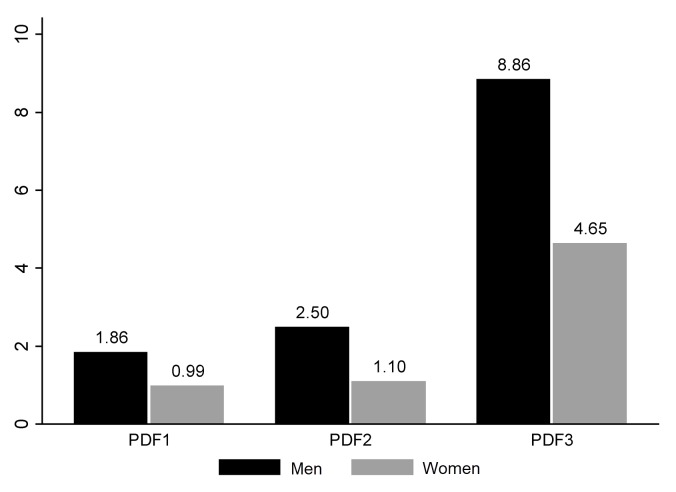
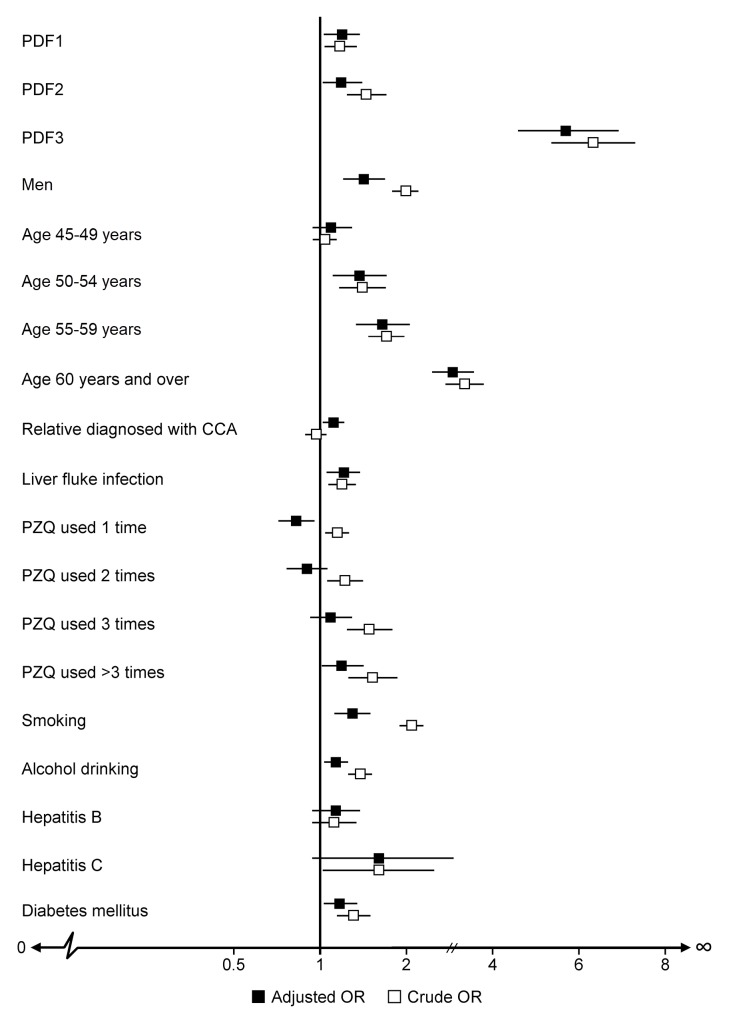
Results: BDD was found in 6.6% of PDF3, 1.7% of PDF2 and 1.4% of PDF1 cases. Among PDF cases, especially in PDF3, BDD was found in men more than in women (8.9% and 4.6%, respectively). Compared with non-PDF, the association between PDF3 and BDD was highly significant (adjusted OR=5.74, 95% CI 4.57 to 7.21, p<0.001).
Conclusions: Our findings reveal that there is a relationship between PDF and BDD, which is associated with CCA. Therefore, PDF can also be an indicator for suspected CCA diagnosis through US.
Keywords: Thailand; bile duct dilatation; cholangiocarcinoma; periductal fibrosis; screening; ultrasonography.
© Author(s) (or their employer(s)) 2019. Re-use permitted under CC BY-NC. No commercial re-use. See rights and permissions. Published by BMJ.
Conflict of interest statement
Competing interests: None declared.
Figures
References
-
- Moore MA, Attasara P, Khuhaprema T, et al. Cancer epidemiology in mainland South-East Asia - past, present and future. Asian Pac J Cancer Prev 2010;11(Suppl 2):67–80. - PubMed
-
- Moore MA, Manan AA, Chow KY, et al. Cancer epidemiology and control in peninsular and island South-East Asia - past, present and future. Asian Pac J Cancer Prev 2010;11(Suppl 2):81–98. - PubMed
-
- Institue NC. Hospital based cancer registry annual report. Bangkok: Eastern Printing Public Company Limited PCL, 2012:157.
Publication types
MeSH terms
LinkOut - more resources
Full Text Sources
Medical
