


Associations between lipid profiles of adolescents and their mothers based on a nationwide health and nutrition survey in South Korea
- PMID: 30898813
- PMCID: PMC6475165
- DOI: 10.1136/bmjopen-2018-024731
Associations between lipid profiles of adolescents and their mothers based on a nationwide health and nutrition survey in South Korea
Abstract
Objectives: Dyslipidaemia is a metabolic disease influenced by environmental and genetic factors. Especially, family history related to genetic background is a strong risk factor of lipid abnormality. The aim of this study is to evaluate the association between the lipid profiles of adolescents and their mothers.
Design: A cross-sectional study.
Setting: The data were derived from the Korea National Health and Nutrition Examination Survey (IV-VI) between 2009 and 2015.
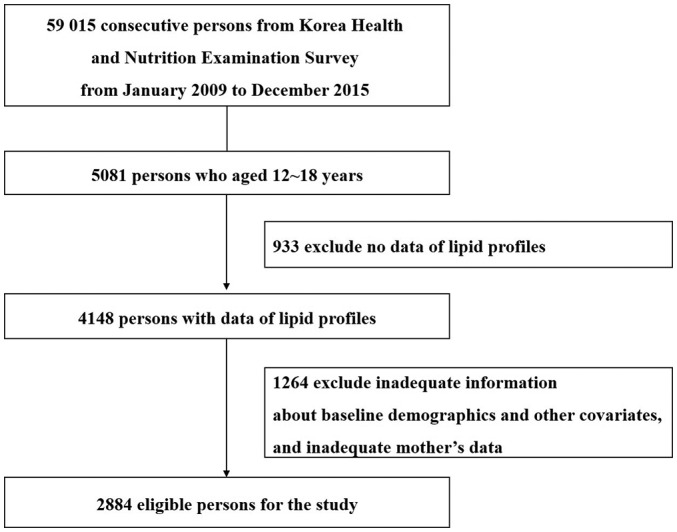
Participants: 2884 adolescents aged 12-18 years and their mothers were included.
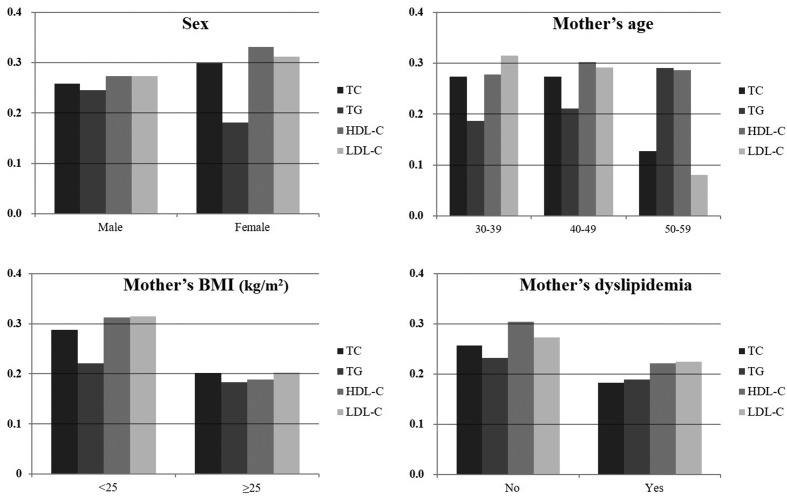
Primary outcome measures: Outcome variables were adolescents' lipid levels. Mothers' lipid levels were the interesting variables. The lipid profiles included total cholesterol (TC), triglyceride (TG), high-density lipoprotein cholesterol (HDL-C) and low-density lipoprotein cholesterol (LDL-C). We identified partial correlation coefficients (r) between the lipids. Multiple linear regressions were performed to identify the amount of change in adolescents' lipid levels for each unit increase of their mothers' lipids. The regression models included various clinical characteristics and health behavioural factors of both adolescents and mothers.
Results: The mean levels of adolescents' lipids were 156.6, 83.6, 50.4 and 89.4 mg/dL, respectively for TC, TG, HDL-C and LDL-C. Positive correlations between lipid levels of adolescents and mothers were observed for TC, TG, HDL-C and LDL-C (r, 95% CI: 0.271, 0.236 to 0.304; 0.204, 0.169 to 0.239; 0.289, 0.255 to 0.322; and 0.286, 0.252 to 0.319). The adolescent TC level was increased by 0.23 mg/dL for each unit increase of the mother's TC (SE, 0.02; p<0.001). The beta coefficients were 0.16 (SE, 0.01), 0.24 (SE, 0.02) and 0.24 (SE, 0.02), respectively, in each model of TG, HDL-C and LDL-C (all p<0.001). The linear relationships were significant regardless of sex and mother's characteristics.
Conclusions: Mothers' lipid levels are associated with adolescents' lipids; therefore, they can serve as a reference for the screening of adolescent's dyslipidaemia.
Keywords: adolescent; cholesterol; dyslipidemia; lipids; mother.
© Author(s) (or their employer(s)) 2019. Re-use permitted under CC BY-NC. No commercial re-use. See rights and permissions. Published by BMJ.
Conflict of interest statement
Competing interests: None declared.
Figures
References
-
- Shin H-Y, Lee J-Y, Song J, et al. . Cause-of-death statistics in the Republic of Korea, 2014. J Korean Med Assoc 2016;59:221–32. 10.5124/jkma.2016.59.3.221 - DOI
-
- McGill HC, McMahan CA, Zieske AW, et al. . Associations of coronary heart disease risk factors with the intermediate lesion of atherosclerosis in youth. The Pathobiological Determinants of Atherosclerosis in Youth (PDAY) Research Group. Arterioscler Thromb Vasc Biol 2000;20:1998–2004. - PubMed
MeSH terms
Substances
LinkOut - more resources
Full Text Sources
Medical
Miscellaneous
