The Expression and Clinical Significance of Spleen Tyrosine Kinase in Patients with Coronary Heart Disease
- PMID: 30898992
- PMCID: PMC6441303
- DOI: 10.12659/MSM.913543
The Expression and Clinical Significance of Spleen Tyrosine Kinase in Patients with Coronary Heart Disease
Abstract
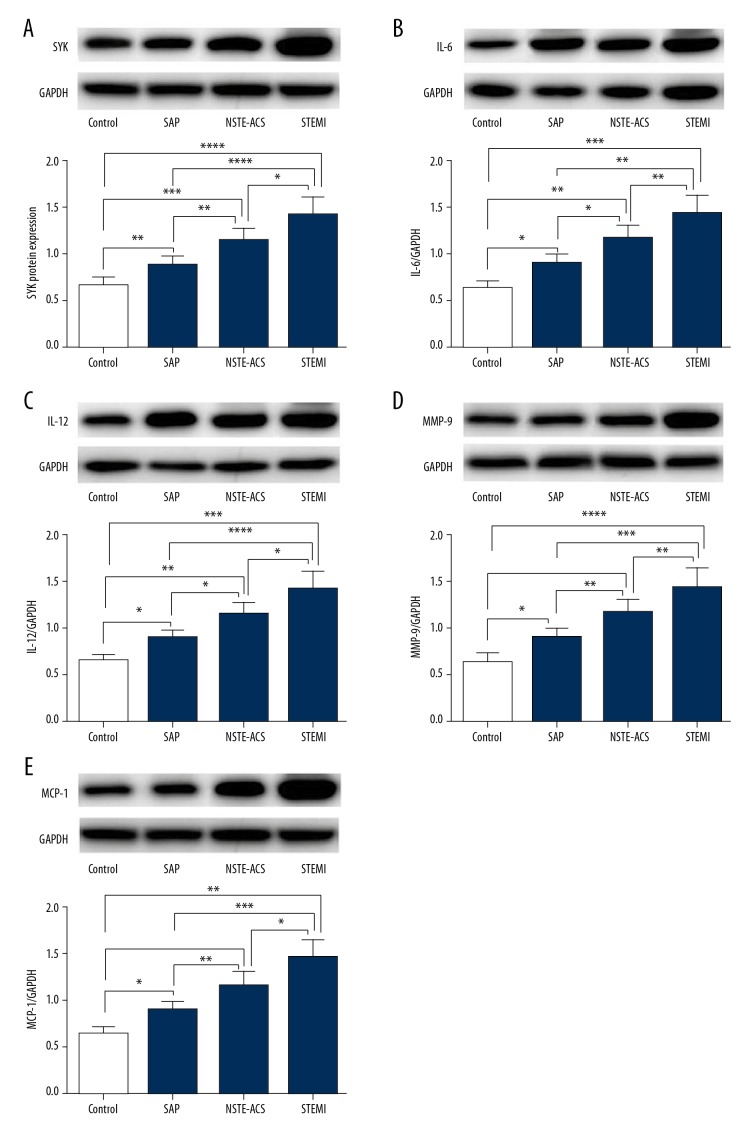
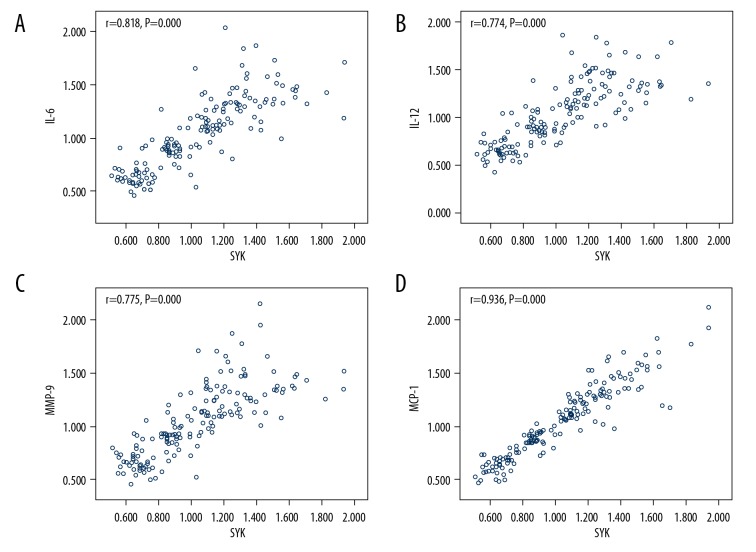
BACKGROUND Our research was designed to investigate the relationship of spleen tyrosine kinase (Syk) and inflammatory factors with coronary heart disease (CHD) and the risk factors of CHD. MATERIAL AND METHODS In our study, 226 patients were enrolled, from October 2017 to March 2018. Clinical and biochemical data were collected. We collected samples of peripheral blood monocytes (PBMs) from the enrolled patients. The patients were divided in 4 groups: patients without coronary artery disease (control group), patients with stable angina pectoris (SAP group), patients with non-ST-segment elevation acute coronary syndrome (NSTE-ACS group), and patients with ST-segment elevation acute myocardial infarction group (STEMI group). We detect the protein levels of Syk and inflammatory factors expression by western blot. RESULTS Our results found the protein levels of Syk and inflammatory factors expression in the NSTE-ACS and STEMI groups were higher than those in the SAP and control groups. The protein levels of Syk and inflammatory factors expression in the SAP group were higher than those in the control group. Moreover, there were many risk factors significantly associated with Syk. Besides that, these risk factors were also independent risk factors of CHD. CONCLUSIONS Our results found that the level of Syk was associated with the severity of CHD. From our study, we found that higher levels of Syk and inflammatory factors protein were associated with worse results of the CHD. For the first time, Syk was reported to be a promising therapeutic factor for CHD patients.
Figures
References
-
- Tanaka K, Sata M. [Atherosclerosis: Progress in diagnosis and treatments. Topics: II. Atherosclerosis – promoting factors; Pathogenesis and pathophysiology; 3. From basic research: focusing on large and peripheral vessels]. Nihon Naika Gakkai Zasshi. 2013;102:305–12. [in Japanese] - PubMed
-
- Plasschaert H, Heeneman S, Daemen MJ. Progression in atherosclerosis: Histological features and pathophysiology of atherosclerotic lesions. Top Magn Reson Imaging. 2009;20:227–37. - PubMed
-
- Vanhoutte PM, Shimokawa H, Feletou M, Tang EHC. Endothelial dysfunction and vascular disease – a 30th anniversary update. Acta Physiologica (Oxford, England) 2017;219:22–96. - PubMed
MeSH terms
Substances
LinkOut - more resources
Full Text Sources
Miscellaneous