


Beneficial effects of pre-stroke statins use in cardioembolic stroke patients with atrial fibrillation: a hospital-based retrospective analysis
- PMID: 30899291
- PMCID: PMC6425215
- DOI: 10.5114/aoms.2019.82925
Beneficial effects of pre-stroke statins use in cardioembolic stroke patients with atrial fibrillation: a hospital-based retrospective analysis
Abstract
Introduction: Statins are widely used in stroke patients. The AHA/ASA guidelines recommend aggressive statin therapy in atherosclerotic stroke patients. Their beneficial effects are due to both their hypolipemic and pleiotropic properties. The aim of this study was to establish potential benefits from statin use in ischemic stroke patients with the diagnosis of atrial fibrillation (AF).
Material and methods: Ischemic stroke patients with AF were enrolled in the study. Group I, the statin group (n = 181), consisted of patients who had been treated with statins before stroke. Group II, the non-statin group (n = 153), consisted of patients who had not received such treatment in the last year. In-hospital mortality and neurological deficit on admission and at discharge were analyzed using the National Institutes of Health Stroke Scale (NIHSS) score.
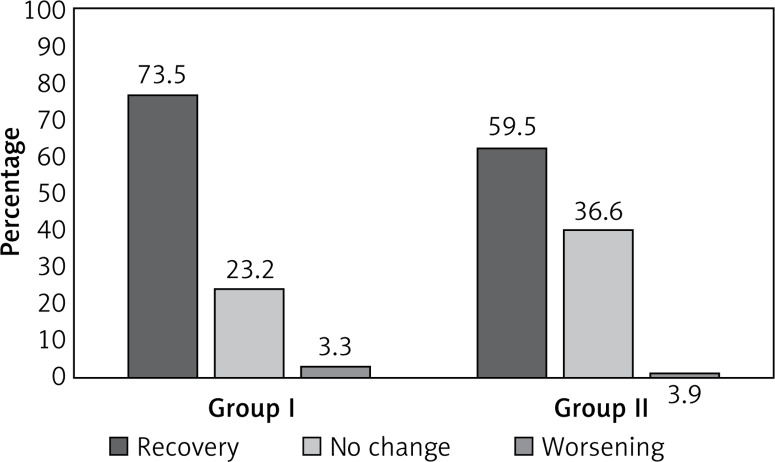
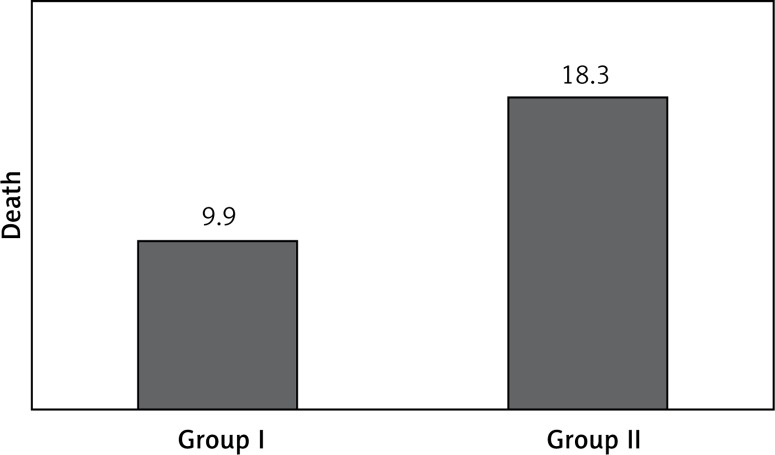
Results: Patients from the non-statin group had greater initial and discharge NIHSS scores (10 vs. 11.9, probability value p < 0.05; 7.6 vs. 9.5, p < 0.05 respectively). The improvement in NIHSS score was greater in the statin group (73.5% vs. 59.5%, p < 0.01). In-hospital mortality was more frequent in the non-statin group (9.9% vs. 18.3%, p < 0.05).
Conclusions: Despite the predominant use of statins in atherothrombotic stroke patients, we demonstrated the beneficial effects of statins in cardioembolic stroke patients. Detailed cardiovascular screening for statin therapy should be carried out in all AF patients with regard to primary and secondary stroke prevention.
Keywords: anticoagulant prophylaxis; atrial fibrillation; embolism; outcome; statin; stroke.
Conflict of interest statement
The authors declare no conflict of interest.
Figures
References
-
- Sienkiewicz-Jarosz H, Głuszkiewicz M, Pniewski J, et al. Zapadalność i wskaźnik śmiertelności dla pierwszego w życiu udaru mózgu – porównanie dwóch warszawskich badań populacyjnych. Neurol Neurochir Pol. 2011;45:207–12. - PubMed
-
- Kotlęga D, Ciećwież S, Turowska-Kowalska J, Nowacki P. Pathogenetic justification of statin use in ischaemic stroke prevention according to inflammatory theory in development of atherosclerosis. Neurol Neurochir Pol. 2012;46:176–83. - PubMed
-
- Gołąb-Janowska M, Meller A, Kotlęga D, Bajer-Czajkowska A, Nowacki P. Atrial fibrillation and stroke – coexistence and attitude to preventive therapy on the basis of Szczecin and Szczecin region patients. Neurol Neurochir Pol. 2014;48:410–5. - PubMed
-
- Wolf PA, Abbott RD, Kannel WB. Atrial fibrillation as an independent risk factor for stroke: the Framingham Study. Stroke. 1991;22:983–8. - PubMed
-
- Saposnik G, Gladstone D, Raptis R, Zhou L, Hart RD. the Investigators of the Registry of the Canadian Stroke Network (RCSN) and the Stroke Outcomes Research Canada (SORCan) Working Group Atrial fibrillation in ischemic stroke: predicting response to thrombolysis and clinical outcomes. Stroke. 2013;44:99–104. - PubMed
LinkOut - more resources
Full Text Sources
