Improving resource mobilisation for global health R&D: a role for coordination platforms?
- PMID: 30899563
- PMCID: PMC6407558
- DOI: 10.1136/bmjgh-2018-001209
Improving resource mobilisation for global health R&D: a role for coordination platforms?
Abstract
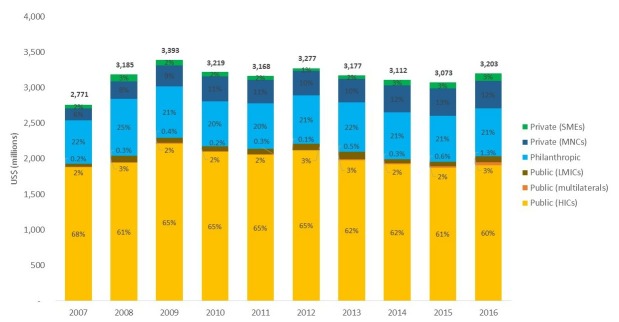
Achieving many of the health targets in the Sustainable Development Goals will not be possible without increased financing for global health research and development (R&D). Yet financing for neglected disease product development fell from 2009-2015, with the exception of a one-time injection of Ebola funding. An important cause of the global health R&D funding gap is lack of coordination across R&D initiatives. In particular, existing initiatives lack robust priority-setting processes and transparency about investment decisions. Low-income countries (LICs) and middle-income countries (MICs) are also often excluded from global investment initiatives and priority-setting discussions, leading to limited investment by these countries. An overarching global health R&D coordination platform is one promising response to these challenges. This analysis examines the essential functions such a platform must play, how it should be structured to maximise effectiveness and investment strategies for diversifying potential investors, with an emphasis on building LIC and MIC engagement. Our analysis suggests that a coordination platform should have four key functions: building consensus on R&D priorities; facilitating information sharing about past and future investments; building in accountability mechanisms to track R&D spending against investment targets and curating a portfolio of prioritised projects alongside mechanisms to link funders to these projects. Several design features are likely to increase the platform's success: public ownership and management; separation of coordination and financing functions; inclusion of multiple diseases; coordination across global and national efforts; development of an international R&D 'roadmap' and a strategy for the financial sustainability of the platform's secretariat.
Keywords: child health; control strategies; health economics; health policies and all other topics; health policy.
Conflict of interest statement
Competing interests: GY declares that the Center for Policy Impact in Global Health has received grant funding from multiple funders that support global health R&D: the Bill & Melinda Gates Foundation, the Global Health Technologies Coalition and the WHO. NB and SF declare that the Global Health Group has received grant funding from the Bill & Melinda Gates Foundation.
Figures
References
-
- World Health Organization Global health sector strategy on HIV, 2016-2021. Geneva, Switzerland: World Health Organization, 2016.
-
- Stop TB Partnership The global plan to stop TB 2016 – 2020. Geneva, Switzerland: Stop TB Partnership, 2016.
-
- Chapman N, Doubell A, Oversteegen L. Neglected disease research and development: reflecting on a decade of global investment In: Policy cures research, 2017.
LinkOut - more resources
Full Text Sources
Miscellaneous