


Multimodal Integration and Vividness in the Angular Gyrus During Episodic Encoding and Retrieval
- PMID: 30902869
- PMCID: PMC6538859
- DOI: 10.1523/JNEUROSCI.2102-18.2018
Multimodal Integration and Vividness in the Angular Gyrus During Episodic Encoding and Retrieval
Abstract
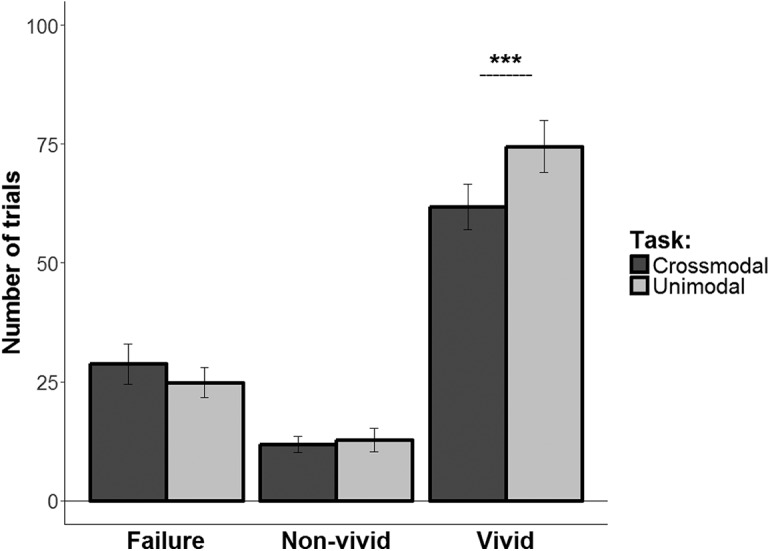
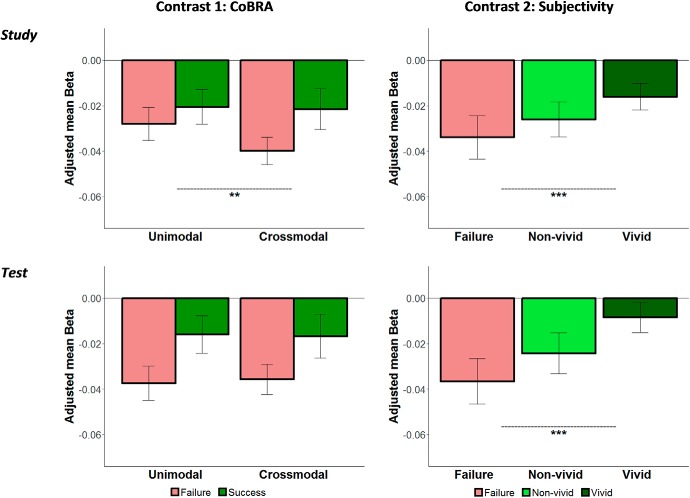
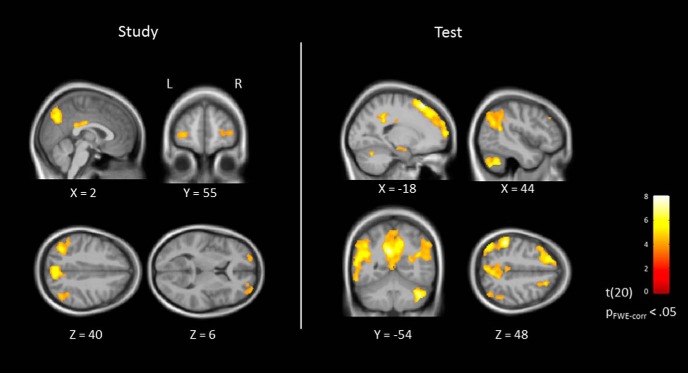
Much evidence suggests that the angular gyrus (AnG) is involved in episodic memory, but its precise role has yet to be determined. We examined two possible accounts within the same experimental paradigm: the "cortical binding of relational activity" (CoBRA) account (Shimamura, 2011), which suggests that the AnG acts as a convergence zone that binds multimodal episodic features, and the subjectivity account (Yazar et al., 2012), which implicates AnG involvement in subjective mnemonic experience (such as vividness or confidence). fMRI was used during both encoding and retrieval of paired associates. During study, female and male human participants memorized picture-pairs of common objects (in the unimodal task) or of an object-picture and an environmental sound (in the crossmodal task). At test, they performed a cued-recall task and further indicated the vividness of their memory. During retrieval, BOLD activation in the AnG was greatest for vividly remembered associates, consistent with the subjectivity account. During encoding, the same effect of vividness was found, but this was further modulated by task: greater activations were associated with subsequent recall in the crossmodal than the unimodal task. Therefore, encoding data suggest an additional role to the AnG in crossmodal integration, consistent with its role at retrieval proposed by CoBRA. These results resolve some of the puzzles in the literature and indicate that the AnG can play different roles during encoding and retrieval as determined by the cognitive demands posed by different mnemonic tasks.SIGNIFICANCE STATEMENT We offer new insights into the multiplicity of processes that are associated with angular gyrus (AnG) activation during encoding and retrieval of newly formed memories. We used fMRI while human participants learned and subsequently recalled pairs of objects presented to the same sensory modality or to different modalities. We were able to show that the AnG is involved when vivid memories are created and retrieved, as well as when encoded information is integrated across different sensory modalities. These findings provide novel evidence for the contribution of the AnG to our subjective experience of remembering alongside its role in integrative processes that promote subsequent memory.
Keywords: angular gyrus; cued recall; episodic memory; multimodal integration; vividness.
Copyright © 2019 the authors.
Figures

References
-
- Bates D, Kliegl R, Vasishth S, Baayen H (2015) Parsimonious mixed models. arXiv preprint arXiv:1506.04967.
Publication types
MeSH terms
Grants and funding
LinkOut - more resources
Full Text Sources
Miscellaneous
