Review
. 2019 Mar 22;10(1):1350.
doi: 10.1038/s41467-019-09113-0.

The causes of spatiotemporal variations in erupted fluxes and compositions along a volcanic arc

Affiliations
Review

The causes of spatiotemporal variations in erupted fluxes and compositions along a volcanic arc

C B Till et al. Nat Commun. .

Abstract

Decades of study on volcanic arcs have provided insight into the overarching processes that control magmatism, and how these processes manifest at individual volcanoes. However, the causes of ubiquitous and dramatic intra-arc variations in volcanic flux and composition remain largely unresolved. Investigating such arc-scale issues requires greater quantitative comparison of geophysical and geochemical data, linked through sets of common intensive variables. To work towards these goals, we use observed lava compositions to estimate the heat budget associated with Quaternary volcanism in the Cascades Arc and compare this to the heat required to produce the observed geophysical properties of the crust. Here we show that along-strike volcanic variability in the Quaternary Cascades Arc is primarily related to variations in the flux of basalt into the crust, rather than variations in their crustal storage history. This approach shows promise for studying other large-scale frontier geologic problems in volcanic arcs.


Conflict of interest statement

The authors declare no competing interests

Figures
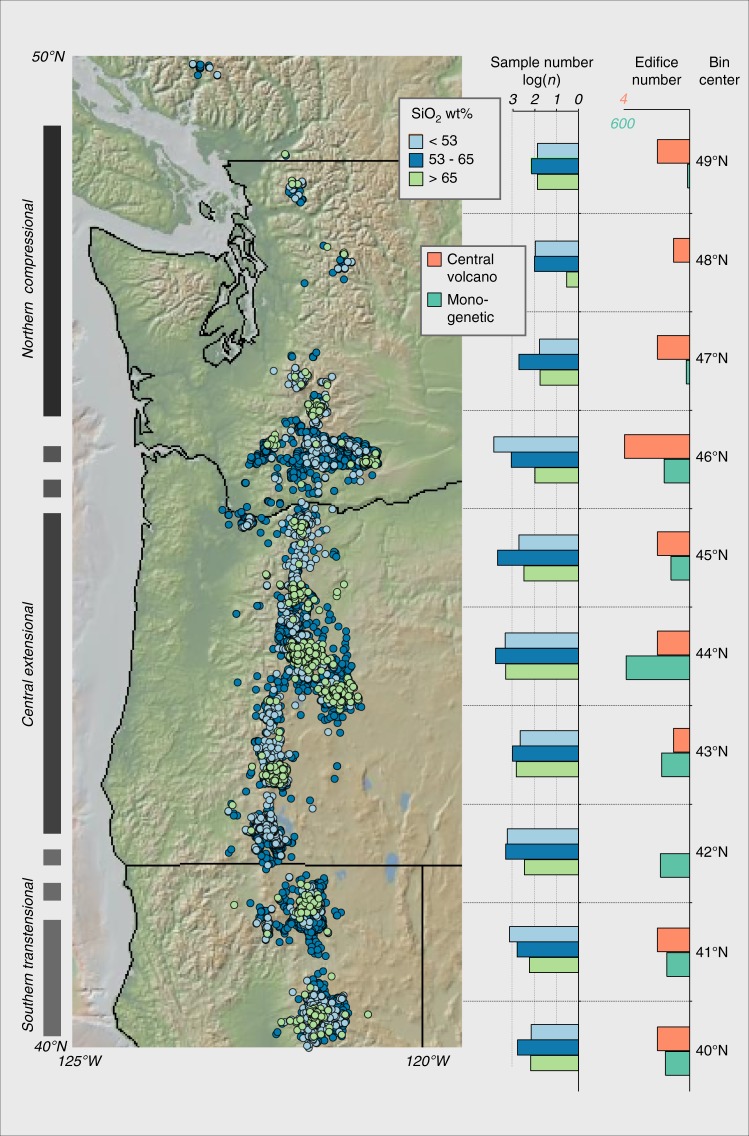
Fig. 1
Fig. 1
Map of Cascades Arc showing locations of geochemical samples and selected summaries of the existing datasets. The map and the accompanying histograms illustrate the available Quaternary Cascade volcanic rock compositions from Earthref.org separated into three categories according to SiO2 content (colors are the same for map symbols), the number of major edifices, and monogenetic vents from Hildreth
Fig. 2
Fig. 2
Schematic figure of the possible mantle and crustal roles in forming arc volcanic diversity. Mantle-derived magmas are input into the crust, where they are stored, crystallize, and trigger crustal melting, which in some combination produces the variation in eruptive behavior (eruptive style, composition, and flux) observed along striking a volcanic arc
Fig. 3
Fig. 3
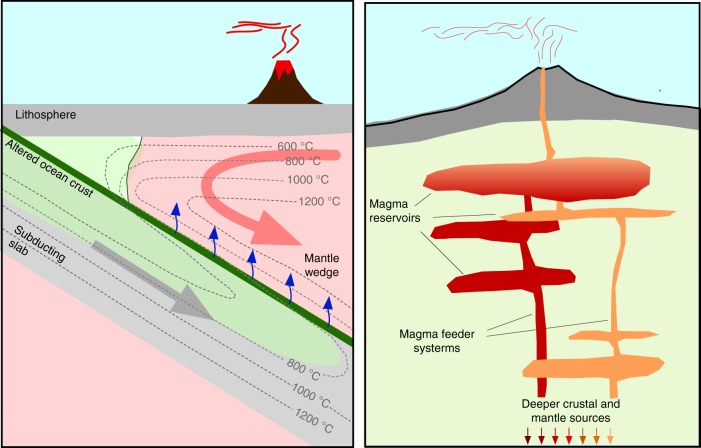
Representative figures from different communities studying volcanoes. Left, archetypical mantle-focused subduction cartoon with an “emoji volcano” that only alludes to a shallower magmatic system. Right, archetypical upper crust-focused subduction volcano cartoon, with a “disembodied volcano”, disconnected from the deeper magma source region
Fig. 4
Fig. 4
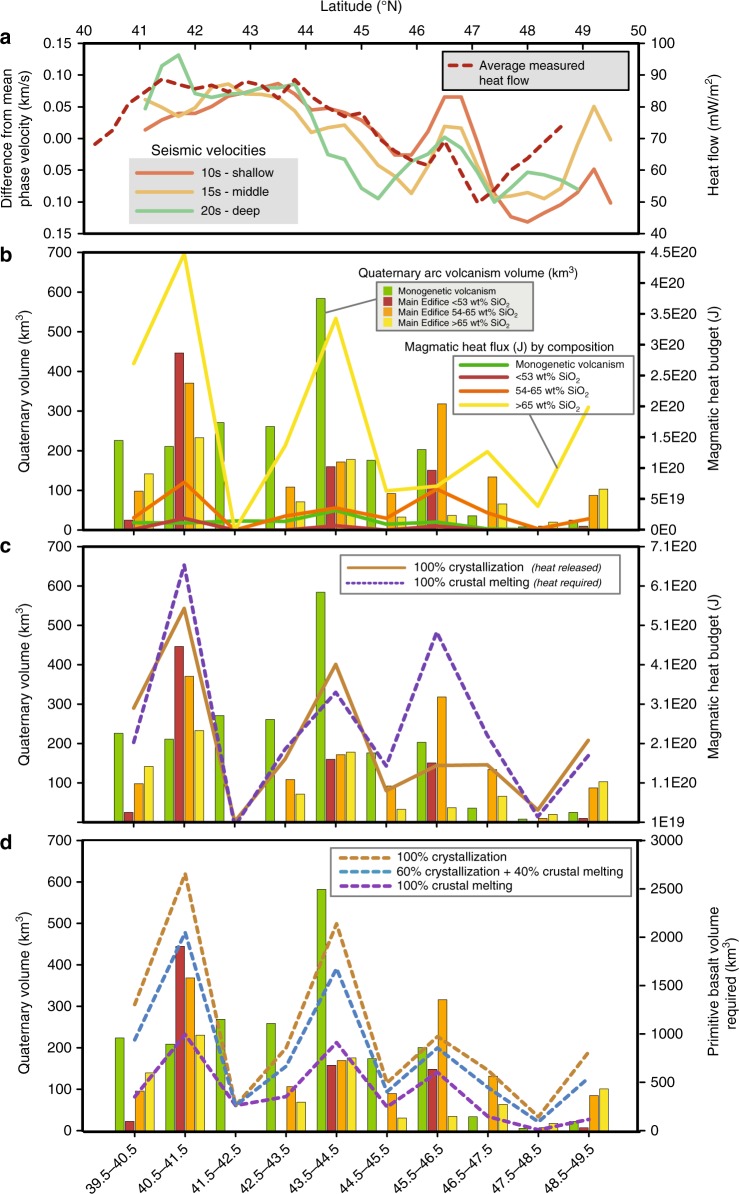
Results of our heat and flux calculations. a Earthquake and ambient noise seismic phase velocities from Janiszewski and measured heat flow from Ingebritsen and Mariner. b Histogram of the quantity and composition of Quaternary arc volcanism plotted in 1° latitude bins (i.e., samples in 40.5–41.5°N plotted in the associated histogram bin) and the calculated magmatic heat budget (curves) required to generate each compositional category by pure fractional crystallization following the methods described in text. Note the dominant role of silicic magma generation in the overall heat budget. c Calculated magmatic heat budget (curves) required to generate Quaternary Cascades volcanism (histogram) by 100% fractional crystallization vs. 100% crustal melting. d Volume of mantle basalt (curves) required to generate Quaternary Cascades volcanism (histogram) via varying amounts of crystallization and crustal melting
Fig. 5
Fig. 5
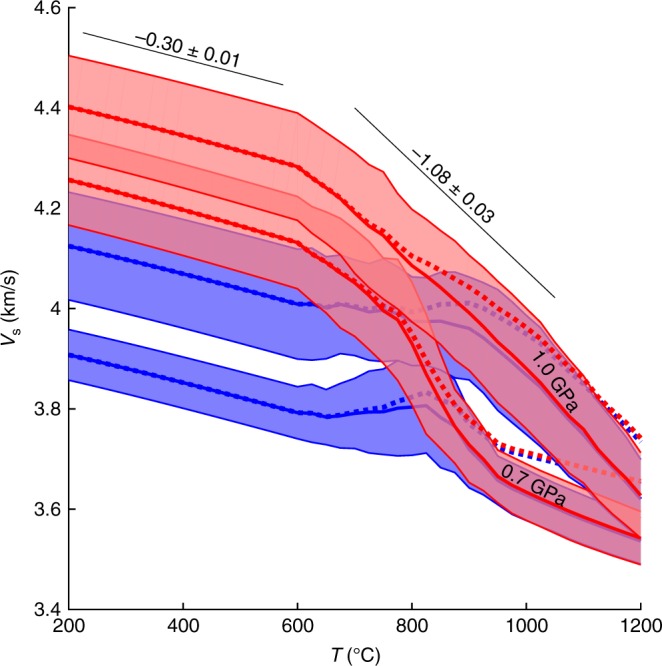
Calibration of Vs—temperature relationship for typical Cascadia basement rocks. Velocities are calculated for a suite of 16 reported major-element compositions for the Siletz-Crescent basaltic terranes,, which are likely basement for the Cascadia forearc. Modal mineralogy is calculated for each sample’s major element composition via the free-energy minimization code Perple_X at a range of pressures and temperatures, and parameters such as Vs and density are calculated. Because chemical equilibrium is unlikely at low temperatures, below 600 °C the modal compositions are fixed to those at 600 °C (500 °C for when H2O is present). At high temperatures additional anelastic velocity reduction is incorporated by scaling gabbro to olivine anelasticity through their creep properties (see Methods). Red: water-free calculations; blue: calculations with 2 wt% H2O; thickness of swath includes one standard deviation of variation among the 16 samples. Dotted lines show results neglecting physical dispersion. Calculations shown at 0.7 and 1.0 GPa as labeled. Note change in slope, labeled, between −0.30 ± 0.01 m/s/K at low temperatures where only mineral elasticity effects velocities, to −1.08 ± 0.03 m/s/K for dry conditions at temperatures where petrologic and anelastic effects also contribute. In modeled compositions with 2 wt% H2O the effect is more complicated and the overall trend is midway between these extremes

References

    1. Rudnick RL. Making continental crust. Nature. 1995;378:571. doi: 10.1038/378571a0. - DOI
    1. Arndt NT. Formation and evolution of the continental crust. Geochem. Perspect. 2013;2:405–533. doi: 10.7185/geochempersp.2.3. - DOI
    1. Carmichael IS. The redox states of basic and silicic magmas: a reflection of their source regions? Contrib. Mineral. Petrol. 1991;106:129–141. doi: 10.1007/BF00306429. - DOI
    1. Kogiso T, Tatsumi Y, Nakano S. Trace element transport during dehydration processes in the subducted oceanic crust: 1. Experiments and implications for the origin of ocean island basalts. Earth Planet. Sci. Lett. 1997;148:193–205. doi: 10.1016/S0012-821X(97)00018-6. - DOI
    1. Wallace PJ. Volatiles in subduction zone magmas: concentrations and fluxes based on melt inclusion and volcanic gas data. J. Volcanol. Geotherm. Res. 2005;140:217–240. doi: 10.1016/j.jvolgeores.2004.07.023. - DOI

Publication types