


Cardiovascular disease risk among children with focal segmental glomerulosclerosis: a report from the chronic kidney disease in children study
- PMID: 30903375
- PMCID: PMC6594397
- DOI: 10.1007/s00467-019-04229-3
Cardiovascular disease risk among children with focal segmental glomerulosclerosis: a report from the chronic kidney disease in children study
Abstract
Background: The aims were to compare the cardiovascular disease (CVD) risk among children with chronic kidney disease (CKD) secondary to focal segmental glomerulosclerosis (FSGS) with the CVD risk of children with CKD due to other diagnoses.
Methods: Casual blood pressure (BP), ambulatory blood pressure monitoring (APBM), echocardiogram, lipids, carotid intima medial thickness (cIMT), and uric acid obtained from participants in the Chronic Kidney Disease in Children (CKiD) cohort were analyzed longitudinally. Seventy-nine children with FSGS (FSGS-CKD) were compared to 196 children with non-FSGS glomerular disease (GDO-CKD) and 616 children with non-glomerular disease (NG-CKD).
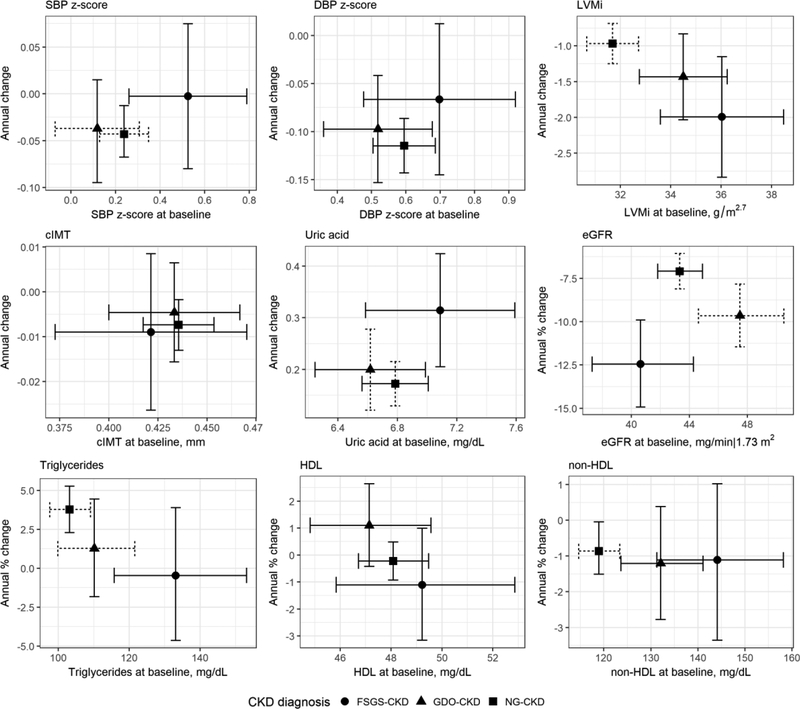
Results: At baseline, FSGS-CKD (median 14 years) had ambulatory hypertension (24.6%), masked hypertension (46.2%), left ventricular hypertrophy (LVH) (26.3%), and dyslipidemia (60.0%). In adjusted models, FSGS-CKD had higher systolic BP z-score (0.52 vs 0.11 and 0.23, p = 0.002 and 0.02), triglycerides (133 vs 109 and 102 mg/dl, p = 0.007 and < 0.001), and non-high density lipoprotein (144 vs 132 and 119 mg/dl, p = 0.07 and < 0.001) at baseline when compared to GDO-CKD and NG-CKD, respectively. Left ventricular mass index (LVMI) (36.0 vs 31.7 g/m2.7, p < 0.001) and the odds of LVH (OR 3.38, 95% CI 1.42, 8.08) at baseline were greater in FSGS-CKD compared to NG-CKD. Adjusted longitudinal analysis showed that FSGS-CKD had a faster decline in LVMI than NG-CKD, and FSGS-CKD had a faster increase in uric acid compared to both groups.
Conclusions: Children with CKD due to FSGS had a relatively high prevalence of CVD risk factors. FSGS was associated with greater CVD risk when compared to other CKD diagnoses.
Keywords: Carotid intima medial thickness; Dyslipidemia; Glomerular disease; Hypertension; Left ventricular hypertrophy; Pediatrics.
Figures
References
-
- Kitiyakara C, Eggers P, Kopp JB (2004) Twenty-one-year trend in ESRD due to focal segmental glomerulosclerosis in the United States. Am J Kidney Dis 44:815–825. - PubMed
-
- Korbet SM, Schwartz MM, Lewis EJ (1994) Primary focal segmental glomerulosclerosis: clinical course and response to therapy. Am J Kidney Dis 23:773–783. - PubMed
-
- Studies NAPRTaC (2014) NAPRTCS Annual Report.
-
- Ng DK, Robertson CC, Woroniecki RP, Limou S, Gillies CE, Reidy KJ, Winkler CA, Hingorani S, Gibson KL, Hjorten R, Sethna CB, Kopp JB, Moxey-Mims M, Furth SL, Warady BA, Kretzler M, Sedor JR, Kaskel FJ, Sampson MG (2017) APOL1-associated glomerular disease among African-American children: a collaboration of the Chronic Kidney Disease in Children (CKiD) and Nephrotic Syndrome Study Network (NEPTUNE) cohorts. Nephrol Dial Transplant 32:983–990. - PMC - PubMed
Publication types
MeSH terms
Substances
Grants and funding
LinkOut - more resources
Full Text Sources
Medical
