


Comment
doi: 10.1016/j.kint.2018.12.032.
Expanding opportunities and emerging challenges: broadening the scope of genetic testing in nephrology
Affiliations
- PMID: 30904063
- PMCID: PMC7780545
- DOI: 10.1016/j.kint.2018.12.032
Item in Clipboard
Comment
Expanding opportunities and emerging challenges: broadening the scope of genetic testing in nephrology
Kidney Int.
2019 Apr.
Abstract
Massively parallel sequencing technologies such as exome sequencing are increasingly applied across medicine. Connaughton et al. report a high diagnostic yield of exome sequencing among adults with hereditary nephropathy or nephropathy of unknown cause. Their findings support broader use of genomic sequencing in nephrology and highlight key associated questions, including how to identify those patients for whom testing is indicated, pinpoint pathogenic variants, and balance the resultant health care benefits and clinical follow-up burden.
Copyright © 2019 International Society of Nephrology. Published by Elsevier Inc. All rights reserved.
Conflict of interest statement
DISCLOSURE
All the authors declared no competing interests.
Figures
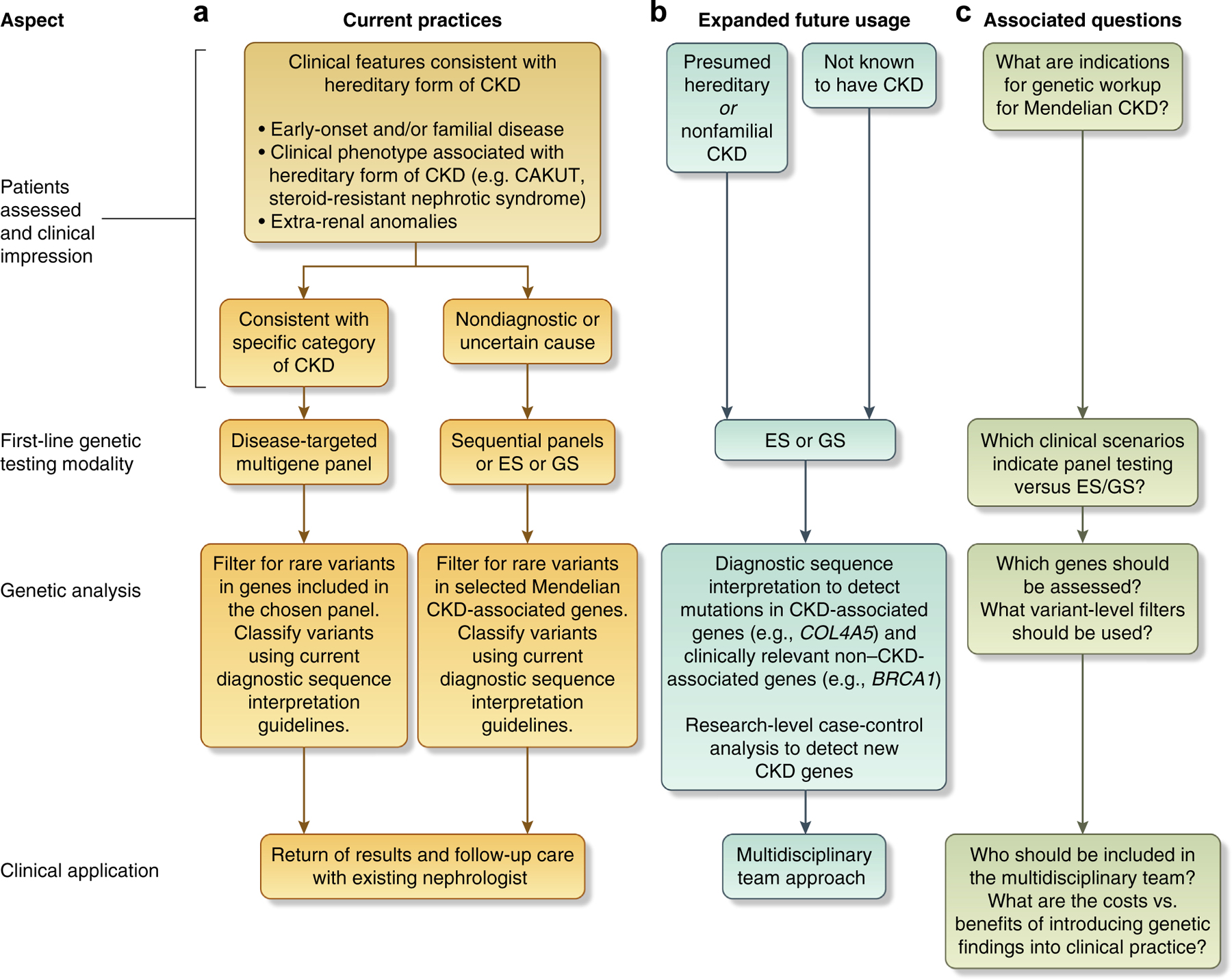
The key aspects of MPS in nephrology include (i) patient populations
assessed and determination of the first-line genetic testing modality; (ii)
genetic analysis procedures; and (iii) clinical application of the genetic
findings detected. (a) Current use of MPS consists largely of
applying disease-targeted multigene panels as a first-line test to probands
clinically diagnosed with the associated disease. If the clinical impression is
uncertain or the presentation wholly nondiagnostic, sequential gene panel
testing or exome sequencing (ES) or genome sequencing (GS) may be applied
instead. Genetic analysis assesses rare variants occurring in the genes included
on the panel; for ES or GS, rare variants in known Mendelian
nephropathy-associated genes are assessed. Return of results and follow-up
clinical care are generally conducted as part of the patient’s routine
nephrologic care, with his or her existing nephrologist. (b)
Potential future use of MPS involves applying genome-wide testing (exome
sequencing or genome sequencing) to a broader population, which may include
individuals not known to have chronic kidney disease (CKD; e.g., for purposes of
disease screening and presymptomatic genetic diagnosis, or, among probands
undergoing genomic sequencing for other disease indications, as secondary
genetic findings) as well as patients with CKD of diverse etiologies, including
those presumed to have acquired causes of disease (e.g., diabetic nephropathy).
The scope of genetic analysis may expand to all genes (genome-wide), integrating
genetic diagnostics with case-control analyses for novel gene discovery. As the
disorders detected often involve multiple organ systems, and the patients
sequenced may not have previously been under nephrologic care, return of results
and clinical follow-up will involve a multidisciplinary team, including other
medical subspecialists for the organ systems affected by the given disease, and
genetic counselors. (c) The key questions associated with this
expanded, future use include (i) the clinical indications for genetic workup for
Mendelian forms of CKD, (ii) determining which genes should be assessed and
which filtering parameters most effectively identify bonafide disease-causal
variants in the context of the abundance of putatively damaging variation
present in any human genome, and (iii) determining which health care
professionals should be involved and how to balance the opportunity to identify
potentially medically actionable conditions with the financial and psychosocial
burdens of the often considerable clinical follow-up.
Comment on
-
Monogenic causes of chronic kidney disease in adults.Kidney Int. 2019 Apr;95(4):914-928. doi: 10.1016/j.kint.2018.10.031. Epub 2019 Feb 14. Kidney Int. 2019. PMID: 30773290 Free PMC article.
References
Publication types
MeSH terms
Grants and funding
LinkOut - more resources
Full Text Sources
Medical
