


Not engaged in education, employment or training (NEET) in an Arctic sociocultural context: the NAAHS cohort study
- PMID: 30904841
- PMCID: PMC6475364
- DOI: 10.1136/bmjopen-2018-023705
Not engaged in education, employment or training (NEET) in an Arctic sociocultural context: the NAAHS cohort study
Abstract
Objectives: The purpose of the study is to explore the prevalence and predictors of not engaged in education, employment or training (NEET) status in a multicultural young adult population in Northern Norway.
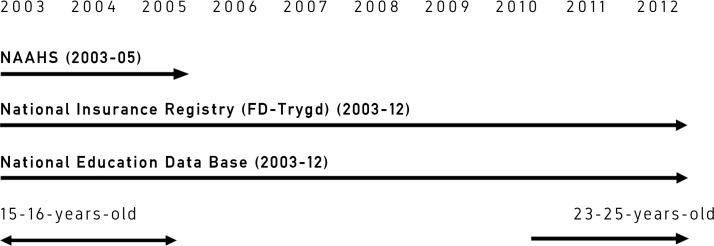
Design and setting: The longitudinal design link a self-reported survey (2003-2005) with an objective registry linkage follow-up 8-10 years later.
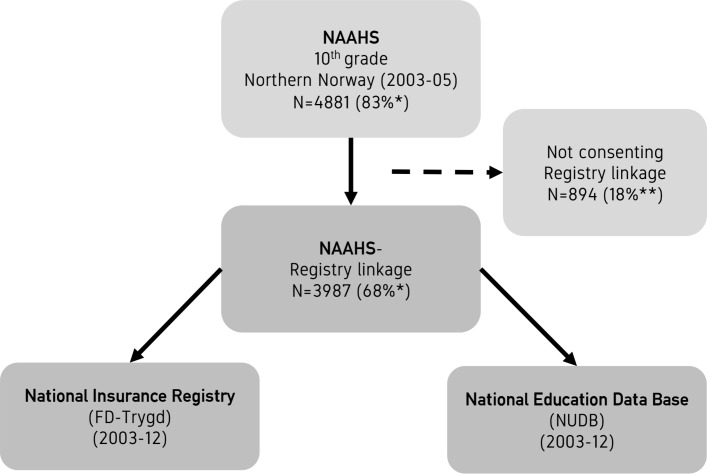
Participants: Of all 5877 tenth graders (aged 15-16 years) in Northern Norway, 83% of the total age cohort from all 87 municipalities participated in the baseline survey. The follow-up studies consisted of 3987 consent giving adolescents (68%), were 365 (9.2%) reported indigenous Sami ethnicity.
Outcome measures: Youth NEET at the age of 23-25 years.
Methods: Explanatory variables were sociodemographic factors (gender, ethnicity, residency, parental education), mental health problems and musculoskeletal pain in adolescence. Outcome variable characterised as NEET-status was defined by no educational engagement, long-term recipient of sickness benefit, medical and non-medical benefit receipt or long-term unemployment.
Results: NEET-status in young adulthood was significantly higher among females (20.9%) than among males (16.2%). Ethnic differences occurred as being NEET among Sami males was significantly higher than among non-Sami males, 23.0% and 15.2% respectively. Minority Sami females experienced NEET-status to a lower degree (16.6%) than non-Sami females (20.8%). Among females adolescent peer problems (adjusted OR=1.09) and hyperactivity problems (adjusted OR=1.10) were associated with later NEET-status. Peer problems (adjusted OR=1.23), conduct problems (adjusted OR=1.17) and musculoskeletal problems (adjusted OR=1.15) in male adolescents were associated with later NEET-status, whereas emotional problems among males predicted significantly less later NEET- status (adjusted OR=0.88).We found lower parental education to be significantly associated with being NEET-later in young adults (females: adjusted OR=2.11, males: adjusted OR=3.22).
Conclusions: To address the disengagement of education and work, particular emphasis must be placed on supporting young people struggling with mental and physical health problems.
Keywords: NEET-status; indigenous; longitudinal design; mental health problems; musculoskeletal pain; parental education; public health; young adults.
© Author(s) (or their employer(s)) 2019. Re-use permitted under CC BY-NC. No commercial re-use. See rights and permissions. Published by BMJ.
Conflict of interest statement
Competing interests: None declared.
Figures
References
-
- Thompson R, Russell L, Simmons R. Space, place and social exclusion: an ethnographic study of young people outside education and employment. J Youth Stud 2014;17:63–78. 10.1080/13676261.2013.793793 - DOI
-
- Olsen T, Tägtström J, Bremberg S, et al. . For det som vokser: Unge, psykisk uhelse og tidliguførepensjonering i Norden. En antologi 2013.
-
- Social Exclusion Unit CO, Great Britain. Bridging the gap: new opportunities for 16-18 year olds not in education, employment or training. 1999.
-
- Lunsing W. The Creation of the social category of NEET (Not in Education, employment or training): Do NEET Need This? Soc Sci Jpn J 2007;10:105–10. 10.1093/ssjj/jym016 - DOI
Publication types
MeSH terms
LinkOut - more resources
Full Text Sources
Medical
