. 2018 Oct;110(7):952-973.
doi: 10.1037/edu0000255. Epub 2018 Mar 8.

THE PERSISTENCE OF PRESCHOOL EFFECTS FROM EARLY CHILDHOOD THROUGH ADOLESCENCE

Affiliations

THE PERSISTENCE OF PRESCHOOL EFFECTS FROM EARLY CHILDHOOD THROUGH ADOLESCENCE

Arya Ansari. J Educ Psychol. 2018 Oct.

Abstract

Using data from the Early Childhood Longitudinal Study Kindergarten Cohort of 1998 (n = 15,070), this study used propensity scores to examine the short- and long-term academic and psychosocial benefits of preschool education for a diverse sample of middle-class children. Compared with children who attended informal care at age 4, preschool attendees consistently performed better on achievement tests from age 5 through early adolescence, but exhibited less optimal psychosocial skills. These negative behavioral effects of preschool were concentrated among children who attended preschool for 20 or more hours per week, but otherwise, there was little evidence of heterogeneity as a function of program type or child- and family-characteristics. The long-term academic advantages of preschool were, however, largely explained by their positive effects on academic skills early in formal schooling and there was evidence for convergence in children's academic test scores, which was partially attributed to the differences in children's social skills during the early elementary school years.

Keywords: ECLS-K 1998; convergence; informal care; persistence; preschool.


Figures
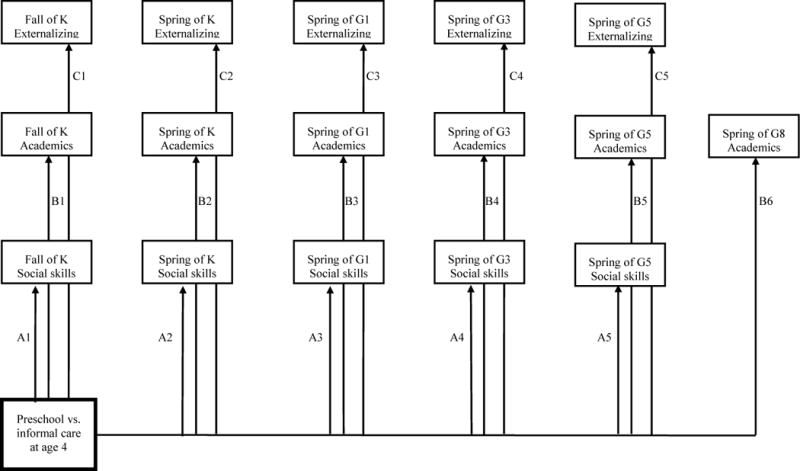
Figure 1
Figure 1
Hypothesized model for the direct effects of preschool enrollment on children’s social skills (A paths), academic achievement (B paths), and externalizing behavior (C paths). K = kindergarten. G = grade. All within time measures were covaried.
Figure 2
Figure 2
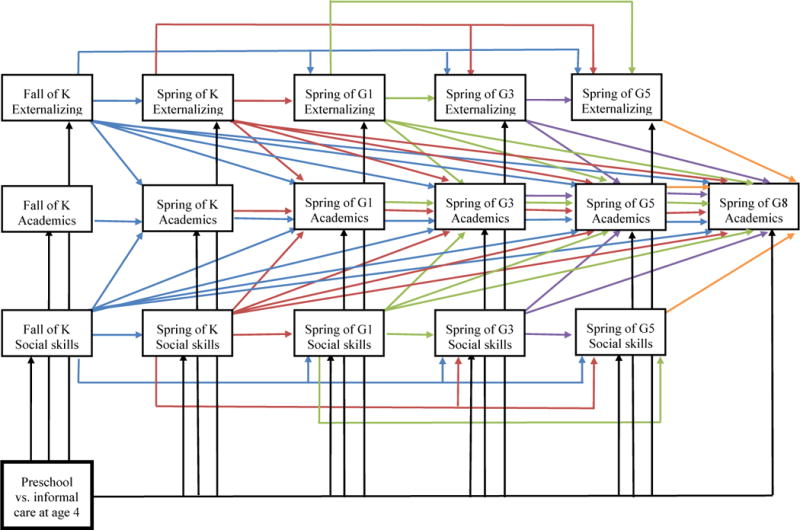
Hypothesized model for the total indirect effects of preschool enrollment. Black lines correspond to preschool effects. Blue lines correspond to fall of kindergarten effects. Red lines correspond to spring of kindergarten effects. Green lines correspond to spring of first grade effects. Purple lines correspond to spring of third grade effects. Orange lines correspond to spring of fifth grade effects. K = kindergarten. G = grade. All within time measures were covaried.
Figure 3
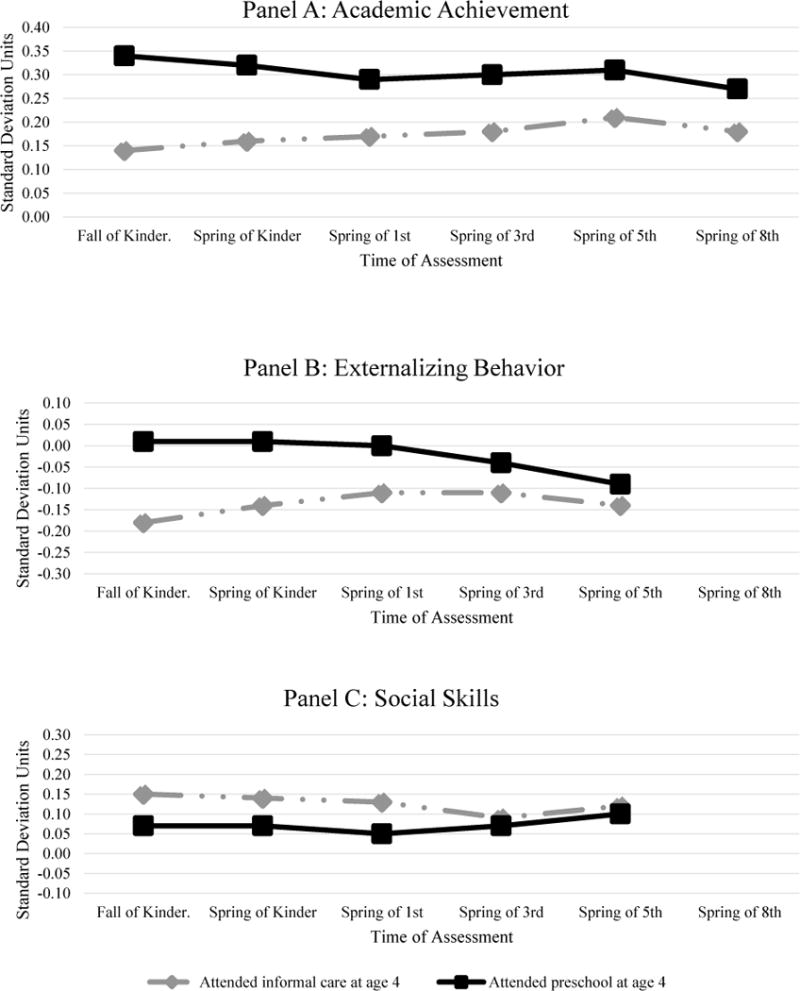
Figure 3
Plots of the children’s academic test scores (panel A), externalizing behavior (panel B), and social skills (panel C) from kindergarten entry through the end of eighth grade across the preschool and informal care conditions, using the matched samples. Kinder = kindergarten.

References

    1. Alexander KL, Entwisle DR. Achievement in the first two years of school. Monographs of the Society for Research on Child Development. 1988;53:1–157. doi: 10.2307/1166081. - DOI - PubMed
    1. Ansari A, López ML, Manfra L, Bleiker C, Dinehart LHB, Hartman SC, Winsler A. Differential third grade outcomes associated with attending publicly funded preschool programs for low-income, Latino children. Child Development. 2017;88:1743–1756. doi: 10.1111/cdev.12663. - DOI - PMC - PubMed
    1. Austin PC. An introduction to propensity score methods for reducing the effects of confounding in observational studies. Multivariate Behavioral Research. 2011;46:399–424. doi:00273171.2011.568786. - PMC - PubMed
    1. Austin PC, Jembere N, Chiu M. Propensity score matching and complex surveys. Statistical methods in medical research. 2016 doi: 10.1177/0962280216658920. Advance online publication. - DOI - PMC - PubMed
    1. Bailey D, Duncan GJ, Odgers CL, Yu W. Persistence and fadeout in the impacts of child and adolescent interventions. Journal of Research on Educational Effectiveness. 2016:1–33. doi: 10.1080/19345747.2016.1232459. - DOI - PMC - PubMed