. 2019 Feb 18:2019:3862949.
doi: 10.1155/2019/3862949. eCollection 2019.

Antimicrobial-Resistant Escherichia coli from Environmental Waters in Northern Colorado

Affiliations

Antimicrobial-Resistant Escherichia coli from Environmental Waters in Northern Colorado

Hannah B Haberecht et al. J Environ Public Health. .

Abstract

Waterborne Escherichia coli are a major reservoir of antimicrobial resistance (AMR), including but not limited to extended-spectrum beta-lactamase (ESBL) and Klebsiella pneumoniae carbapenemase (KPC) mechanisms. This study quantified and described ESBL- and KPC-producing E. coli in Northern Colorado from sewer water, surface water, and influent and effluent wastewater treatment sources. Total detected bacteria and E. coli abundances, and the percentages that contain ESBL and/or KPC, were compared between water sources. Seventy E. coli isolates from the various waters had drug resistance validated with a panel of 17 antibiotics using a broth microdilution assay. The diverse drug resistance observed across E. coli isolates was further documented by polymerase chain reaction of common ESBL genes and functional relatedness by PhenePlate assay-generated dendrograms (n=70). The total E. coli abundance decreased through the water treatment process as expected, yet the percentages of E. coli harboring ESBL resistance were increased (1.70%) in surface water. Whole-genome sequencing analysis was completed for 185 AMR genes in wastewater E. coli isolates and confirmed the presence of diverse AMR gene classes (e.g., beta-lactams and efflux pumps) in isolate genomes. This study completed surveillance of AMR patterns in E. coli that reside in environmental water systems and suggests a role for integrating both phenotypic and genotypic profiling beyond ESBL and KPC mechanisms. AMR screening via multiple approaches may assist in the prevention of drug-resistant E. coli spread from waters to animals and humans.


Figures
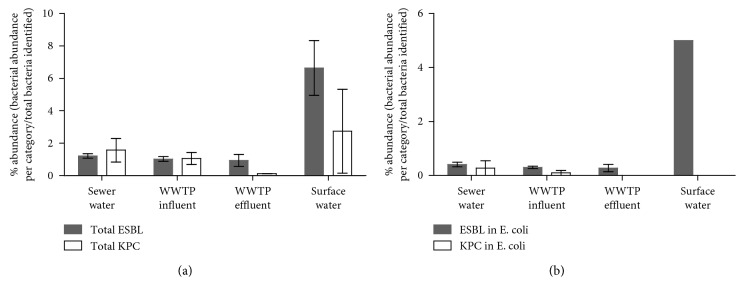
Figure 1
Figure 1
Relative percentages of ESBL and suspected KPC in total detected bacteria and E. coli sampled from environmental waters. Relative percentages of antimicrobial-resistant bacteria from (a) total detected bacterial colonies and (b) E. coli collected from membrane filtration across 17 respective environmental water sources. Error bars, representing standard deviation, were generated from each numerator value (individual ESBL/KPC bacterial abundance counts per source) divided by the average of total detected plated bacteria per source. ESBL = extended-spectrum beta-lactamase (grey bars), KPC = Klebsiella pneumoniae carbapenemase (white bars), and WWTP = wastewater treatment plant.
Figure 2
Figure 2
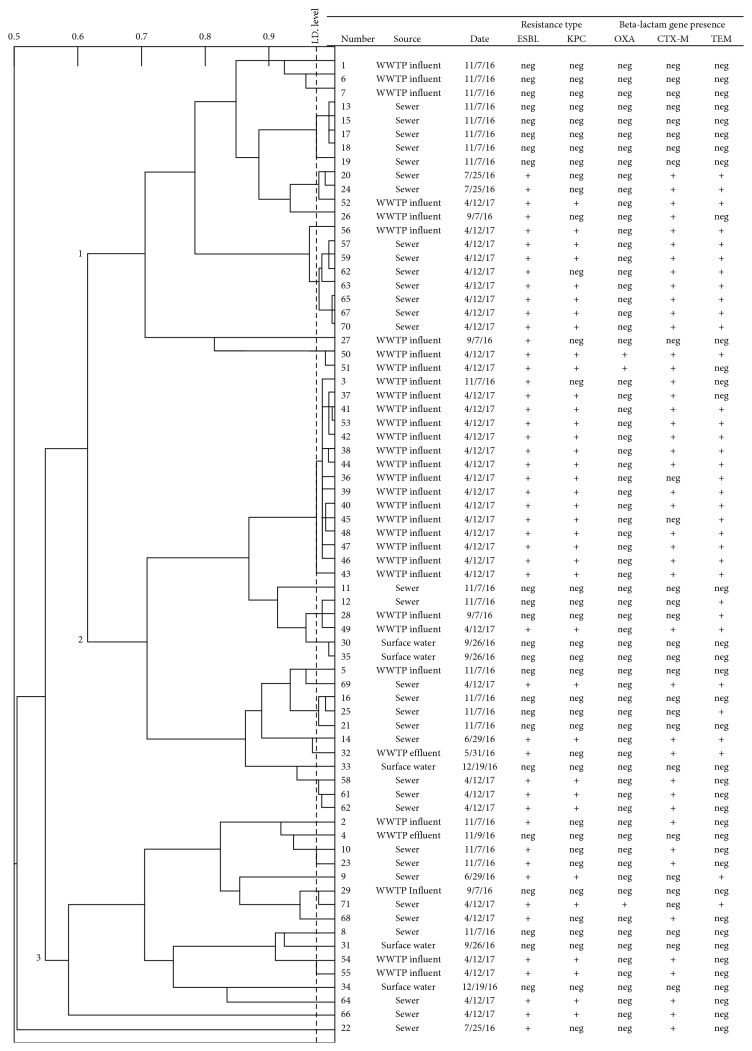
Clonal relatedness of E. coli isolates (n=70) from environmental sources using a functional biochemical analysis and PCR verification of beta-lactam resistance gene presence. Identity “ID” levels are to the left of the dotted line, which represents a sensitivity of 0.975. Branches to the right of this line represent isolates that are too similar to distinguish. Bold numbers on branches (1, 2, 3) refer to three major clusters of isolates identifiable from the Pheneplate assay. Isolate numbers represent the unique identifiers assigned to each E. coli isolate throughout this study. WWTP = water treatment plant. Date = isolation date. ESBL = extended-spectrum beta-lactamase and KPC: Klebsiella pneumoniae carbapenamase. OXA, CTM-M, and TEM were the three beta-lactamase genes assessed with PCR, where “+”: gene present and “neg”: gene absent.
Figure 3
Figure 3
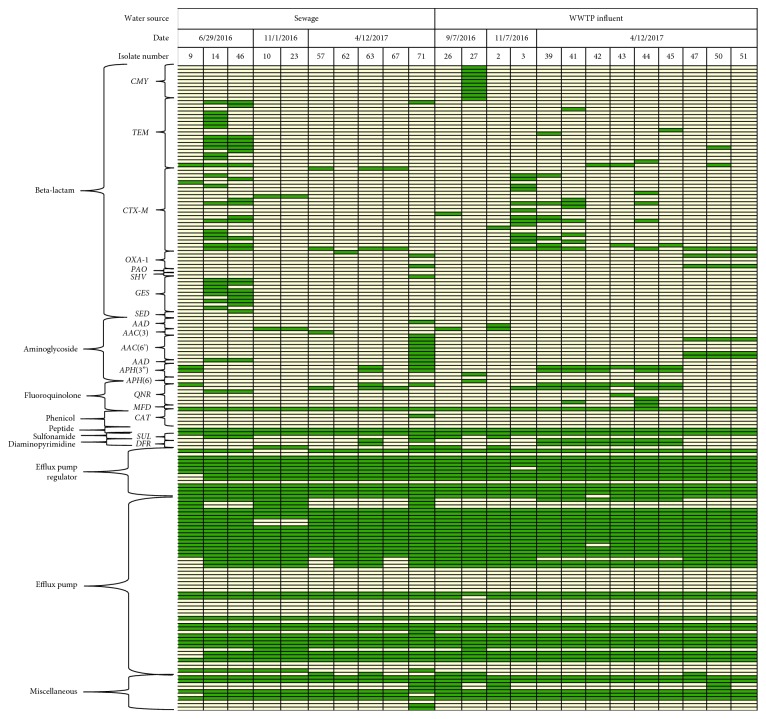
Whole-genome sequencing distinguished sewer water and WWTP-influent E. coli across sample type and collection date. AMR profiles of wastewater E. coli isolates (n = 21) are organized by sample type (sewer water versus wastewater treatment plant influent) and are further categorized by sample collection date. Antimicrobial function and subclass of gene family names were used to group resistance genes. For each isolate, green boxes indicate gene presence and beige boxes indicate gene absence. Isolate #: the unique identifier assigned to each E. coli isolate with MALDI-TOF confirmation.

References

    1. Hatosy S. M., Martiny A. C. the ocean as a global reservoir of antibiotic resistance genes. Applied and Environmental Microbiology. 2015;81(21):7593–7599. doi: 10.1128/aem.00736-15. - DOI - PMC - PubMed
    1. Moore D. F., Guzman J. A., McGee C. Species distribution and antimicrobial resistance of enterococci isolated from surface and ocean water. Journal of Applied Microbiology. 2008;105(4):1017–1025. doi: 10.1111/j.1365-2672.2008.03828.x. - DOI - PubMed
    1. Marti E., Jofre J., Balcazar J. L. Prevalence of antibiotic resistance genes and bacterial community composition in a river influenced by a wastewater treatment plant. PLoS One. 2013;8(10) doi: 10.1371/journal.pone.0078906.e78906 - DOI - PMC - PubMed
    1. Ronald J. A., Brena M., Melissa M. Antibiotic resistance of gram-negative bacteria in rivers, United States. Emerging Infectious Disease Journal. 2002;8(7):713–715. doi: 10.3201/eid0807.010264. - DOI - PMC - PubMed
    1. Pang Y.-C., Xi J.-Y., Li G.-Q., Shi X.-J., Hu H.-Y. Prevalence of antibiotic-resistant bacteria in a lake for the storage of reclaimed water before and after usage as cooling water. Environmental Science: Processes & Impacts. 2015;17(6):1182–1189. doi: 10.1039/c5em00177c. - DOI - PubMed

Publication types

MeSH terms