Review
doi: 10.12779/dnd.2018.17.3.73.
Epub 2018 Dec 6.
Characteristics of Cerebral Microbleeds
Affiliations
- PMID: 30906396
- PMCID: PMC6428007
- DOI: 10.12779/dnd.2018.17.3.73
Item in Clipboard
Review
Characteristics of Cerebral Microbleeds
Dement Neurocogn Disord.
2018 Sep.
Abstract
Cerebral microbleeds (CMBs) are increasingly recognized neuroimaging findings, occurring with cerebrovascular disease, dementia, and aging. CMBs are associated with subsequent hemorrhagic and ischemic stroke, and also with an increased risk of cognitive deterioration and dementia. They occur in the setting of impaired small vessel integrity due to hypertension or cerebral amyloid angiopathy. This review summarizes the concepts, cause or risk factors, histopathological mechanisms, and clinical consequences of CMBs.
Keywords: Cerebral Microbleeds; Dementia; Stroke.
Conflict of interest statement
Conflict of Interest: The authors have no financial conflicts of interest.
Figures
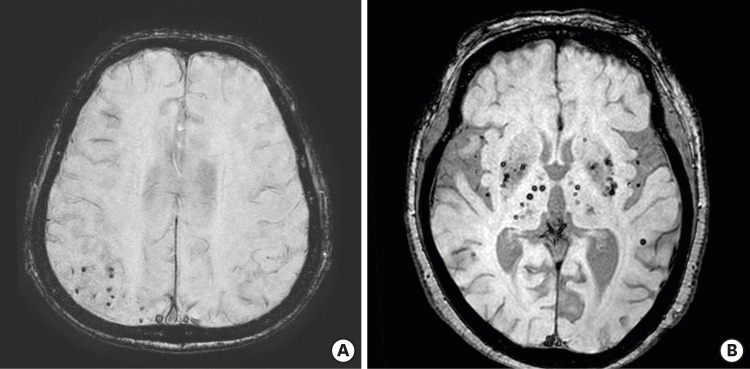
CMB: cerebral microbleed.

B: brain stem, Bg: basal ganglia, C: cerebellum, Cc:corpus callosum, DPWM: deep periventricular white matter, Ec: external capsule, F: frontal lobe, I: insula, Ic: internal capsule, O: occipital lobe, P: parietal lobe, T: temporal lobe, Th: thalamus.
References
-
- Roob G, Schmidt R, Kapeller P, Lechner A, Hartung HP, Fazekas F. MRI evidence of past cerebral microbleeds in a healthy elderly population. Neurology. 1999;52:991–994. - PubMed
-
- Poels MM, Ikram MA, van der Lugt A, Hofman A, Krestin GP, Breteler MM, et al. Incidence of cerebral microbleeds in the general population: the Rotterdam Scan Study. Stroke. 2011;42:656–661. - PubMed
-
- Vernooij MW, van der Lugt A, Ikram MA, Wielopolski PA, Niessen WJ, Hofman A, et al. Prevalence and risk factors of cerebral microbleeds: the Rotterdam Scan Study. Neurology. 2008;70:1208–1214. - PubMed
Publication types
LinkOut - more resources
Full Text Sources