


Associations of Oxidative Stress and Postoperative Outcome in Liver Surgery with an Outlook to Future Potential Therapeutic Options
- PMID: 30906502
- PMCID: PMC6393879
- DOI: 10.1155/2019/3950818
Associations of Oxidative Stress and Postoperative Outcome in Liver Surgery with an Outlook to Future Potential Therapeutic Options
Abstract
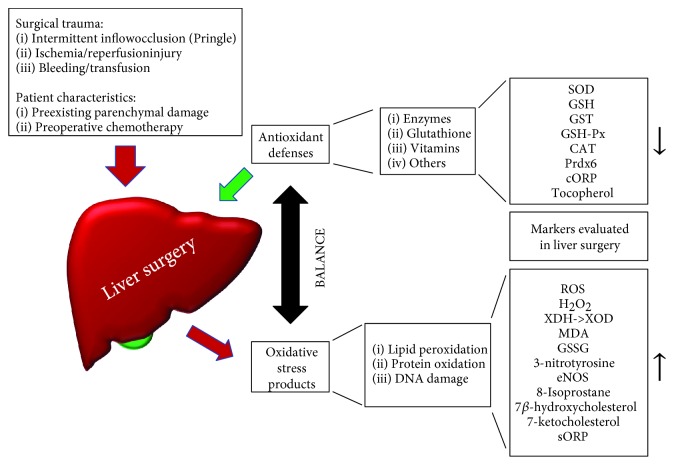
Several types of surgical procedures have shown to elicit an inflammatory stress response, leading to substantial cytokine production and formation of oxygen-based or nitrogen-based free radicals. Chronic liver diseases including cancers are almost always characterized by increased oxidative stress, in which hepatic surgery is likely to potentiate at least in the short term and hereby furthermore impair the hepatic redox state. During liver resection, intermittent inflow occlusion is commonly applied to prevent excessive blood loss but resulting ischemia and reperfusion of the liver have been linked to increased oxidative stress, leading to impairment of cell functions and subsequent cell death. In the field of liver transplantation, ischemia/reperfusion injury has extensively been investigated in the last decades and has recently been in the scientific focus again due to increased use of marginal donor organs and new machine perfusion concepts. Therefore, given the intriguing role of oxidative stress in the pathogenesis of numerous diseases and in the perioperative setting, the interest for a therapeutic antioxidative agent has been present for several years. This review is aimed at giving an introduction to oxidative stress in surgical procedures in general and then examines the role of oxidative stress in liver surgery in particular, discussing both transplantation and resection. Results from studies in the animal and human settings are included. Finally, potential therapeutic agents that might be beneficial in reducing the burden of oxidative stress in hepatic diseases and during surgery are presented. While there is compelling evidence from animal models and a limited number of clinical studies showing that oxidative stress plays a major role in both liver resection and transplantation and several recent studies have suggested a potential for antioxidative treatment in chronic liver disease (e.g., steatosis), the search for effective antioxidants in the field of liver surgery is still ongoing.
Figures
References
-
- Arias J.-L., Aller M. A., S??nchez-Patan F., Arias J. The inflammatory bases of hepatic encephalopathy. European Journal of Gastroenterology & Hepatology. 2006;18(12):1297–1310. doi: 10.1097/01.meg.0000243873.94572.de. - DOI - PubMed
Publication types
MeSH terms
Substances
LinkOut - more resources
Full Text Sources
Medical
