


Web-based intervention to promote weight-loss maintenance using an activity monitor: A randomized controlled trial
- PMID: 30906687
- PMCID: PMC6411634
- DOI: 10.1016/j.pmedr.2019.100839
Web-based intervention to promote weight-loss maintenance using an activity monitor: A randomized controlled trial
Abstract
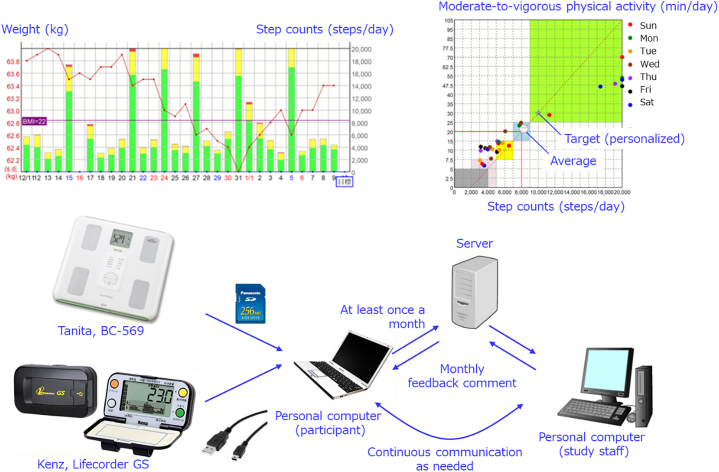
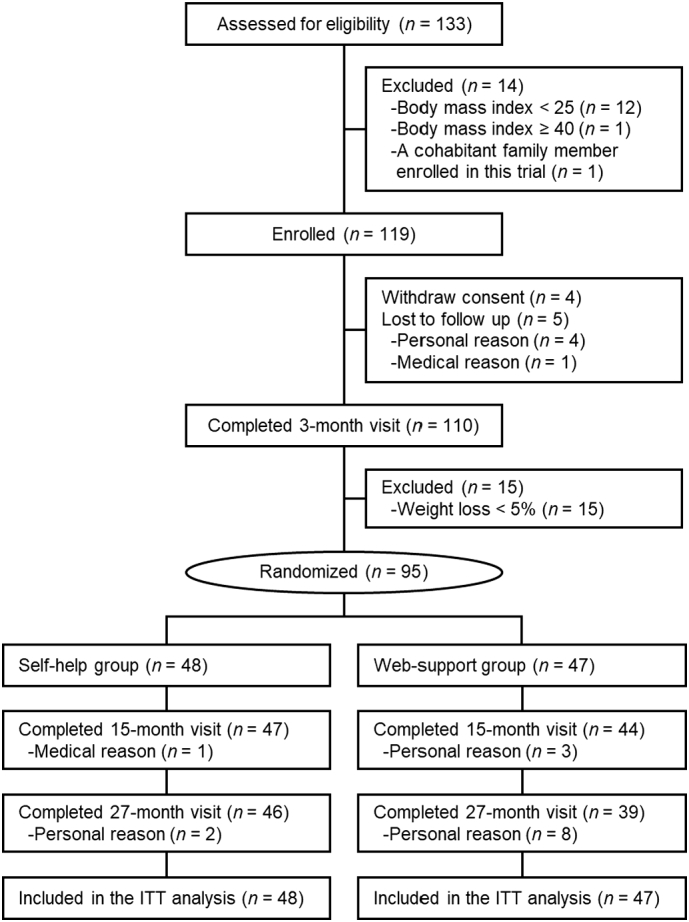
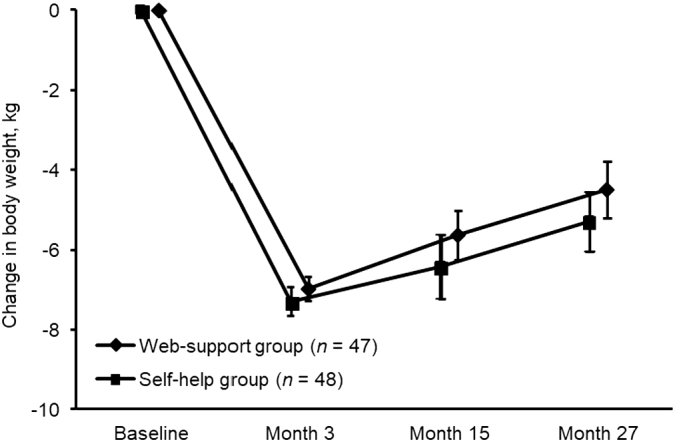
The present study examined whether a web-based intervention could promote weight-loss maintenance, after weight loss. The study was a two-phase, 27-month, randomized controlled trial conducted in Ibaraki, Japan, from 2014 to 2017; 133 participants were recruited through local newspaper advertisements. The eligibility criteria were as follows: age of 40-64 years, body mass index of 25-40 kg/m2, and having at least one metabolic syndrome component. In phase 1, a 3-month, group-based weight-loss program was provided to all eligible participants (n = 119). We then randomly assigned (1:1) participants who had lost 5% or more of their weight during phase 1 (n = 95) to either the self-help (mean 3-month weight loss 7.30 kg) or the web-support group (7.00 kg). Participants in the web-support group regularly reported their body weight and physical activity through a web-based system. They received monthly personalized feedback from a study staff for 24 months. The primary outcome, 27-month body-weight change (mean ± standard deviation), in the self-help and web-support groups were - 5.3 ± 5.0 kg and -4.5 ± 4.9 kg, respectively. There was no significant difference. An exploratory secondary analysis demonstrated that those with greater 27-month increases in their step count, assessed with an accelerometer, lost more weight with no difference in changes in energy intake. The mean 27-month body-weight change in the 4th quartile of changes in step count was -7.78 kg. Although web-based intervention using an activity monitor failed to promote weight-loss maintenance, increased physical activity was associated with successful weight-loss maintenance.
Keywords: BMI, body mass index; Body weight changes; CI, confidence interval; Diet; Exercise; FG, food group; HDL, high-density lipoprotein; ITT, intention-to-treat; MET, metabolic equivalents; MVPA, moderate-to-vigorous physical activity; Obesity management; RCT, randomized controlled trial; SD, SansDisk; UMIN, University Hospital Medical Information Network; USB, Universal Serial Bus.
Figures
References
-
- Aoyagi Y., Shephard R.J. Sex differences in relationships between habitual physical activity and health in the elderly: practical implications for epidemiologists based on pedometer/accelerometer data from the Nakanojo Study. Arch. Gerontol. Geriatr. 2013;56(2):327–338. - PubMed
-
- Finucane M.M., Stevens G.A., Cowan M.J., Danaei G., Lin J.K., Paciorek C.J., Singh G.M., Gutierrez H.R., Lu Y., Bahalim A.N., Farzadfar F., Riley L.M., Ezzati M. Global burden of metabolic risk factors of chronic diseases collaborating group (body mass index), 2011. National, regional, and global trends in body-mass index since 1980: systematic analysis of health examination surveys and epidemiological studies with 960 country-years and 9.1 million participants. Lancet. 2011;377(9765):557–567. - PMC - PubMed
-
- Funk K.L., Stevens V.J., Appel L.J., Bauck A., Brantley P.J., Champagne C.M., Coughlin J., Dalcin A.T., Harvey-Berino J., Hollis J.F., Jerome G.J., Kennedy B.M., Lien L.F., Myers V.H., Samuel-Hodge C., Svetkey L.P., Vollmer W.M. Associations of internet website use with weight change in a long-term weight loss maintenance program. J. Med. Internet Res. 2010;2(3) - PMC - PubMed
-
- Hutchesson M.J., Rollo M.E., Krukowski R., Ells L., Harvey J., Morgan P.J., Callister R., Plotnikoff R., Collins C.E. eHealth interventions for the prevention and treatment of overweight and obesity in adults: a systematic review with meta-analysis. Obes. Rev. 2015;16(5):376–392. - PubMed
LinkOut - more resources
Full Text Sources
Miscellaneous
