. 2019 Mar 20;5(3):eaav8423.
doi: 10.1126/sciadv.aav8423. eCollection 2019 Mar.

pH-dependent gating mechanism of the Helicobacter pylori urea channel revealed by cryo-EM

Affiliations

pH-dependent gating mechanism of the Helicobacter pylori urea channel revealed by cryo-EM

Yanxiang Cui et al. Sci Adv. .

Abstract

The urea channel of Helicobacter pylori (HpUreI) is an ideal drug target for preventing gastric cancer but incomplete understanding of its gating mechanism has hampered development of inhibitors for the eradication of H. pylori. Here, we present the cryo-EM structures of HpUreI in closed and open conformations, both at a resolution of 2.7 Å. Our hexameric structures of this small membrane protein (~21 kDa/protomer) resolve its periplasmic loops and carboxyl terminus that close and open the channel, and define a gating mechanism that is pH dependent and requires cooperativity between protomers in the hexamer. Gating is further associated with well-resolved changes in the channel-lining residues that modify the shape and length of the urea pore. Site-specific mutations in the periplasmic domain and urea pore identified key residues important for channel function. Drugs blocking the urea pore based on our structures should lead to a new strategy for H. pylori eradication.


Figures
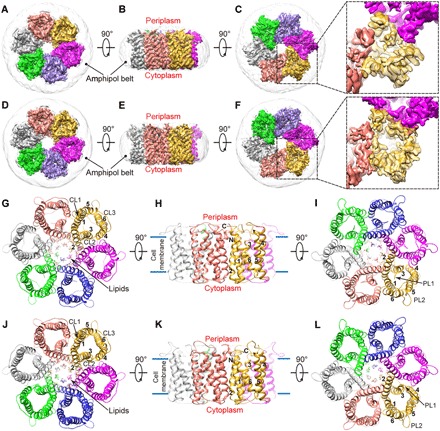
Fig. 1
Fig. 1. Cryo-EM density maps and atomic models of 6hisHpUreI.
(A to F) Shaded surface views of the cryo-EM density maps of 6hisHpUreI in the closed (A to C) and open (D to F) conformations viewed from the cytoplasm (A and D), plane of the membrane (B and E), and periplasm (C and F). Protomers are colored separately, and amphipol is in gray. (G to L) Ribbon diagrams of the atomic models of 6hisHpUreI in the closed (G to I) and open (J to L) conformations viewed as in (A) to (F). Transmembrane helices (TM1 to TM6) are numbered 1 to 6; N and C termini are indicated by N and C; cytoplasmic loops (CL) and periplasmic loops (PL) are labeled CL1 to CL3 and PL1 and PL2, respectively. Lipids are shown as sticks.
Fig. 2
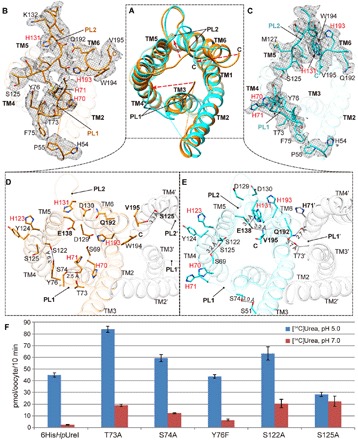
Fig. 2. Comparison of PLs and C terminus in the closed and open conformations.
(A) Overlaid protomers (ribbons) in closed (orange) and open (cyan) conformations, as viewed from the periplasm. Conformational changes are marked by red arrows. (B and C) Cryo-EM density of PL1, PL2, and C terminus in either the closed (B) or open (C) conformation, overlaid with the atomic model of a protomer of each conformation. (D and E) Key residues and interactions involved in conformation transition in closed (orange) and open (cyan) conformations. The neighboring protomers are in gray. (F) [14C]Urea influx (pmol/oocyte per 10 min) for oocytes expressing point mutants of 6hisHpUreI as compared to the control.
Fig. 3
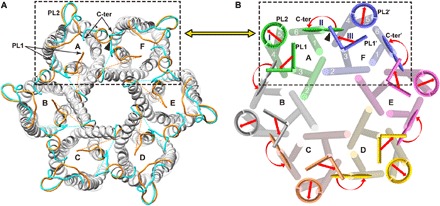
Fig. 3. Comparison of closed and open conformations of 6hisHpUreI elucidates coordinated transitions involving interprotomer cooperation.
(A) Periplasmic view of superposed hexamers in closed and open conformations, with their PL1, PL2, and C terminus highlighted in orange (closed) and cyan (open). (B) Illustration of sequential cooperative changes in one protomer (A) that would convert a neighboring protomer (F) from closed to open conformation (black dashed boxes). Our structures show that steric hindrance (black triangle) would prevent the simultaneous occurrence of the C terminus (C-ter) of protomer A in its closed conformation and PL1′ of protomer F in its open conformation. We posit that, as indicated by arrows, the movement of PL2 on protomer A (step I) allows its C terminus to flip 180° (step II), which makes space for PL1′ of the neighboring protomer F to reorient to the open conformation (step III). The final open state of protomer F (i.e., the open channel structure presented here) would then be formed with conversion of its own PL2 (PL2′) and C terminus (C-ter′) to the open conformation.
Fig. 4
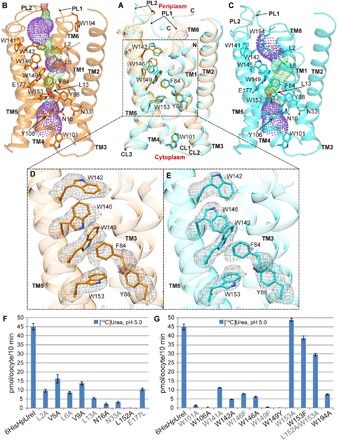
Fig. 4. Change in the solvent accessibility of the channel between closed and open conformations and significances of the residues lining the channel.
(A) Superposition of the channel in the closed (orange) and open (cyan) conformations. (B and C) The solvent accessibilities of the channel as determined by HOLE program in the closed (B) and open (C) conformations (dots). Red for pore radii < 1.2 Å, green for 1.2 Å < pore radii < 2.3 Å, and purple for 2.3 Å < pore radii < 4.0 Å. (D and E) Aromatic residues, particularly tryptophans, lining the channel. The side chains of these residues are well defined in the cryo-EM map (mesh). (F) [14C]Urea influx (pmol/oocyte per 10 min) for oocytes expressing mutants of 6hisHpUreI. (G) [14C]Urea influx (pmol/oocyte per 10 min) for oocytes expressing tryptophan mutants of 6hisHpUreI. Comparison to the control shows significant loss of activity for point mutation replacing channel-lining Trp141, Trp142, Trp146, or Trp149.

References

    1. Hooi J. K. Y., Lai W. Y., Ng W. K., Suen M. M. Y., Underwood F. E., Tanyingoh D., Malfertheiner P., Graham D. Y., Wong V. W. S., Wu J. C. Y., Chan F. K. L., Sung J. J. Y., Kaplan G. G., Ng S. C., Global prevalence of Helicobacter pylori infection: Systematic review and meta-analysis. Gastroenterology 153, 420–429 (2017). - PubMed
    1. Cherezov V., Rosenbaum D. M., Hanson M. A., Rasmussen S. G. F., Thian F. S., Kobilka T. S., Choi H.-J., Kuhn P., Weis W. I., Kobilka B. K., Stevens R. C., High-resolution crystal structure of an engineered human β2-adrenergic G protein-coupled receptor. Science 318, 1258–1265 (2007). - PMC - PubMed
    1. Herrera V., Parsonnet J., Helicobacter pylori and gastric adenocarcinoma. Clin. Microbiol. Infect. 15, 971–976 (2009). - PubMed
    1. Jung D. H., Kim J.-H., Lee Y. C., Lee S. K., Shin S. K., Park J. C., Chung H. S., Kim H., Kim H., Kim Y. H., Park J. J., Youn Y. H., Park H., Helicobacter pylori eradication reduces the metachronous recurrence of gastric neoplasms by attenuating the precancerous process. J. Gastric Cancer 15, 246–255 (2015). - PMC - PubMed
    1. Choi I. J., Kook M.-C., Kim Y.-I., Cho S.-J., Lee J. Y., Kim C. G., Park B., Nam B.-H., Helicobacter pylori therapy for the prevention of metachronous gastric cancer. N. Engl. J. Med. 378, 1085–1095 (2018). - PubMed

Publication types

MeSH terms

Substances