Women's Values and Preferences Regarding Osteoporosis Treatments: A Systematic Review
- PMID: 30907968
- PMCID: PMC7296202
- DOI: 10.1210/jc.2019-00193
Women's Values and Preferences Regarding Osteoporosis Treatments: A Systematic Review
Abstract
Background: Several treatments are available to reduce the risk of fragility fractures associated with osteoporosis. The choice of treatment requires knowledge of patients' values and preferences. The aim of the present study was to summarize what is known about the values and preferences relevant to the management of osteoporosis in women.
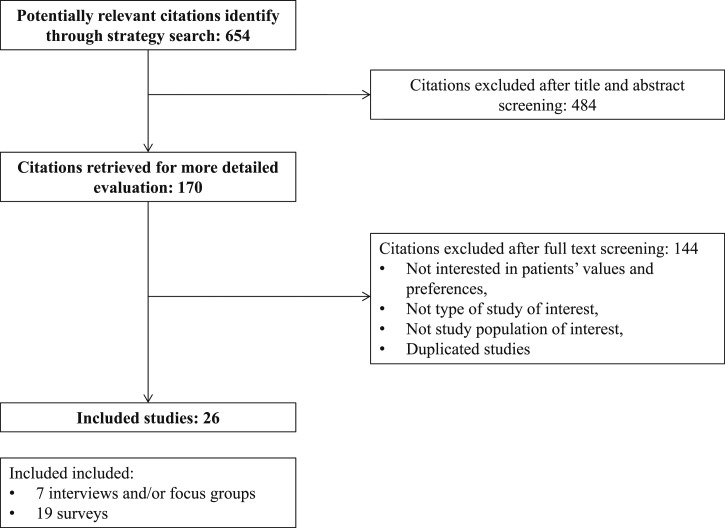
Methods: We conducted a comprehensive search of several databases for studies reported in any language that had included women who had already started or were about to start any pharmacological therapy for osteoporosis. Pairs of reviewers independently selected the studies and extracted the data. The results were synthesized narratively.
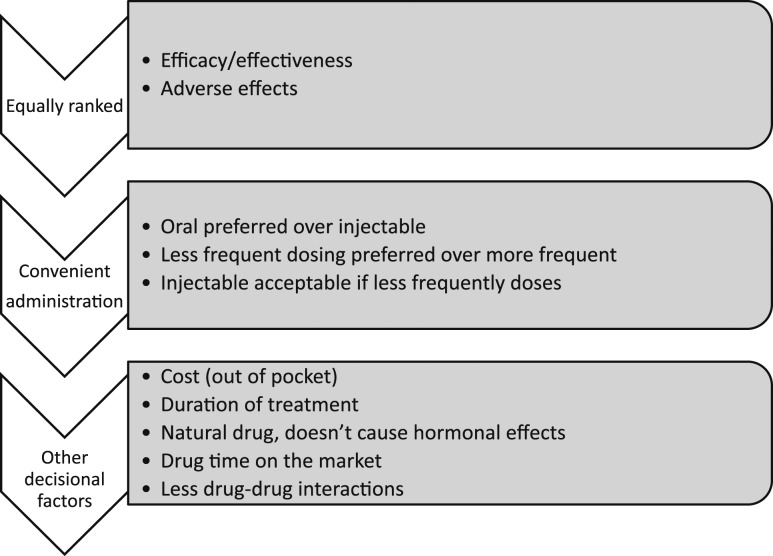
Results: We included 26 studies reporting on 15,348 women (mean age, 66 years). The women considered the effectiveness and adverse events equally, followed by the convenience of taking the drug and its effect on daily routine (less frequent dosing was preferred, the oral route was preferred, and the injectable route was preferred over oral if given less frequently). The treatment cost and duration were less important factors for decision making. Fear of breast cancer and fear of resuming uterine bleeding were common reasons for not choosing estrogen therapy. Calcium and vitamin D were viewed as safe and natural. Across the studies, the preferences were not affected by age, previous drug exposure, or employment status.
Conclusions: Women starting osteoporosis medications value effectiveness and side effects equally and prefer medications given less frequently. Injectable drugs appear acceptable if given less frequently. More research on patient values and preferences is needed to guide decision making in osteoporosis.
Copyright © 2019 Endocrine Society.
Figures
References
-
- Cooper C, Campion G, Melton LJ III. Hip fractures in the elderly: a world-wide projection. Osteoporosis Int.1992;2(6):285–289. - PubMed
-
- Sornay-Rendu E, Boutroy S, Munoz F, Delmas PD. Alterations of cortical and trabecular architecture are associated with fractures in postmenopausal women, partially independent of decreased BMD measured by DXA: the OFELY study. J Bone Miner Res. 2007;22(3):425–433. - PubMed
-
- Kanis JA, McCloskey EV, Johansson H, Cooper C, Rizzoli R, Reginster JY; Scientific Advisory Board of the European Society for Clinical and Economic Aspects of Osteoporosis and Osteoarthritis (ESCEO) and the Committee of Scientific Advisors of the International Osteoporosis Foundation (IOF) . European guidance for the diagnosis and management of osteoporosis in postmenopausal women. Osteoporos Int. 2013;24(1):23–57. - PMC - PubMed
-
- Lindsay R. The burden of osteoporosis: cost. Am J Med. 1995;98(2A)9S–11S. - PubMed
-
- Murad MH, Drake MT, Mullan RJ, Mauck KF, Stuart LM, Lane MA, Abu Elnour NO, Erwin PJ, Hazem A, Puhan MA, Li T, Montori VM. Clinical review: comparative effectiveness of drug treatments to prevent fragility fractures: a systematic review and network meta-analysis. J Clin Endocrinol Metab. 2012;97(6):1871–1880. - PubMed
Publication types
MeSH terms
Substances
Grants and funding
LinkOut - more resources
Full Text Sources
Medical