


Comment
doi: 10.1164/rccm.201901-0248ED.
Seeing the Forest for the (Arterial) Tree: Vascular Pruning and the Chronic Obstructive Pulmonary Disease Pulmonary Vascular Phenotype
Affiliations
- PMID: 30908925
- PMCID: PMC6701042
- DOI: 10.1164/rccm.201901-0248ED
Item in Clipboard
Comment
Seeing the Forest for the (Arterial) Tree: Vascular Pruning and the Chronic Obstructive Pulmonary Disease Pulmonary Vascular Phenotype
Am J Respir Crit Care Med.
.
No abstract available
Figures
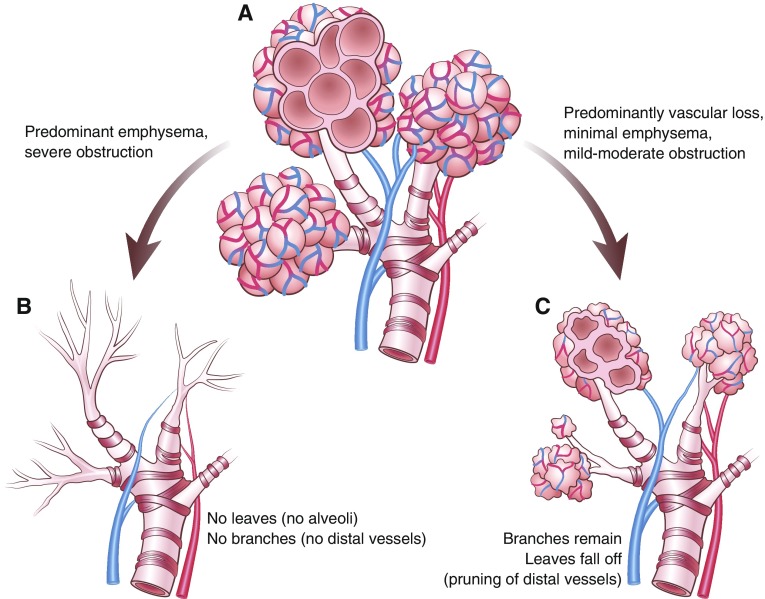
(A) A normal, healthy bronchovascular tree. Imagine the airways and alveoli are like branches on a tree with pulmonary arterial–capillary networks reflecting the individual leaves. (B) In most patients with chronic obstructive pulmonary disease, smoking-induced damage to the distal airways and alveolar destruction are the main mechanisms for loss of the pulmonary vascular bed and the consequent pulmonary hypertension. Dropout of the distal arteries and capillaries (leaves) is congruent with the degree of damage to the branches (i.e., emphysema and severe airflow obstruction). (C) In patients with chronic obstructive pulmonary disease with a pulmonary vascular phenotype, smoking-related vascular injury predominates. There may be primarily a loss of the distal arterial–capillary networks (pruning of the leaves) with relative preservation of the airways and alveoli (branches). Illustration by Patricia Ferrer Beals.
Comment on
-
Arterial Vascular Pruning, Right Ventricular Size, and Clinical Outcomes in Chronic Obstructive Pulmonary Disease. A Longitudinal Observational Study.Am J Respir Crit Care Med. 2019 Aug 15;200(4):454-461. doi: 10.1164/rccm.201811-2063OC. Am J Respir Crit Care Med. 2019. PMID: 30758975 Free PMC article.
References
-
- Andersen KH, Iversen M, Kjaergaard J, Mortensen J, Nielsen-Kudsk JE, Bendstrup E, et al. Prevalence, predictors, and survival in pulmonary hypertension related to end-stage chronic obstructive pulmonary disease. J Heart Lung Transplant. 2012;31:373–380. - PubMed
-
- Chaouat A, Bugnet A-S, Kadaoui N, Schott R, Enache I, Ducoloné A, et al. Severe pulmonary hypertension and chronic obstructive pulmonary disease. Am J Respir Crit Care Med. 2005;172:189–194. - PubMed
-
- Galiè N, Humbert M, Vachiery J-L, Gibbs S, Lang I, Torbicki A, et al. 2015 ESC/ERS guidelines for the diagnosis and treatment of pulmonary hypertension: the Joint Task Force for the diagnosis and treatment of pulmonary hypertension of the European Society of Cardiology (ESC) and the European Respiratory Society (ERS). Endorsed by: Association for European Paediatric and Congenital Cardiology (AEPC), International Society for Heart and Lung Transplantation (ISHLT) Eur Respir J. 2015;46:903–975. - PubMed
-
- Kovacs G, Agusti A, Barberà JA, Celli B, Criner G, Humbert M, et al. Pulmonary vascular involvement in chronic obstructive pulmonary disease: is there a pulmonary vascular phenotype? Am J Respir Crit Care Med. 2018;198:1000–1011. - PubMed
Publication types
MeSH terms
LinkOut - more resources
Full Text Sources
Medical
