Review
. 2019 Mar 22;7(3):90.
doi: 10.3390/microorganisms7030090.

Mycobacterium abscessus: Environmental Bacterium Turned Clinical Nightmare

Affiliations
Review

Mycobacterium abscessus: Environmental Bacterium Turned Clinical Nightmare

Rose C Lopeman et al. Microorganisms. .

Abstract

Mycobacteria are a large family of over 100 species, most of which do not cause diseases in humans. The majority of the mycobacterial species are referred to as nontuberculous mycobacteria (NTM), meaning they are not the causative agent of tuberculous (TB) or leprosy, i.e., Mycobacterium tuberculous complex and Mycobacterium leprae, respectively. The latter group is undoubtedly the most infamous, with TB infecting an estimated 10 million people and causing over 1.2 million deaths in 2017 alone TB and leprosy also differ from NTM in that they are only transmitted from person to person and have no environmental reservoir, whereas NTM infections are commonly acquired from the environment. It took until the 1950's for NTM to be recognised as a potential lung pathogen in people with underlying pulmonary disease and another three decades for NTM to be widely regarded by the medical community when Mycobacterium avium complex was identified as the most common group of opportunistic pathogens in AIDS patients. This review focuses on an emerging NTM called Mycobacterium abscessus (M. abs). M. abs is a rapidly growing NTM that is responsible for opportunistic pulmonary infections in patients with structural lung disorders such as cystic fibrosis and bronchiectasis, as well as a wide range of skin and soft tissue infections in humans. In this review, we discuss how we came to understand the pathogen, how it is currently treated and examine drug resistance mechanisms and novel treatments currently in development. We highlight the urgent need for new and effective treatments for M. abs infection as well as improved in vivo methods of efficacy testing.

Keywords: Mycobacterium abscessus; antimicrobial drug discovery; cystic fibrosis; non-tuberculous mycobacteria.


Conflict of interest statement

The authors declare no conflict of interest.

Figures
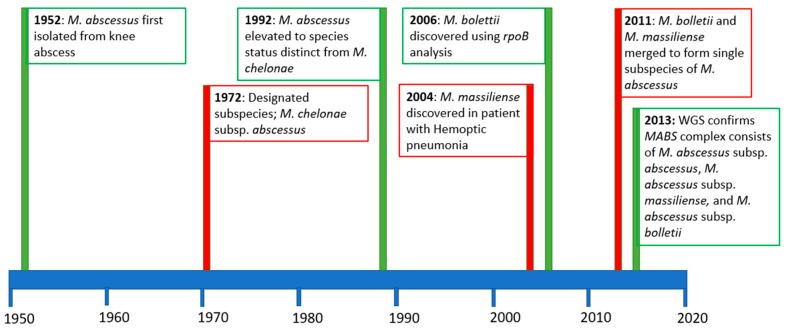
Figure 1
Figure 1
Timeline of Mycobacterium abscessus taxonomy from 1950 through to the present day. In the first 50 years since its discovery, no congruent terminology was in widespread use to accurately describe and differentiate M. abs from other nontuberculous mycobacteria (NTM). In the mid-2000s, improved molecular technology resulted in the discovery of the two M. abscessus subspecies; M. abscessus subsp. massiliense and M. abscessus subsp. bolletii in 2004 and 2006, respectively. Then, in 2011, it was proposed that M. abscessus subsp. massiliense and M. abscessus subsp. bolletii should be merged into one subspecies, M. abscessus subsp. massiliense. This caused some confusion within the medical community, until in 2013, when whole genome sequencing (WGS) showed genetic divisions that clearly identified the three subspecies within the M. abs complex.
Figure 2
Figure 2
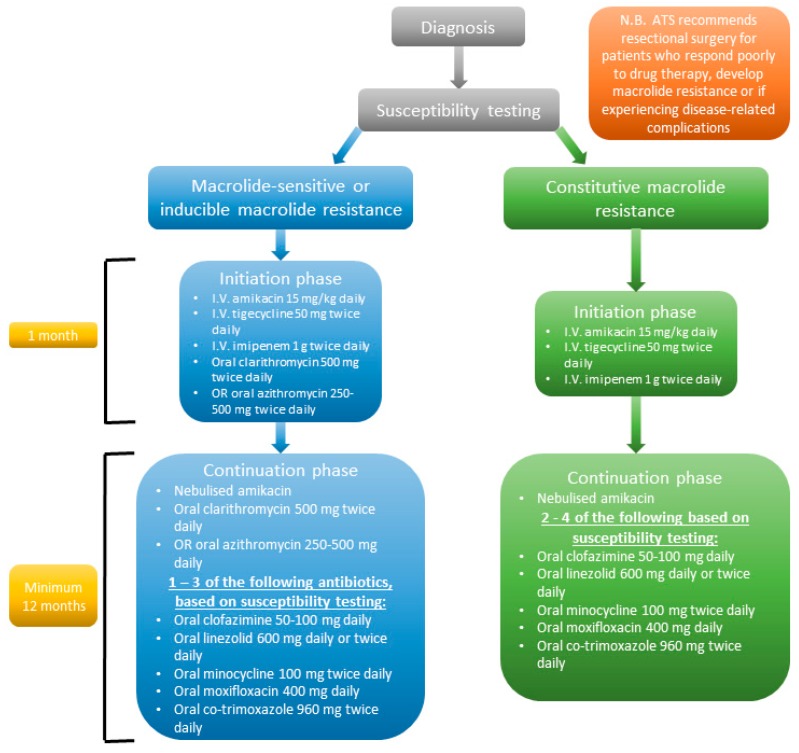
Flow chart showing treatment regimen for M. abs-pulmonary disease based on laboratory susceptibility testing results as recommended by the British Thoracic Society. Treatment will differ based on the whether the isolate displays macrolide sensitivity/inducible macrolide resistance or constitutive macrolide resistance. The initial phase of treatment involves three intravenous (I.V.) antibiotics, and for macrolide sensitive/inducible macrolide resistance one of two oral macrolides, and this phase lasts one month. The continuation phase also depends on laboratory susceptibility testing results and clinicians will typically administer 1-4 oral antibiotics over a period of at least 12 months. It is also important to note that the American Thoracic Society (ATS) recommends surgical resection of infected area if the patient is not responding to therapy, if macrolide resistance develops and/or if the patient develops disease-related complications such as haemoptysis.
Figure 3
Figure 3
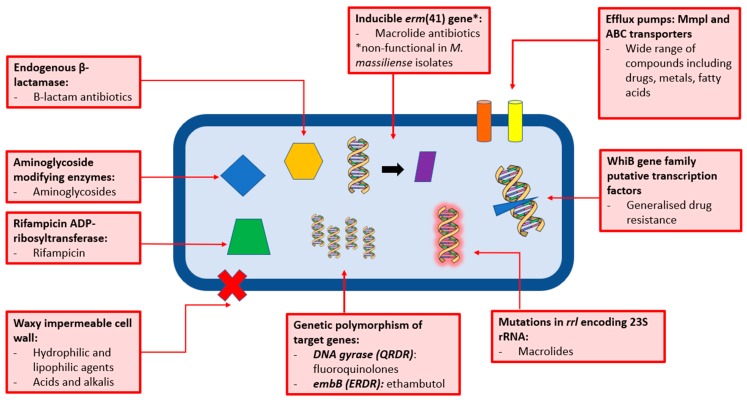
Graphical summary of the resistance mechanisms exhibited by Mycobacterium abscessus (M. abs). There are several mechanisms involving different physiological, enzymatic and genomic processes that contribute to the notoriously drug-resistant profile of M. abs. It is likely that these processes, such as efflux pumps and drug resistance genes, work in synergy to produce a highly resistant pathogen.
Figure 4
Figure 4
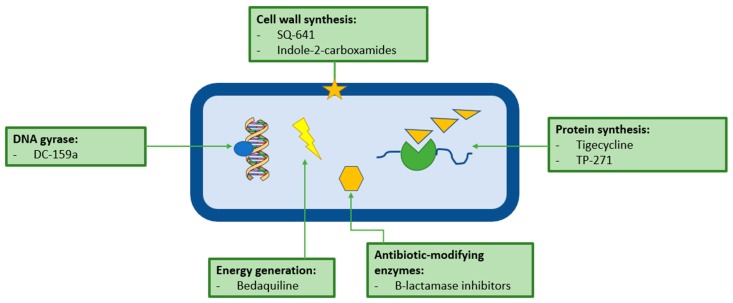
Graphical summary of the exploitable drug targets in Mycobacterium abscessus (M. abs). There are several potential target areas in M. abs including physiological, genomic, enzymatic and metabolic processes. Many of the drugs with potential to be used as part of M. abs treatment are old classes of antibiotics that have been repurposed, such as β-lactamase inhibitors, or have been discovered as part of the anti-tuberculous drug discovery pipelines, such as bedaquiline.

References

    1. Moore M., Frerichs J.B. An Unusual Acid-Fast Infection of the Knee with Subcutaneous, Abscess-Like Lesions of the Gluteal Region. J. Investig. Dermatol. 1953;20:133–169. doi: 10.1038/jid.1953.18. - DOI - PubMed
    1. Griffith D.E., Girard W.M., Wallace R.J. Clinical Features of Pulmonary Disease Caused by Rapidly Growing Mycobacteria: An Analysis of 154 Patients. Am. Rev. Respir. Dis. 1993;147:1271–1278. doi: 10.1164/ajrccm/147.5.1271. - DOI - PubMed
    1. Sopko J.A., Fieselmann J., Kasik J.E. Pulmonary disease due to Mycobacterium chelonei subspecies abscessus: A report of four cases. Tubercle. 1980;61:165–169. doi: 10.1016/0041-3879(80)90006-9. - DOI - PubMed
    1. Kubica G.P., Baess I., Gordon R.E., Jenkins P.A., Kwapinski J.B.G., McDurmont C., Pattyn S.R., Saito H., Silcox V., Stanford J.L., et al. A Co-operative Numberical Analysis of Rapidly Growing Mycobacteria. J. Gen. Microbiol. 1972;73:55–70. doi: 10.1099/00221287-73-1-55. - DOI - PubMed
    1. Kusunoki S., Ezaki T. Proposal of Mycobacterium peregrinum sp. Nov., nom. Rev., and elevation of Mycobacterium chelonae subsp. abscessus (Kubica et al.) to species status: Mycobacterium abscessus comb. nov. Int. J. Syst. Bacteriol. 1992;42:240–245. doi: 10.1099/00207713-42-2-240. - DOI - PubMed

LinkOut - more resources