Review
. 2019 Mar 22;5(1):30.
doi: 10.3390/ncrna5010030.

Increased Extracellular Matrix Protein Production in Chronic Diabetic Complications: Implications of Non-Coding RNAs

Affiliations
Review

Increased Extracellular Matrix Protein Production in Chronic Diabetic Complications: Implications of Non-Coding RNAs

Saumik Biswas et al. Noncoding RNA. .

Abstract

Management of chronic diabetic complications remains a major medical challenge worldwide. One of the characteristic features of all chronic diabetic complications is augmented production of extracellular matrix (ECM) proteins. Such ECM proteins are deposited in all tissues affected by chronic complications, ultimately causing organ damage and dysfunction. A contributing factor to this pathogenetic process is glucose-induced endothelial damage, which involves phenotypic transformation of endothelial cells (ECs). This phenotypic transition of ECs, from a quiescent state to an activated dysfunctional state, can be mediated through alterations in the synthesis of cellular proteins. In this review, we discussed the roles of non-coding RNAs, specifically microRNAs (miRNAs) and long non-coding RNAs (lncRNAs), in such processes. We further outlined other epigenetic mechanisms regulating the biogenesis and/or function of non-coding RNAs. Overall, we believe that better understanding of such molecular processes may lead to the development of novel biomarkers and therapeutic strategies in the future.

Keywords: ECM alterations; diabetic complications; epigenetics; histone modifications; lncRNAs; miRNAs.


Conflict of interest statement

The authors declare no conflict of interest.

Figures
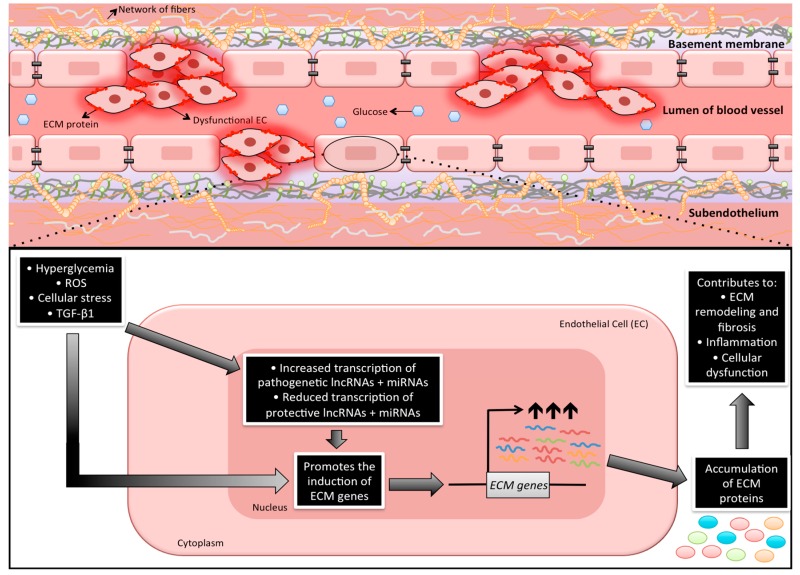
Figure 1
Figure 1
An illustration depicting the potential involvement of long non-coding RNAs (lncRNAs) and microRNAs (miRNAs) in the regulation of extracellular matrix proteins in endothelial cells during diabetes. As endothelial cells (ECs) are the first cell types to be exposed to systemic hyperglycemia, increased intracellular glucose triggers a number of metabolic disturbances. Among these disturbances, chronic hyperglycemia can cause the endothelium to lose its inherent physiological properties. Because these changes work primarily through the transcriptional machinery of the cell, recent research is beginning to demonstrate that non-coding RNAs are implicated in this complex pathogenetic process. In fact, the aberrant production of extracellular matrix (ECM) proteins in diabetes has been linked to many miRNAs and lncRNAs, which suggests that these non-coding RNAs are key epigenetic regulators in such a synthetic process. Additional notes: Cells denoted as “dysfunctional EC” in the image above are showcasing the abnormal ECs that have heightened production and deposition of ECM proteins. As well, the endothelial basement membrane is comprised of a complex network of fibers (includes collagen IV and laminin) that crosslink with many other proteins (i.e., perlecans). Endothelial cells are connected to this network by the presence of integrins (the orange molecules in the diagram). Of note, it has been documented that early hyperglycemia can provoke basement membrane thickening, which can have many detrimental consequences, such as the inability to prevent vascular permeability [178].

References

    1. Cho N.H., Shaw J.E., Karuranga S., Huang Y., da Rocha Fernandes J.D., Ohlrogge A.W., Malanda B. IDF Diabetes Atlas: Global estimates of diabetes prevalence for 2017 and projections for 2045. Diabetes Res. Clin. Pract. 2018;138:271–281. doi: 10.1016/j.diabres.2018.02.023. - DOI - PubMed
    1. Gregg E.W. Complications of diabetes in elderly people. BMJ. 2002;325:916–917. doi: 10.1136/bmj.325.7370.916. - DOI - PMC - PubMed
    1. Chow E.A., Foster H., Gonzalez V., McIver L. The Disparate Impact of Diabetes on Racial/Ethnic Minority Populations. Clin. Diabetes. 2012;30:130–133. doi: 10.2337/diaclin.30.3.130. - DOI
    1. Beckman J.A., Creager M.A. Vascular complications of diabetes. Circ. Res. 2016;118:1771–1785. doi: 10.1161/CIRCRESAHA.115.306884. - DOI - PubMed
    1. Garcia M.J., McNamara P.M., Gordon T., Kannel W.B. Morbidity and mortality in diabetics in the Framingham population. Sixteen year follow-up study. Diabetes Care. 1974;23:105–111. doi: 10.2337/diab.23.2.105. - DOI - PubMed

LinkOut - more resources
