. 2019 Mar 23;11(3):296.
doi: 10.3390/v11030296.

A Field Recombinant Strain Derived from Two Type 1 Porcine Reproductive and Respiratory Syndrome Virus (PRRSV-1) Modified Live Vaccines Shows Increased Viremia and Transmission in SPF Pigs

Affiliations

A Field Recombinant Strain Derived from Two Type 1 Porcine Reproductive and Respiratory Syndrome Virus (PRRSV-1) Modified Live Vaccines Shows Increased Viremia and Transmission in SPF Pigs

Julie Eclercy et al. Viruses. .

Abstract

In Europe, modified live vaccines (MLV) are commonly used to control porcine reproductive and respiratory syndrome virus (PRRSV) infection. However, they have been associated with safety issues such as reversion to virulence induced by mutation and/or recombination. On a French pig farm, we identified a field recombinant strain derived from two PRRSV-1 MLV (MLV1). As a result, we aimed to evaluate its clinical, virological, and transmission parameters in comparison with both parental strains. Three groups with six pigs in each were inoculated with either one of the two MLV1s or with the recombinant strain; six contact pigs were then added into each inoculated group. The animals were monitored daily for 35 days post-inoculation (dpi) for clinical symptoms; blood samples and nasal swabs were collected twice a week. PRRS viral load in inoculated pigs of recombinant group was higher in serum, nasal swabs, and tonsils in comparison with both vaccine groups. The first viremic contact pig was detected as soon as 2 dpi in the recombinant group compared to 10 and 17 dpi for vaccine groups. Estimation of transmission parameters revealed fastest transmission and longest duration of infectiousness for recombinant group. Our in vivo study showed that the field recombinant strain derived from two MLV1s demonstrated high viremia, shedding and transmission capacities.

Keywords: PRRS virus; PRRSV-1; modified live vaccine; persistence; recombination; safety; transmission.


Conflict of interest statement

The authors declare no conflict of interest.

Figures
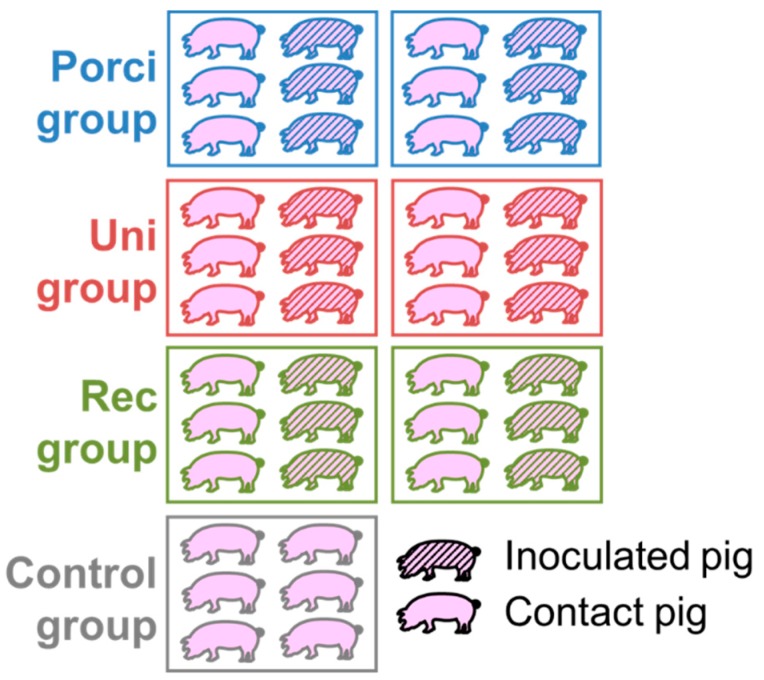
Figure 1
Figure 1
Experimental design.
Figure 2
Figure 2
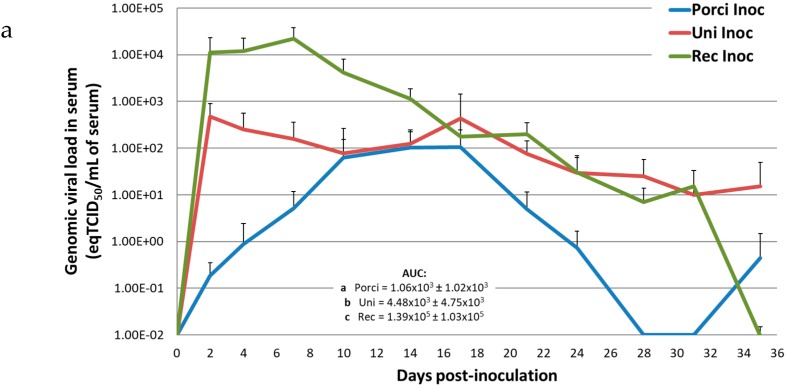
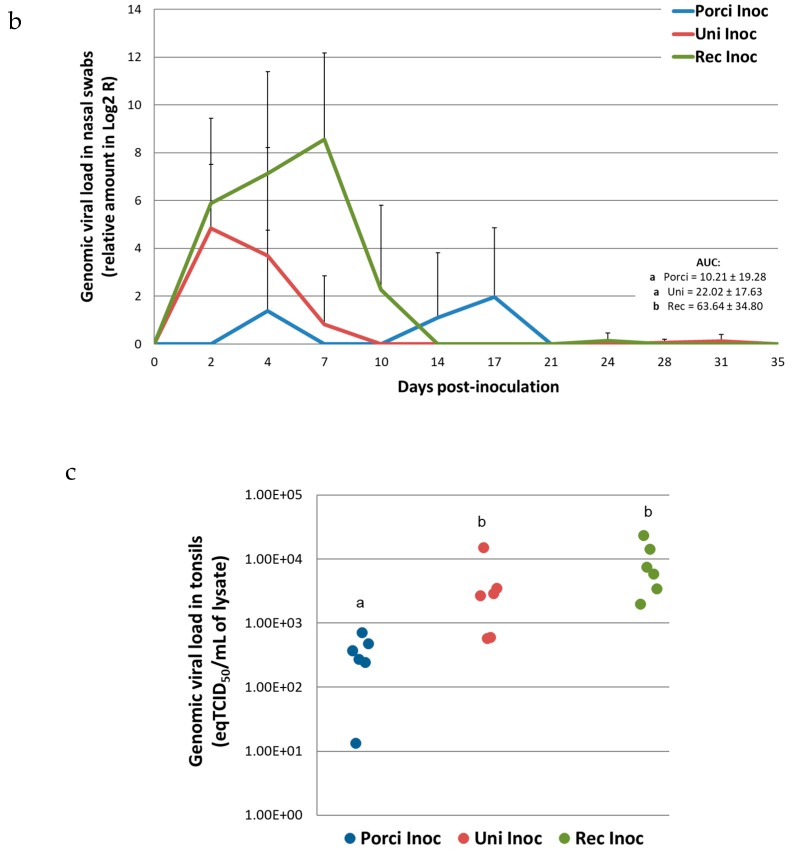
Genomic viral loads in serum, nasal swabs, and tonsils from inoculated pigs. (a) Evolution of the mean genomic viral loads in inoculated pigs from the Porci, Uni, and Rec groups in serum (equivalent TCID50/mL of serum) after inoculation (day 0). AUC: Area Under the Curve. Different letters (a, b, c) indicate that the groups are significantly different from each other with p ≤ 0.05. (b) Evolution of the mean genomic viral loads in inoculated pigs from Porci, Uni, and Rec groups in nasal swab supernatants (relative amount expressed in log2 R) after inoculation (day 0). AUC: Area Under the Curve. Different letters (a, b) indicate that the groups are significantly different from each other with p ≤ 0.05. (c) Post-mortem analysis of individual genomic viral loads in tonsils (equivalent TCID50/mL of tissue lysate) at 36–39 dpi in inoculated pigs from Porci, Uni, and Rec groups. Different letters (a, b) indicate that the groups are significantly different from each other with p ≤ 0.05.
Figure 2
Figure 2
Genomic viral loads in serum, nasal swabs, and tonsils from inoculated pigs. (a) Evolution of the mean genomic viral loads in inoculated pigs from the Porci, Uni, and Rec groups in serum (equivalent TCID50/mL of serum) after inoculation (day 0). AUC: Area Under the Curve. Different letters (a, b, c) indicate that the groups are significantly different from each other with p ≤ 0.05. (b) Evolution of the mean genomic viral loads in inoculated pigs from Porci, Uni, and Rec groups in nasal swab supernatants (relative amount expressed in log2 R) after inoculation (day 0). AUC: Area Under the Curve. Different letters (a, b) indicate that the groups are significantly different from each other with p ≤ 0.05. (c) Post-mortem analysis of individual genomic viral loads in tonsils (equivalent TCID50/mL of tissue lysate) at 36–39 dpi in inoculated pigs from Porci, Uni, and Rec groups. Different letters (a, b) indicate that the groups are significantly different from each other with p ≤ 0.05.
Figure 3
Figure 3
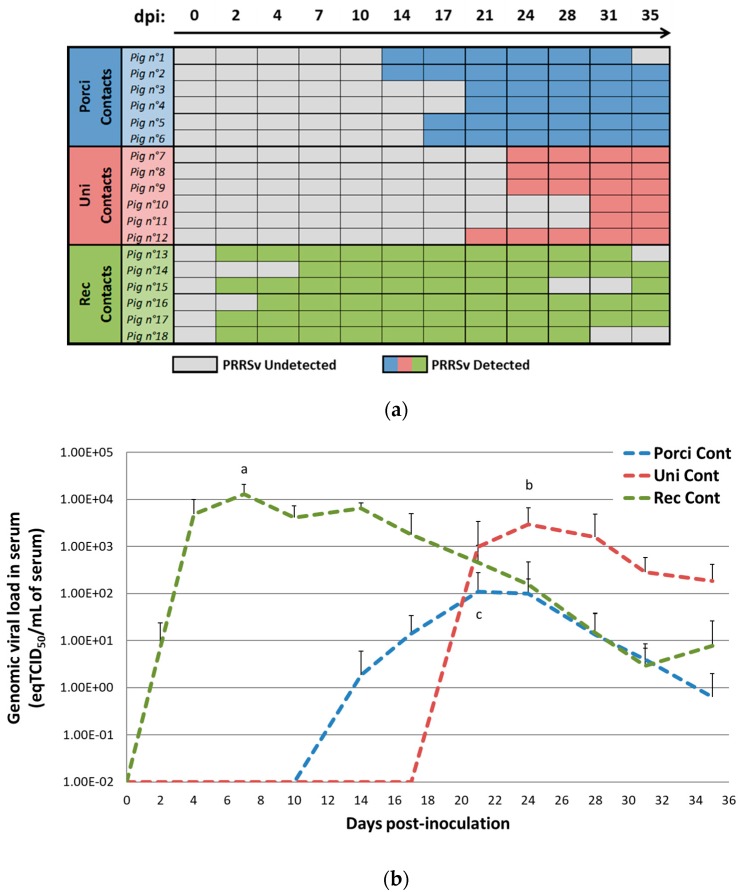
Porcine Reproductive and Respiratory Syndrome Virus (PRRSV) detection and genomic viral load in serum from contact pigs. (a) Detection of genomic viral loads in the serum of contact animals from the Porci, Uni, and Rec groups: individual detection data. (b) Evolution of the mean viremia in contact pigs after inoculation (day 0) (equivalent TCID50/mL of serum). Different letters (a, b, c) indicate that the groups are significantly different from each other at viremia peak with p ≤ 0.05.
Figure 4
Figure 4
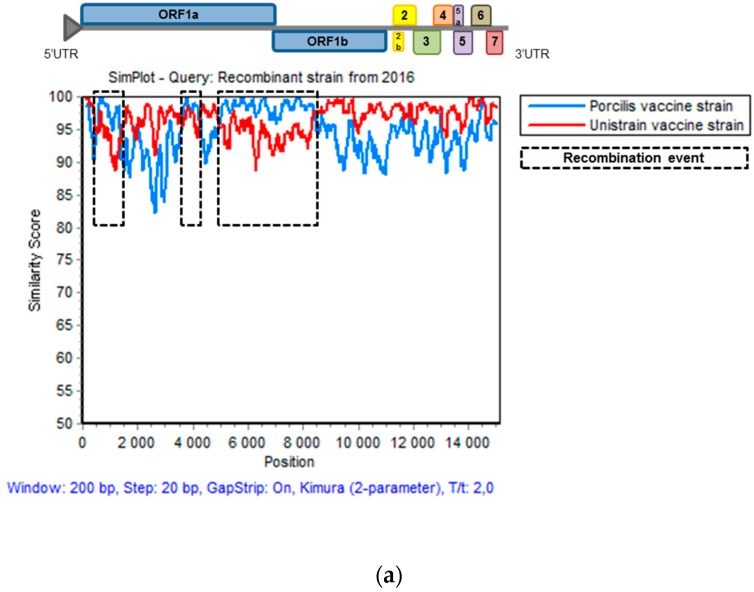
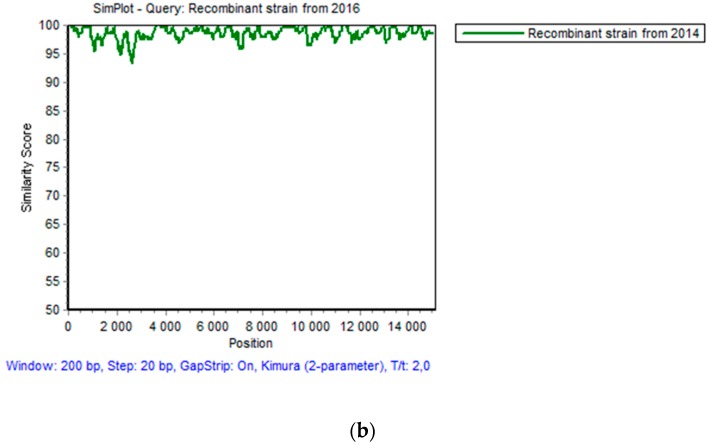
Full-genome similarities between the recombinant strain from 2016 and the vaccine strains or the recombinant strain from 2014. (a) Comparison of full-genome similarities with the recombinant strain isolated in 2016 and the Porcilis® PRRS and Unistrain® PRRS parental vaccine strains. (b) Comparison of full-genome similarities between the recombinant strains isolated in 2014 and 2016. Plots of similarity were generated with the Simplot program using the recombinant strain isolated in 2016 as the genome reference for both graphs.
Figure 4
Figure 4
Full-genome similarities between the recombinant strain from 2016 and the vaccine strains or the recombinant strain from 2014. (a) Comparison of full-genome similarities with the recombinant strain isolated in 2016 and the Porcilis® PRRS and Unistrain® PRRS parental vaccine strains. (b) Comparison of full-genome similarities between the recombinant strains isolated in 2014 and 2016. Plots of similarity were generated with the Simplot program using the recombinant strain isolated in 2016 as the genome reference for both graphs.

References

    1. Albina E. Porcine reproductive and respiratory syndrome: Ten years of experience (1986–1996) with this undesirable viral infection. Vet. Res. 1997;28:305–352. - PubMed
    1. Nathues H., Alarcon P., Rushton J., Jolie R., Fiebig K., Jimenez M., Geurts V., Nathues C. Cost of porcine reproductive and respiratory syndrome virus at individual farm level—An economic disease model. Prev. Vet. Med. 2017;142:16–29. doi: 10.1016/j.prevetmed.2017.04.006. - DOI - PubMed
    1. Meng X.J. Emerging and re-emerging swine viruses. Transbound. Emerg. Dis. 2012;59(Suppl. 1):85–102. doi: 10.1111/j.1865-1682.2011.01291.x. - DOI - PubMed
    1. Zhou L., Yang H. Porcine reproductive and respiratory syndrome in China. Virus Res. 2010;154:31–37. doi: 10.1016/j.virusres.2010.07.016. - DOI - PubMed
    1. Balasuriya U.B., Carossino M. Reproductive effects of arteriviruses: Equine arteritis virus and porcine reproductive and respiratory syndrome virus infections. Curr. Opin. Virol. 2017;27:57–70. doi: 10.1016/j.coviro.2017.11.005. - DOI - PubMed

Publication types

MeSH terms