Review
. 2019 Mar 23;20(6):1475.
doi: 10.3390/ijms20061475.

Psoriasis Pathogenesis and Treatment

Affiliations
Review

Psoriasis Pathogenesis and Treatment

Adriana Rendon et al. Int J Mol Sci. .

Abstract

Research on psoriasis pathogenesis has largely increased knowledge on skin biology in general. In the past 15 years, breakthroughs in the understanding of the pathogenesis of psoriasis have been translated into targeted and highly effective therapies providing fundamental insights into the pathogenesis of chronic inflammatory diseases with a dominant IL-23/Th17 axis. This review discusses the mechanisms involved in the initiation and development of the disease, as well as the therapeutic options that have arisen from the dissection of the inflammatory psoriatic pathways. Our discussion begins by addressing the inflammatory pathways and key cell types initiating and perpetuating psoriatic inflammation. Next, we describe the role of genetics, associated epigenetic mechanisms, and the interaction of the skin flora in the pathophysiology of psoriasis. Finally, we include a comprehensive review of well-established widely available therapies and novel targeted drugs.

Keywords: chronic skin disease; inflammation; psoriasis.


Conflict of interest statement

The authors declare no conflict of interest.

Figures
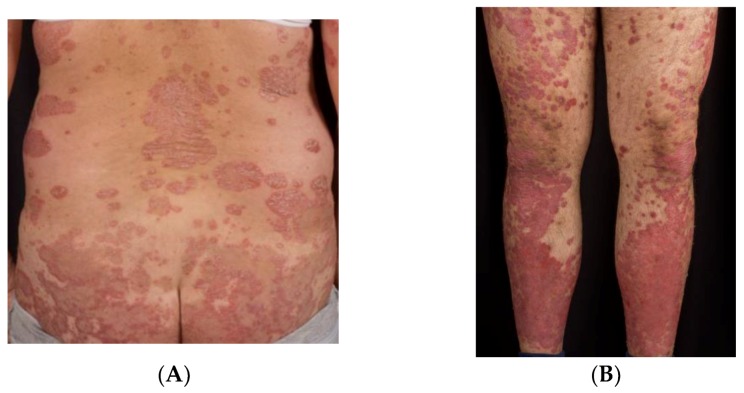
Figure 1
Figure 1
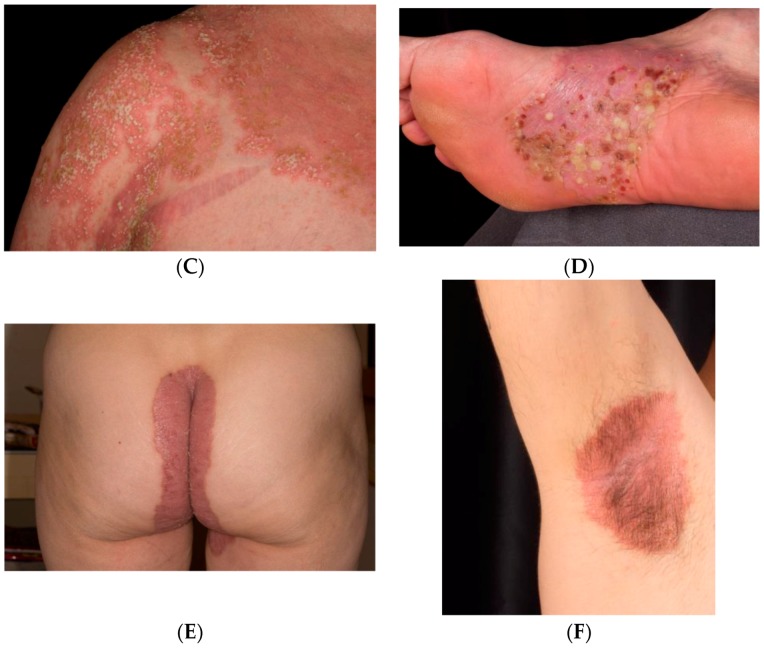
Clinical manifestations of psoriasis. (A,B) Psoriasis vulgaris presents with erythematous scaly plaques on the trunk and extensor surfaces of the limbs. (C) Generalized pustular psoriasis. (D) Pustular psoriasis localized to the soles of the feet. This variant typically affects the palms of the hands as well; hence, psoriasis pustulosa palmoplantaris. (E,F) Inverse psoriasis affects the folds of the skin (i.e., axillary, intergluteal, inframammary, and genital involvement).
Figure 1
Figure 1
Clinical manifestations of psoriasis. (A,B) Psoriasis vulgaris presents with erythematous scaly plaques on the trunk and extensor surfaces of the limbs. (C) Generalized pustular psoriasis. (D) Pustular psoriasis localized to the soles of the feet. This variant typically affects the palms of the hands as well; hence, psoriasis pustulosa palmoplantaris. (E,F) Inverse psoriasis affects the folds of the skin (i.e., axillary, intergluteal, inframammary, and genital involvement).
Figure 2
Figure 2
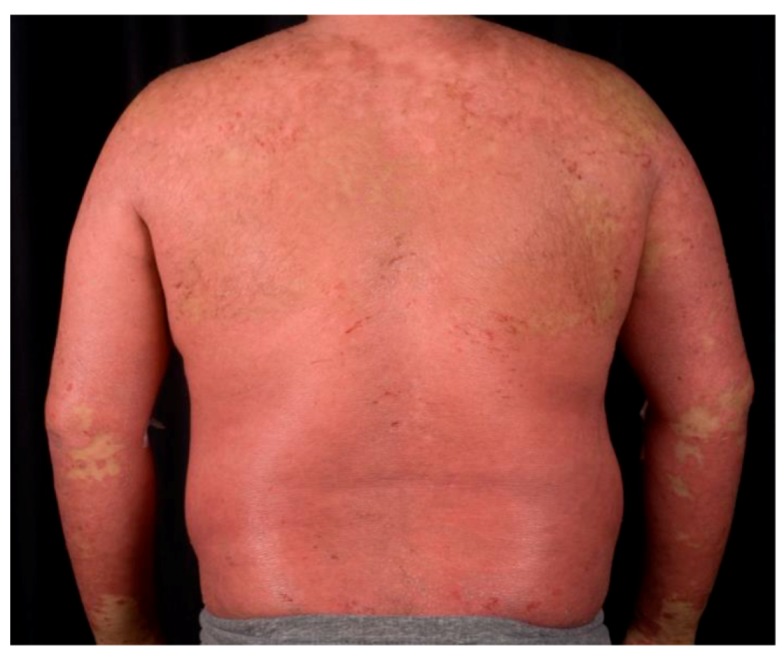
Erythrodermic psoriasis.
Figure 3
Figure 3
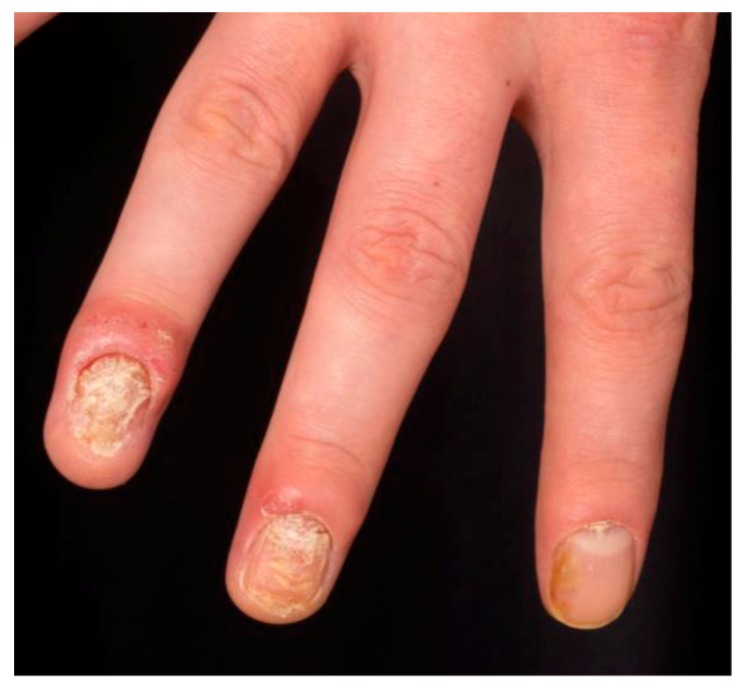
Onycholysis and oil drop changes on psoriatic nail involvement.
Figure 4
Figure 4
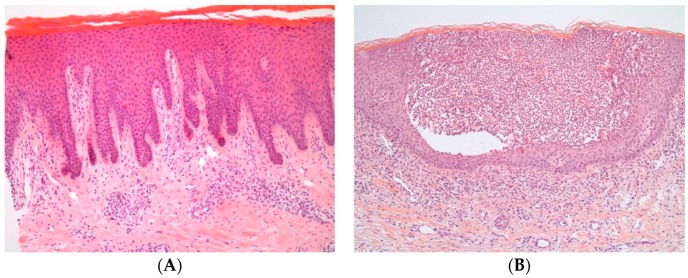
Histopathology of psoriasis. (A) Psoriasis vulgaris characteristically shows acanthosis, parakeratosis, and dermal inflammatory infiltrates. (B) In pustular psoriasis, acanthotic changes are accompanied by epidermal predominantly neutrophilic infiltrates, which cause pustule formation.
Figure 5
Figure 5
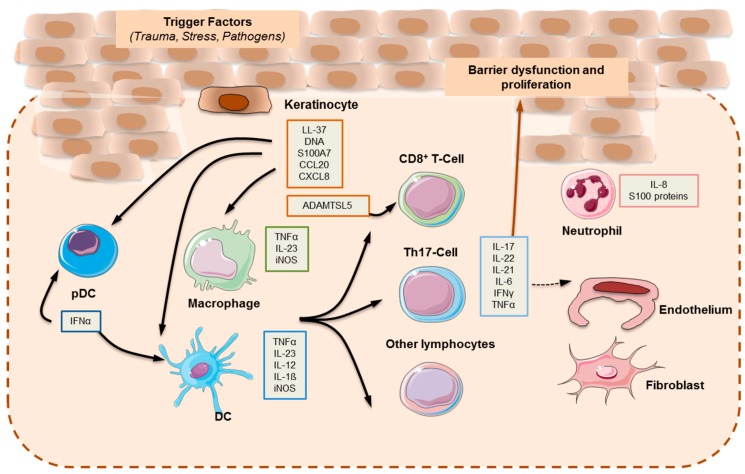
The pathogenesis of psoriasis.

References

    1. Christophers E. Psoriasis—Epidemiology and clinical spectrum. Clin. Exp. Dermatol. 2001;26:314–320. doi: 10.1046/j.1365-2230.2001.00832.x. - DOI - PubMed
    1. Parisi R., Symmons D.P., Griffiths C.E., Ashcroft D.M. Global epidemiology of psoriasis: A systematic review of incidence and prevalence. J. Investig. Dermatol. 2013;133:377–385. doi: 10.1038/jid.2012.339. - DOI - PubMed
    1. Gibbs S. Skin disease and socioeconomic conditions in rural Africa: Tanzania. Int. J. Dermatol. 1996;35:633–639. doi: 10.1111/j.1365-4362.1996.tb03687.x. - DOI - PubMed
    1. Rachakonda T.D., Schupp C.W., Armstrong A.W. Psoriasis prevalence among adults in the united states. J. Am. Acad. Dermatol. 2014;70:512–516. doi: 10.1016/j.jaad.2013.11.013. - DOI - PubMed
    1. Danielsen K., Olsen A.O., Wilsgaard T., Furberg A.S. Is the prevalence of psoriasis increasing? A 30-year follow-up of a population-based cohort. Br. J. Dermatol. 2013;168:1303–1310. doi: 10.1111/bjd.12230. - DOI - PubMed