


Imported Hyalomma ticks in Germany in 2018
- PMID: 30909964
- PMCID: PMC6434826
- DOI: 10.1186/s13071-019-3380-4
Imported Hyalomma ticks in Germany in 2018
Abstract
Background: Hyalomma marginatum and Hyalomma rufipes are two-host tick species, which are mainly distributed in southern Europe, Africa and middle-eastern Asia. They are well-known vectors of Crimean Congo hemorrhagic fever (CCHF) virus and other viruses as well as Rickettsia aeschlimannii. In recent years, these tick species have been found sporadically in Germany, but they do not belong to the autochthonous tick fauna in Germany.
Methods: Ticks with unusual morphology were collected and sent from private persons or public health offices to involve institutions for morphological identification and further testing. All ticks identified as Hyalomma spp. were tested using molecular detection methods for CCHF virus, Rickettsia spp., Coxiella burnetii and Coxiella-like organisms, Babesia spp. and Theileria spp.
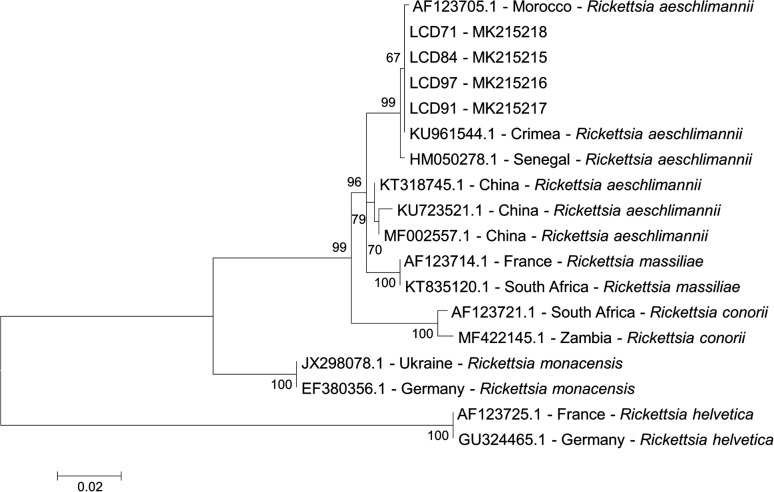
Results: Thirty-five ticks with an unusual appearance or behaviour were reported to us during summer-autumn 2018. For 17 of them, the description or photos implied that they belong to the hard tick genus Hyalomma. The remaining 18 ticks were sent to us and were identified as adult Hyalomma marginatum (10 specimens) or adult Hyalomma rufipes (8 specimens). All ticks tested negative for CCHF virus, Coxiella burnetii, Coxiella-like organisms, Babesia spp. and Theileria spp. The screening for rickettsiae gave positive results in 9 specimens . The Rickettsia species in all cases was identified as R. aeschlimannii.
Conclusions: These results show that exotic tick species imported into Germany were able to develop from the nymphal to the adult stage under appropriate weather conditions. Fifty percent of the ticks carried R. aeschlimannii, a human pathogen, while CCHF virus or other pathogens were not detected. Imported Hyalomma ticks may be the source of exotic diseases acquired in Germany.
Keywords: Germany; Horse; Human; Hyalomma marginatum; Hyalomma rufipes; Rickettsia aeschlimannii; Sheep.
Conflict of interest statement
The authors declare that they have no competing interests.
Figures

References
-
- Guglielmone AA, Robbins RG, Apanaskevich DA, Petney TN, Estrada-Peña A, Horak IG. The hard ticks of the world (Acari: Ixodida: Ixodidae) Berlin: Springer; 2014.
-
- Apanaskevich DA, Horak IG. The genus Hyalomma Koch, 1844: V. Re-evaluation of the taxonomic rank of taxa comprising the H. (Euhyalomma) marginatum Koch complex of species (Acari: Ixodidae) with re-description of all parasitic stages and notes on biology. Int J Acarol. 2008;34:13–42. doi: 10.1080/01647950808683704. - DOI
-
- Apanaskevich DA, Horak IG. The genus Hyalomma Koch, 1844: IX. Redescription of all parasitic stages of H. (Euhyalomma) impeltatum Schulze & Schlottke, 1930 and H. (E.) somalicum Tonelli Rondelli, 1935 (Acari: Ixodidae) Syst Parasitol. 1935;2009(73):199–218. - PubMed
-
- Apanaskevich DA, Santos-Silva MM, Horak IG. The genus Hyalomma Koch, 1844: IV. Redescription of all parasitic stages of H. (Euhyalomma) lusitanicum Koch, 1844 and the adults of H. (E.) franchinii Tonelli Rondelli, 1932 (Acari: Ixodidae) with a first description of its immature stages. Folia Parasitol. 2008;55:61–74. doi: 10.14411/fp.2008.009. - DOI - PubMed
-
- Apanaskevich DA, Schuster AL, Horak IG. The genus Hyalomma: VII. Redescription of all parasitic stages of H. (Euhyalomma) dromedarii and H. (E.) schulzei (Acari: Ixodidae) Morphol Syst Evol. 2008;45:817–831. - PubMed
MeSH terms
Grants and funding
LinkOut - more resources
Full Text Sources
Miscellaneous
