


Acquisition of a hybrid E/M state is essential for tumorigenicity of basal breast cancer cells
- PMID: 30910979
- PMCID: PMC6462070
- DOI: 10.1073/pnas.1812876116
Acquisition of a hybrid E/M state is essential for tumorigenicity of basal breast cancer cells
Erratum in
-
Correction for Kröger et al., Acquisition of a hybrid E/M state is essential for tumorigenicity of basal breast cancer cells.Proc Natl Acad Sci U S A. 2019 Jun 4;116(23):11553-11554. doi: 10.1073/pnas.1907473116. Epub 2019 May 28. Proc Natl Acad Sci U S A. 2019. PMID: 31138691 Free PMC article. No abstract available.
Abstract
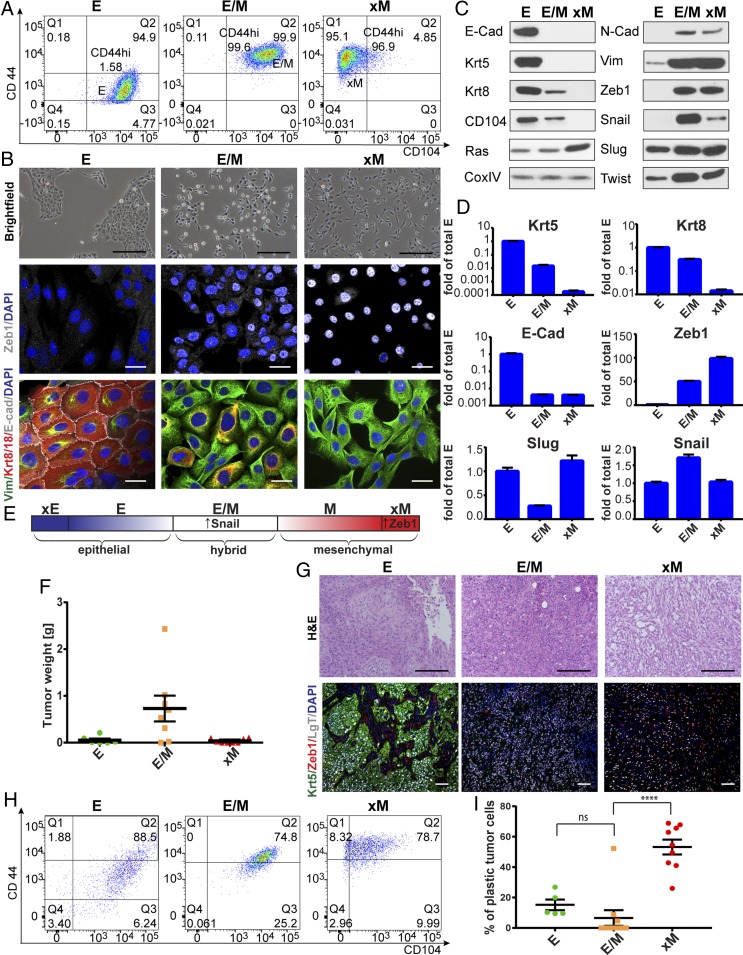
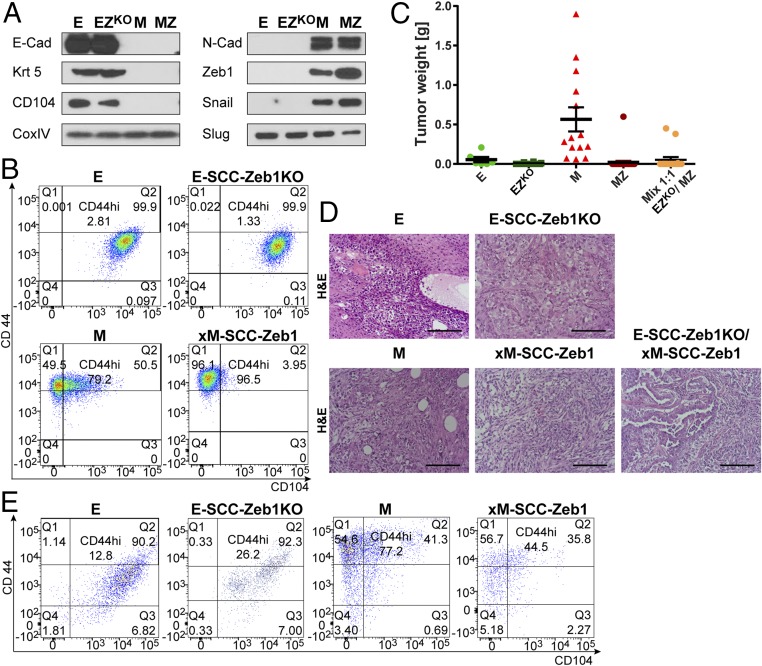
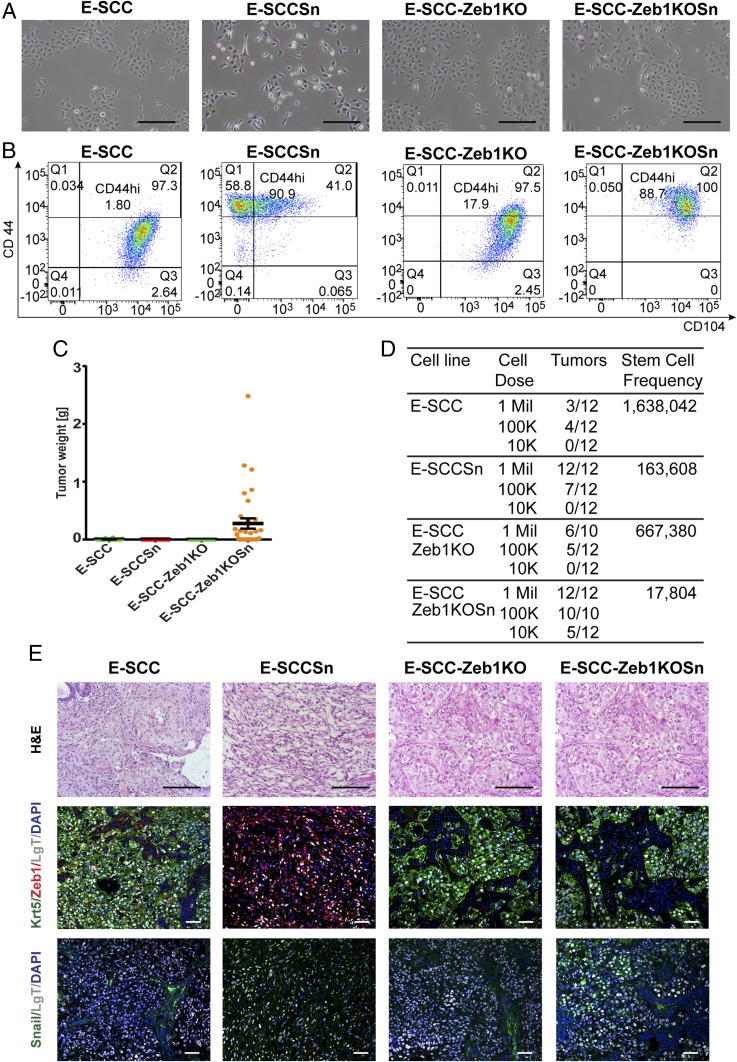
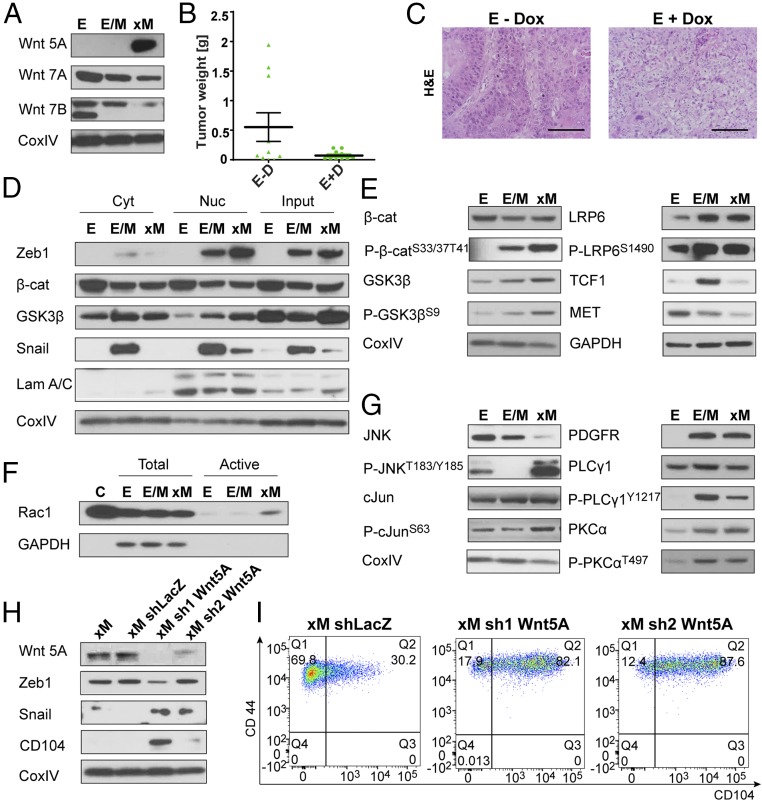
Carcinoma cells residing in an intermediate phenotypic state along the epithelial-mesenchymal (E-M) spectrum are associated with malignant phenotypes, such as invasiveness, tumor-initiating ability, and metastatic dissemination. Using the recently described CD104+/CD44hi antigen marker combination, we isolated highly tumorigenic breast cancer cells residing stably-both in vitro and in vivo-in an intermediate phenotypic state and coexpressing both epithelial (E) and mesenchymal (M) markers. We demonstrate that tumorigenicity depends on individual cells residing in this E/M hybrid state and cannot be phenocopied by mixing two cell populations that reside stably at the two ends of the spectrum, i.e., in the E and in the M state. Hence, residence in a specific intermediate state along the E-M spectrum rather than phenotypic plasticity appears critical to the expression of tumor-initiating capacity. Acquisition of this E/M hybrid state is facilitated by the differential expression of EMT-inducing transcription factors (EMT-TFs) and is accompanied by the expression of adult stem cell programs, notably, active canonical Wnt signaling. Furthermore, transition from the highly tumorigenic E/M state to a fully mesenchymal phenotype, achieved by constitutive ectopic expression of Zeb1, is sufficient to drive cells out of the E/M hybrid state into a highly mesenchymal state, which is accompanied by a substantial loss of tumorigenicity and a switch from canonical to noncanonical Wnt signaling. Identifying the gatekeepers of the various phenotypic states arrayed along the E-M spectrum is likely to prove useful in developing therapeutic approaches that operate by shifting cancer cells between distinct states along this spectrum.
Keywords: E/M hybrid state; EMT; EMT-TFs; Wnt signaling; cancer stem cells.
Copyright © 2019 the Author(s). Published by PNAS.
Conflict of interest statement
The authors declare no conflict of interest.
Figures
References
-
- Nieto MA, Huang RY, Jackson RA, Thiery JP. Emt: 2016. Cell. 2016;166:21–45. - PubMed
-
- Thiery JP. Epithelial-mesenchymal transitions in tumour progression. Nat Rev Cancer. 2002;2:442–454. - PubMed
-
- Brabletz T. To differentiate or not—Routes towards metastasis. Nat Rev Cancer. 2012;12:425–436. - PubMed
-
- Schmidt JM, et al. Stem-cell-like properties and epithelial plasticity arise as stable traits after transient Twist1 activation. Cell Rep. 2015;10:131–139. - PubMed
Publication types
MeSH terms
Grants and funding
LinkOut - more resources
Full Text Sources
Other Literature Sources
Medical
Molecular Biology Databases
Miscellaneous
