


The incidence of mild cognitive impairment: A systematic review and data synthesis
- PMID: 30911599
- PMCID: PMC6416157
- DOI: 10.1016/j.dadm.2019.01.004
The incidence of mild cognitive impairment: A systematic review and data synthesis
Abstract
Introduction: Incidence estimates of mild cognitive impairment (MCI) range widely. We obtained contemporary age-specific MCI incidence rates and examined sources of heterogeneity.
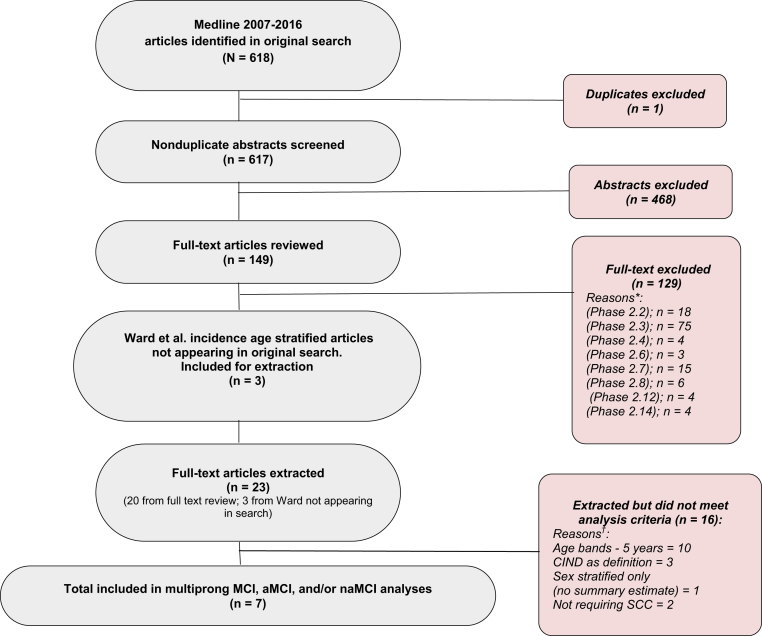
Methods: We conducted a systematic review of population-based studies from the Americas, Europe, and Australia using restrictive inclusion criteria to limit heterogeneity. Incidence was examined using 5-year age categories for MCI and amnestic/nonamnestic subtypes. Data were synthesized using quantitative and qualitative descriptive analyses and quantitative meta-analyses.
Results: Meta-analysis estimates (95% CI) of MCI incidence per 1000 person-years were 22.5 (5.1-51.4) for ages 75-79y, 40.9 (7.7-97.5) for ages 80-84y, and 60.1 (6.7-159.0) for ages 85+y. Despite restrictive inclusion criteria, considerable heterogeneity (measured by I2) remained. Meta-analysis findings and simple descriptive statistics were consistent and supported by qualitative review.
Discussion: Heterogeneity in MCI incidence estimates persisted across age-specific estimates from population samples, likely reflecting differences in populations and methods. Incidence rate ranges are important to consider with summary point estimates.
Keywords: Alzheimer's disease; Diagnosis; Incidence; Meta-analysis; Mild cognitive impairment; Systematic literature review.
Figures
References
-
- Albert M.S., DeKosky S.T., Dickson D., Dubois B., Feldman H.H., Fox N.C. The diagnosis of mild cognitive impairment due to Alzheimer's disease: recommendations from the National Institute on Aging-Alzheimer's Association workgroups on diagnostic guidelines for Alzheimer's disease. Alzheimers Dement. 2011;7:270–279. - PMC - PubMed
-
- Alzheimer's Association 2018 Alzheimer's disease facts and figures. Alzheimers Dement. 2018;14:367–429.
-
- Petersen R.C., Lopez O., Armstrong M.J., Getchius T.S.D., Ganguli M., Gloss D. Practice guideline update summary: mild cognitive impairment: Report of the Guideline Development, Dissemination, and Implementation Subcommittee of the American Academy of Neurology. Neurology. 2018;90:126–135. - PMC - PubMed
-
- Ward A., Arrighi H.M., Michels S., Cedarbaum J.M. Mild cognitive impairment: Disparity of incidence and prevalence estimates. Alzheimers Dement. 2012;8:14–21. - PubMed
Publication types
LinkOut - more resources
Full Text Sources
Medical