. 2019 May 7;9(5):1739-1743.
doi: 10.1534/g3.118.200873.

Identification of a Rat Mammary Tumor Risk Locus That Is Syntenic with the Commonly Amplified 8q12.1 and 8q22.1 Regions in Human Breast Cancer Patients

Affiliations

Identification of a Rat Mammary Tumor Risk Locus That Is Syntenic with the Commonly Amplified 8q12.1 and 8q22.1 Regions in Human Breast Cancer Patients

Cody Plasterer et al. G3 (Bethesda). .

Abstract

Breast cancer risk is 31% heritable, yet the majority of the underlying risk factors remain poorly defined. Here, we used F2-linkage analysis in a rat mammary tumor model to identify a novel 11.2 Mb modifier locus of tumor incidence and burden on rat chromosome 5 (chr5: 15.4 - 26.6 Mb). Genomic and RNA sequencing analysis identified four differentially expressed candidates: TMEM68, IMPAD1, SDCBP, and RBM12B Analysis of the human syntenic candidate region revealed that SDCBP is in close proximity to a previously reported genetic risk locus for human breast cancer. Moreover, analysis of the candidate genes in The Cancer Genome Atlas (TCGA) revealed that they fall within the commonly amplified 8q12.1 and 8q22.1 regions in human breast cancer patients and are correlated with worse overall survival. Collectively, this study presents novel evidence suggesting that TMEM68, IMPAD1, SDCBP, and RBM12B are potential modifiers of human breast cancer risk and outcome.

Keywords: TCGA; breast cancer; incidence; outcome; risk.


Figures

Figure 1
Figure 1
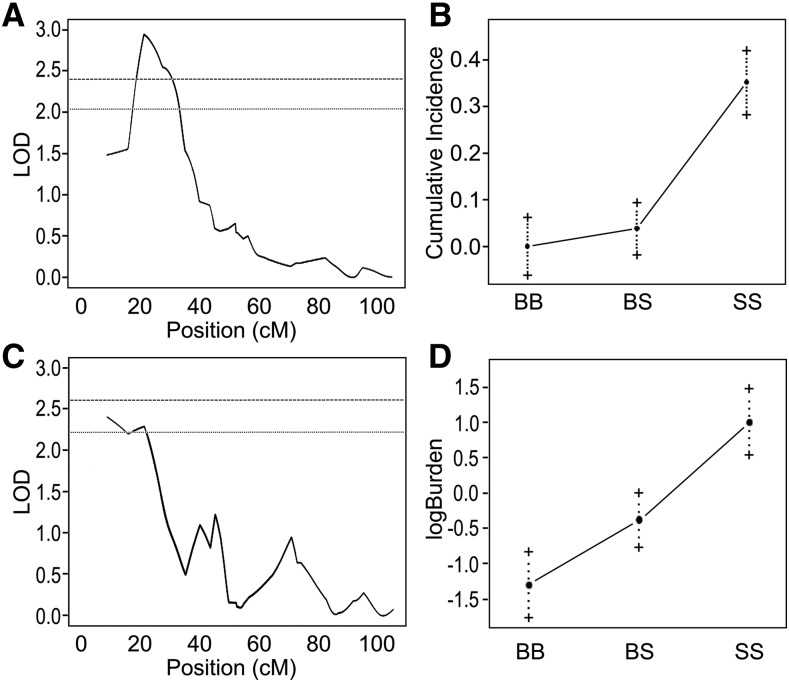
Interval mapping of mammary tumor incidence and burden in F2 progeny from a cross between SS and SS-5BN rats. Genotypes were determined at 25 polymorphic markers for 64 phenotypically defined F2 females. (A) Distribution of LOD scores for tumor incidence at 6 weeks post-exposure to DMBA identified a candidate region between 16.9 cM - 34.4 cM on RNO5. (B) A logistic regression with the peak marker in the candidate region revealed a significant association with tumor incidence at 6 weeks post-exposure to DMBA for the SS parental strain. (C) Distribution of LOD scores for tumor burden at 15 weeks post-exposure to DMBA identified an overlapping candidate region between 8.9 cM and 27.9 cM on RNO5. (D) A logistic regression with the peak marker in the candidate region revealed a significant association with tumor burden at 15 weeks post-exposure to DMBA. Lines indicate permutation-derived thresholds for significance at P = 0.05 (hashed lines) and P = 0.1 (dotted line).
Figure 2
Figure 2
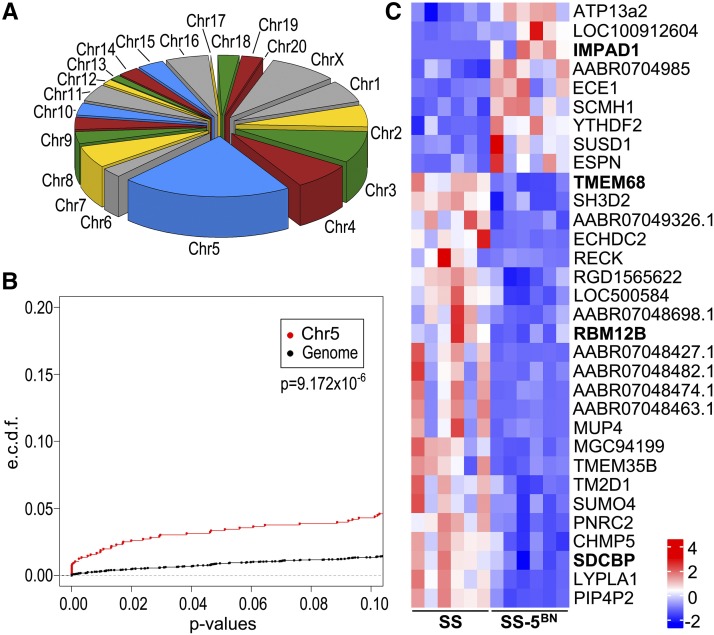
RNAseq analysis of mammary tumors from SS and SS-5BN consomic rats (n = 6 per group). (A) Chromosomal distribution of the 155 differentially expressed genes in mammary tumors isolated fromSS and SS-5BN consomic rats. (B) Distributions of adjusted p-values for differentially expressed genes on RNO5 vs. the rest of the rat genome were tested by a two-sample Kolmogorov–Smirnov test. (C) Heatmap of differentially expressed genes that are localized to RNO5. Genes falling within the candidate region are labeled in bold.

References

    1. Adamovic T., McAllister D., Wang T., Adamovic D., Rowe J. J., et al. , 2010. Identification of novel carcinogen-mediated mammary tumor susceptibility loci in the rat using the chromosome substitution technique. Genes Chromosomes Cancer 49: 1035–1045. 10.1002/gcc.20812 - DOI - PMC - PubMed
    1. Baietti M. F., Zhang Z., Mortier E., Melchior A., Degeest G., et al. , 2012. Syndecan-syntenin-alix regulates the biogenesis of exosomes. Nat. Cell Biol. 14: 677–685. 10.1038/ncb2502 - DOI - PubMed
    1. Cerami E., Gao J., Dogrusoz U., Gross B. E., Sumer S. O., et al. , 2012. The cbio cancer genomics portal: an open platform for exploring multidimensional cancer genomics data. Cancer Discov. 2: 401–404. 10.1158/2159-8290.CD-12-0095 - DOI - PMC - PubMed
    1. Churchill G. A., Doerge R. W., 1994. Empirical threshold values for quantitative trait mapping. Genetics 138: 963–971. - PMC - PubMed
    1. Flister M. J., Endres B. T., Rudemiller N., Sarkis A. B., Santarriaga S., et al. , 2014. Cxm - a new tool for mapping breast cancer risk in the tumor microenvironment. Cancer Res. 74: 6419–6429. 10.1158/0008-5472.CAN-13-3212 - DOI - PMC - PubMed

Publication types