Clinical Trial
. 2019 Mar 26;9(1):5232.
doi: 10.1038/s41598-019-41721-0.

Familiarization with treadmill walking: How much is enough?

Affiliations
Clinical Trial

Familiarization with treadmill walking: How much is enough?

Christian Meyer et al. Sci Rep. .

Abstract

Treadmill-based gait analysis is widely used to investigate walking pathologies and quantify treatment effects on locomotion. Differential sensorimotor conditions during overground vs. treadmill walking necessitate initial familiarization to treadmill walking. Currently, there is no standardized treadmill acclimatization protocol and insufficient familiarization potentially confounds analyses. We monitored initial adaptations to treadmill walking in 40 healthy adults. Twenty-six walking parameters were assessed over 10 minutes with marker-based kinematic analysis and acclimatization profiles were generated. While 16 walking parameters demonstrated initial acclimatization followed by plateau performance, ten parameters remained stable. Distal lower limb control including ankle range of motion, toe trajectory and foot clearance underwent substantial adaptations. Moreover, intralimb coordination and gait variability also demonstrated acclimatization, while measures of symmetry and interlimb coordination did not. All parameters exhibiting a plateau after acclimatization did so within 6-7 minutes (425 strides). Older participants and those naïve to treadmill walking showed adaptations with higher amplitudes but over similar timescales. Our results suggest a minimum of 6 minutes treadmill acclimatization is required to reach a stable performance, and that this should suffice for both older and naïve healthy adults. The presented data aids in optimizing treadmill-based gait analysis and contributes to improving locomotor assessments in research and clinical settings.


Conflict of interest statement

The authors declare no competing interests.

Figures
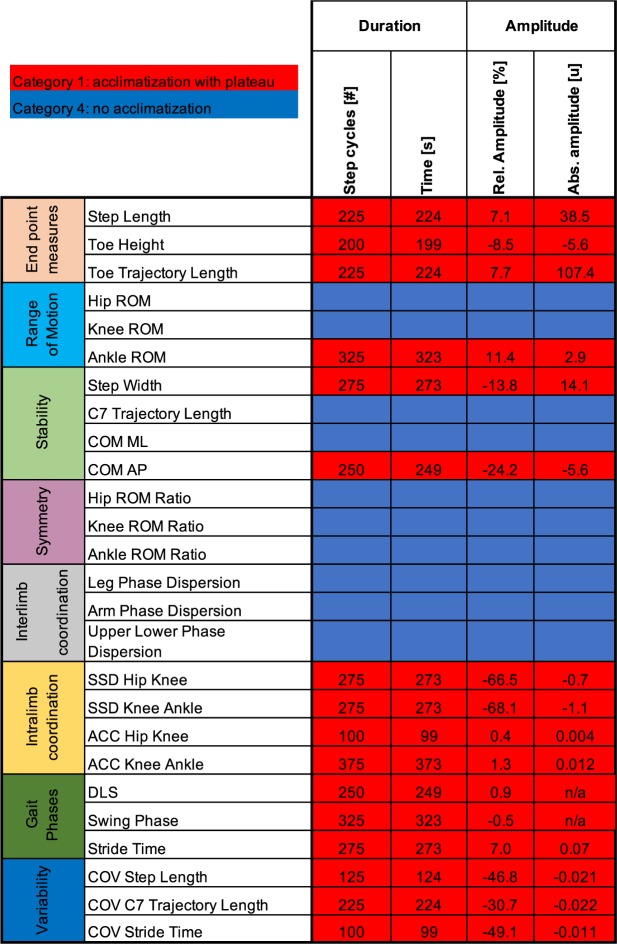
Figure 1
Figure 1
Acclimatization profiles of 26 key gait parameters during treadmill walking. Twenty-six key gait parameters were assessed with respect to acclimatization periods and amplitudes during treadmill walking. Stable parameters without any acclimatization are marked in blue (category 4, see methods), whereas walking parameters demonstrating acclimatization resulting in stable plateau performance are illustrated in red (category 1). The duration of acclimatization (i.e. time to reach a stable plateau) is indicated in number of strides and seconds. Relative and absolute amplitudes of adaptations are provided, indicating the degree and direction of acclimatization. Absolute amplitudes are given in the following units: step length [mm], toe height [mm], toe trajectory length [mm], Ankle ROM [deg], Step width [mm], COM AP [mm], SSD Hip Knee [au], SSD Knee Ankle [au], ACC Hip Knee [au], ACC Knee Ankle [au], Stride time [s], COV step length [au], COV C7 trajectory length [au], and COV stride time [au]. For the parameters with % as unit (DLS, swing phase), relative amplitudes represent the absolute difference to the first bin (i.e. absolute differences do not exist for these parameters). Abbreviations: Abs.: absolute; au: arbitrary units; ACC: angular component of coefficient of correspondence; COM: center of mass; COV: coefficient of variation; DLS: double limb support; ROM: range of motion; Rel.: relative; SSD: sum of squared distances.
Figure 2
Figure 2
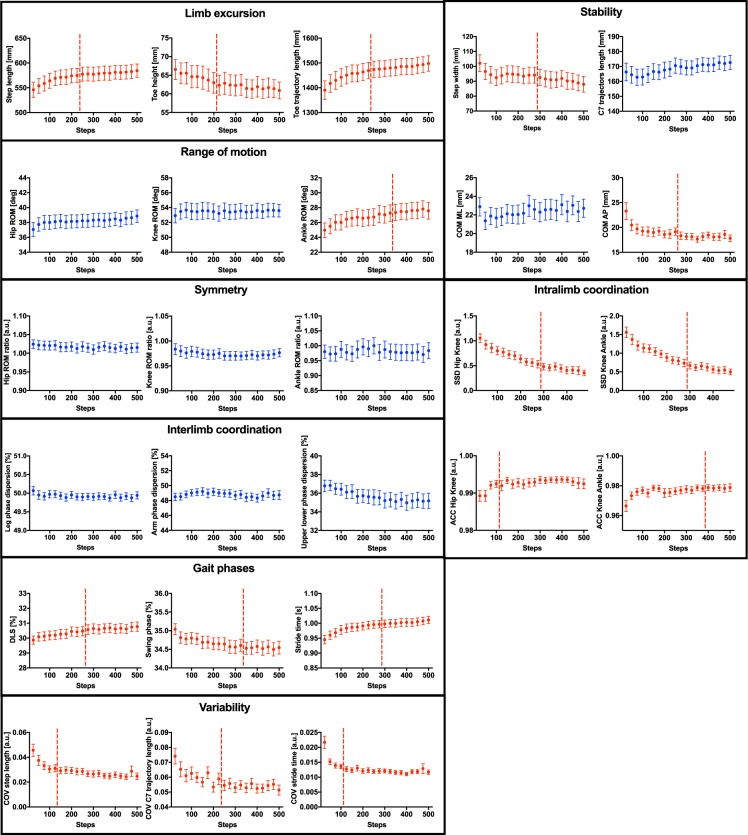
Adaptation curves of all locomotor parameters during acclimatization to treadmill walking. Twenty-six locomotor parameters were monitored in 40 healthy subjects over the course of 10 minutes of treadmill walking (i.e. 20 bins of 25 strides each). Data represent mean values ± SEM. Stable parameters without acclimatization according to our pre-defined criteria (category 4, see methods) are shown in blue, whereas parameters revealing acclimatization (category 1) are highlighted in red. Plateau onset (if applicable; category 1) is illustrated by a horizontal red dashed line. Abbreviations: ACC: angular component of coefficient of correspondence; COM: center of mass; COV: coefficient of variation; DLS: double limb support; ROM: range of motion; SSD: sum of squared distances.
Figure 3
Figure 3
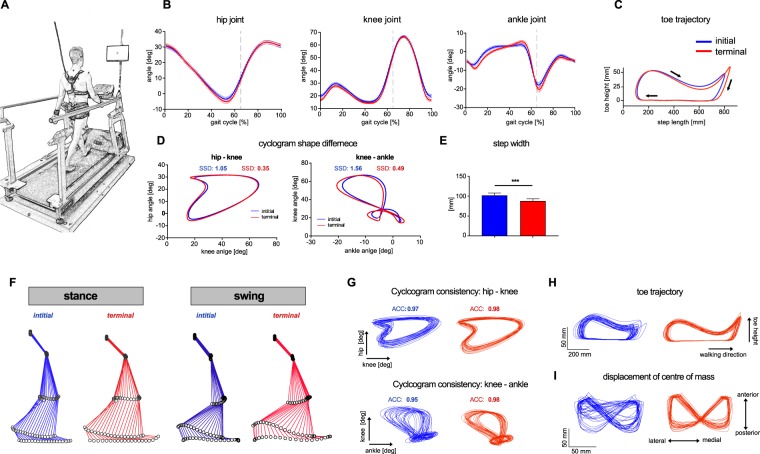
Adaptations of the locomotor pattern during familiarization with treadmill walking. (A) Illustration of the experimental setup. (BI) Representation of initial (fist bin; blue) and terminal (last bin; red) treadmill walking performance. (B) Mean sagittal excursions of the hip, knee and ankle joint (n = 40). Data represent mean values ± SEM. (C) Mean toe trajectory (n = 40). (D) Mean hip-knee and knee-ankle cyclograms (n = 40). (E) Step width (mean ± SEM, n = 40, Wilcoxon signed-rank test, p < 0.0001). (F) Stick figures representing leg movements during stance and swing phase of a representative subject. (G) Hip-knee and knee- ankle cyclograms of 25 strides of a representative subject. (H) Toe trajectories of 25 strides for a representative subject. (I) 2D-representation of the COM displacement on the floor for 25 strides of a representative subject. Representative data in (FI) were collected from the same participant. Abbreviations: ACC: angular component of coefficient of correspondence; SEM: standard error of the mean; SSD: sum of squared distances.
Figure 4
Figure 4
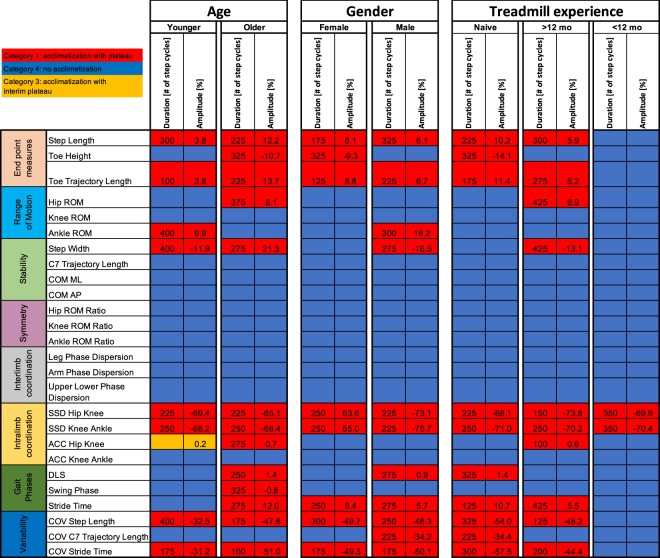
Effects of covariates age, gender and treadmill experience on acclimatization profiles during treadmill walking. Acclimatization of the twenty-six key walking parameters was characterized in three subgroup analyses. Stable parameters without any acclimatization are marked for each subgroup in blue (category 4, see methods), whereas walking parameters revealing acclimatization resulting in a stable plateau performance are illustrated in red (category 1). The duration of acclimatization (i.e. time to reach a stable plateau) is indicated for all subgroups in number of strides and seconds. Relative and absolute amplitudes of adaptations are provided to assess the extent of acclimatization. Reltative amplitudes (highest difference to first bin) of acclimatization are provided in percent. For the parameters with % as unit (DLS, swing phase), relative amplitudes represent the absolute difference to the first bin (i.e. absolute differences do not exist for these parameters). Abbreviations: Abs.: absolute; au: arbitrary units; ACC: angular component of coefficient of correspondence; COM: centre of mass; COV: coefficient of variation; DLS: double limb support; ROM: range of motion; Rel.: relative; SSD: sum of squared distances.

References

    1. Hulet C, Hurwitz DE, Andriacchi TP, Galante JO, Vielpeau C. Functional gait adaptations in patients with painful hip. Rev. Chir. Orthop. Reparatrice Appar. Mot. 2000;86:581–589. - PubMed
    1. Stolze H, et al. Prevalence of Gait disorders in hospitalized neurological patients. Mov. Disord. 2005;20:89–94. doi: 10.1002/mds.20266. - DOI - PubMed
    1. Verghese J, et al. Epidemiology of gait disorders in community-residing older adults. J. Am. Geriatr. Soc. 2006;54:255–261. doi: 10.1111/j.1532-5415.2005.00580.x. - DOI - PMC - PubMed
    1. Gschwind YJ, Bridenbaugh SA, Kressig RW. Gait Disorders and Falls. GeroPsych (Bern). 2010;23:21–32. doi: 10.1024/1662-9647/a000004. - DOI
    1. Bloem BR, Hausdorff JM, Visser JE, Giladi N. Falls and freezing of Gait in Parkinson’s disease: A review of two interconnected, episodic phenomena. Movement Disorders. 2004;19:871–884. doi: 10.1002/mds.20115. - DOI - PubMed

Publication types