Review
. 2019 Oct;56(10):6736-6755.
doi: 10.1007/s12035-019-1568-4. Epub 2019 Mar 27.

Dysregulation of CRMP2 Post-Translational Modifications Drive Its Pathological Functions

Affiliations
Review

Dysregulation of CRMP2 Post-Translational Modifications Drive Its Pathological Functions

Aubin Moutal et al. Mol Neurobiol. 2019 Oct.

Abstract

Collapsin response mediator proteins (CRMPs) are a family of ubiquitously expressed, homologous phosphoproteins best known for coordinating cytoskeletal formation and regulating cellular division, migration, polarity, and synaptic connection. CRMP2, the most studied of the five family members, is best known for its affinity for tubulin heterodimers and function in regulating the microtubule network. These functions are tightly regulated by post-translational modifications including phosphorylation, SUMOylation, oxidation, and O-GlcNAcylation. While CRMP2's physiological functions rely mostly on its non-phosphorylated state, dysregulation of CRMP2 phosphorylation and SUMOylation has been reported to be involved in the pathophysiology of multiple diseases including cancer, chronic pain, spinal cord injury, neurofibromatosis type 1, and others. Here, we provide a consolidated update on what is known about CRMP2 signaling and function, first focusing on axonal growth and neuronal polarity, then illustrating the link between dysregulated CRMP2 post-translational modifications and diseases. We additionally discuss the roles of CRMP2 in non-neuronal cells, both in the CNS and regions of the periphery. Finally, we offer thoughts on the therapeutic implications of modulating CRMP2 function in a variety of diseases.

Keywords: Alzheimer’s disease; CRMP2; Cancer; Chronic pain; Human disease; Interactome; Multiple sclerosis; Neurite outgrowth; Non-neuronal cells; Post-translational modifications; Stroke; Therapeutics.


Conflict of interest statement

Conflict of interest – There is no conflict of interest for any of the authors.

Figures

Figure 1.
Figure 1.. Schematic representation of DPYSL2 gene across species.
The intron/exon DPYSL2 gene organization is shown for the indicated species. Each alternative splicing product is identified by its Ensembl ID and corresponding Uniprot ID. Protein length was extracted from Uniprot. The red boxes indicate the alternative Exon 1 specific to each mRNA isoform. The amino-acid sequence shows the positions of known CRMP2 post-translational modifications, color-coded to indicate the exon carrying the modified amino-acid. When known, the enzyme responsible for each modification is indicated.
Figure 2.
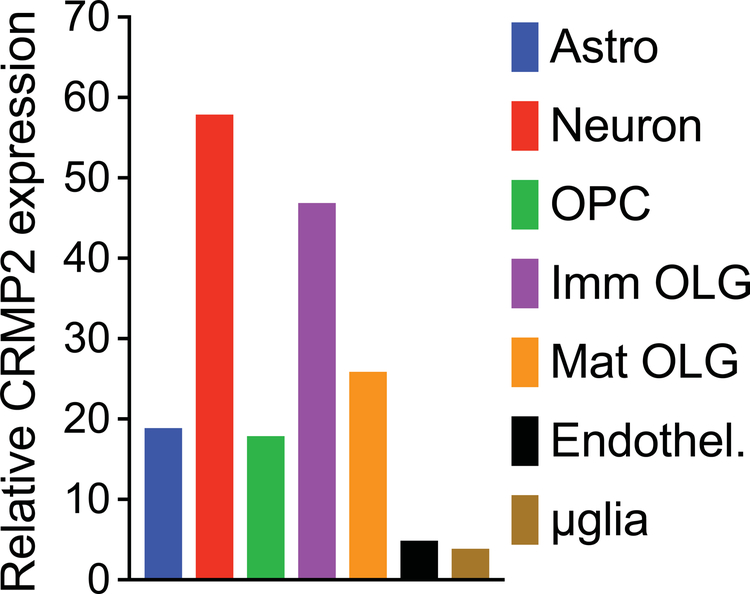
Figure 2.. Relative CRMP isoform mRNA expression in neural cell types determined by RNA-seq analysis.
RNA-seq was carried out using highly enriched cell populations isolated from healthy adult mouse brain [42]. The expression level is plotted relative to the level of CRMP2 in neurons which is set to 100%. After neurons, the 2nd most abundant cell source are immature oligodendrocytes (Imm OLGs) at about 80% of that in neurons, followed by mature myelinating OLGs (Mat OLG, about 45% of that in neurons). Astrocyte and OLG progenitor cell (OPC) expression is about 30% that of neurons, while expression in endothelial cells and microglia is the lowest, roughly 10% that of neurons. The level of CRMP2 measured in neurons was 59.9 FPKM (Fragments Per Kilobase of transcript per Million mapped reads). For comparison, the FPKM for several housekeeping genes were 1,733 for α-tubulin, 334 for β3-tubulin, and 323 for β-actin.
Figure 3.
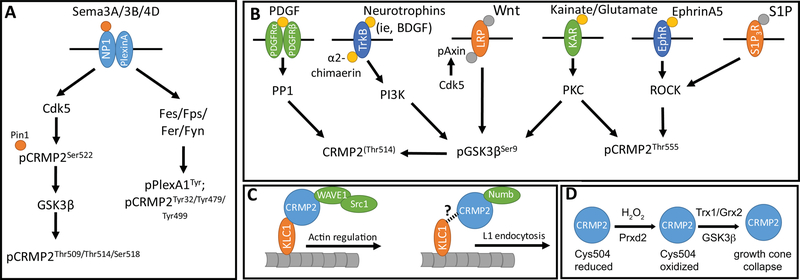
Figure 3.. Summary of signaling cascades regulating CRMP2 microtubule dynamics.
(A) Description of Semaphorin mediated signaling, resulting in 1) CDK5 and GSK3β mediated pCRMP2 (stabilized by Pin1) and/or 2) Fes/Fps/Fer/Fyn mediated pCRMP2 at tyrosine sites. (B) Description of various signaling pathways that result in 1) the dephosphorylation of CRMP2, 2) the phosphorylation of GSK3β, and/or 3) pCRMP2 at Thr555. (C) CRMP2’s association with Src-1/WAVE1 and kinesin light chain 1 (KLC1) modulates actin remodeling. Numb mediated endocytosis of the adhesion molecule L1 may be shuttled using similar processes. (D) Description of redox regulation of CRMP2, modifying its affinity to thioredoxin (TRX).
Figure 4.
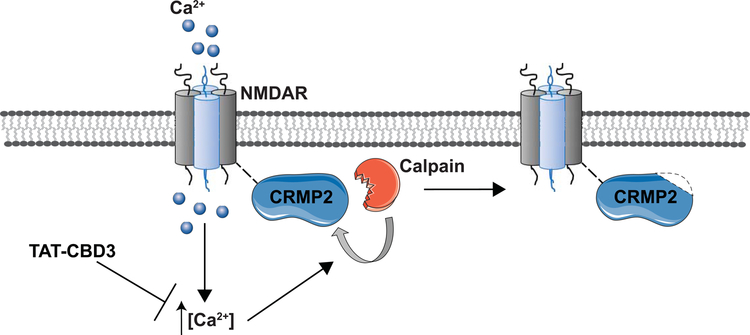
Figure 4.. Overexcitation by glutamate induces an NMDAR-mediated increase in intracellular calcium.
The massive influx of calcium in neurons leads to hyper-activation of deleterious signaling pathway, and thus excitotoxicity. Among the enzymes activated, calpain, a Ca2+ activated protease, cleaves CRMP2. TAT-CBD3 is proposed to prevent the increase in intracellular calcium concentration, preventing CRMP2 cleavage and enhancing NMDAR internalization and thus providing neuroprotection. Adapted from Brittain and colleagues [146].
Figure 5.
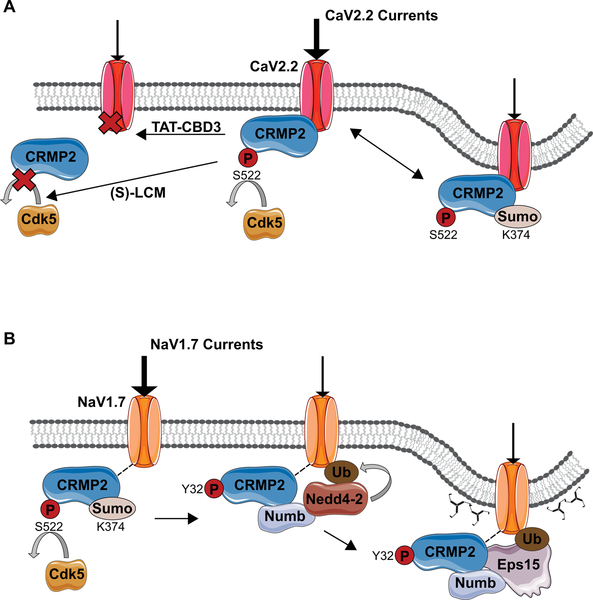
Figure 5.. Regulation of voltage-gated calcium channel CaV2.2 and voltage-gated sodium channel NaV1.7 by CRMP2 post translational modifications.
(A) Regulation of CaV2.2. SUMOylation of CaV2.2 at K374 induces internalization of the channel and thus reduction of CaV2.2 mediated currents. Small molecules and peptides have also been shown to regulates CaV2.2. TAT-CB3 peptide downregulates CaV2.2 by preventing its interaction with CRMP2, while (S)-lacosamide ((S)-LCM)) has a similar effect by preventing phosphorylation of CRMP2 at S522 by Cdk5. Notably, preventing Cdk5-mediated phosphorylation also prevents downstream event such as phosphorylation by GSK3β at T509 and T514 as well as CRMP2 SUMOylation. (B) Blocking CRMP2 SUMOylation a K374 residue, as well as preventing the upstream event Cdk5-mediated phosphorylation at S522, causes a reduction of NaV1.7 membrane content and currents. Fyn-mediated phosphorylation of CRMP2 at Y32 favors binding with Numb and recruitment of Nedd4–2 which mono-ubiquitinates NaV1.7. Numb then recruits the endocytic machinery necessary for clathrin-mediated endocytosis. Adapted from Dustrude [46] and Moutal and co-workers [90].

References

    1. Wang LH, Strittmatter SM (1996) A family of rat CRMP genes is differentially expressed in the nervous system. The Journal of neuroscience : the official journal of the Society for Neuroscience 16 (19):6197–6207 - PMC - PubMed
    1. Tan F, Thiele CJ, Li Z (2014) Collapsin response mediator proteins: Potential diagnostic and prognostic biomarkers in cancers (Review). Oncol Lett 7 (5):1333–1340. doi:10.3892/ol.2014.1909 - DOI - PMC - PubMed
    1. Ip JP, Fu AK, Ip NY (2014) CRMP2: functional roles in neural development and therapeutic potential in neurological diseases. Neuroscientist 20 (6):589–598. doi:10.1177/1073858413514278 - DOI - PubMed
    1. Makihara H, Nakai S, Ohkubo W, Yamashita N, Nakamura F, Kiyonari H, Shioi G, Jitsuki-Takahashi A, Nakamura H, Tanaka F, Akase T, Kolattukudy P, Goshima Y (2016) CRMP1 and CRMP2 have synergistic but distinct roles in dendritic development. Genes to cells : devoted to molecular & cellular mechanisms 21 (9):994–1005. doi:10.1111/gtc.12399 - DOI - PubMed
    1. Fukata Y, Itoh TJ, Kimura T, Menager C, Nishimura T, Shiromizu T, Watanabe H, Inagaki N, Iwamatsu A, Hotani H, Kaibuchi K (2002) CRMP-2 binds to tubulin heterodimers to promote microtubule assembly. Nature cell biology 4 (8):583–591. doi:10.1038/ncb825 - DOI - PubMed

MeSH terms

Substances