Comparison of Biological and Mechanical Prostheses for Heart Valve Surgery: A Systematic Review of Randomized Controlled Trials
- PMID: 30916201
- PMCID: PMC6424027
- DOI: 10.5935/abc.20180272
Comparison of Biological and Mechanical Prostheses for Heart Valve Surgery: A Systematic Review of Randomized Controlled Trials
Abstract
Background: The choice of a mechanical (MP) or biological prosthesis (BP) for patients with valvular heart disease undergoing replacement is still not a consensus.
Objective: We aimed to determine the clinical outcomes of MP or BP placement in those patients.
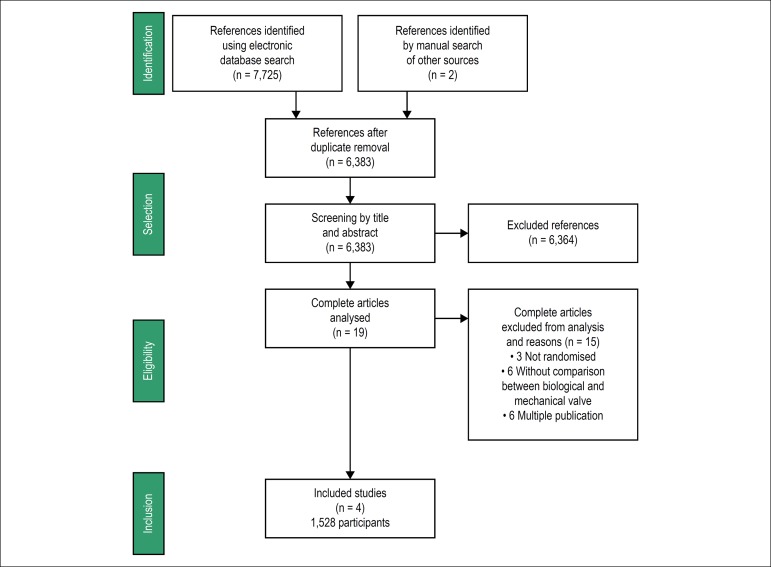
Methods: We conducted a systematic review and meta-analysis of randomized controlled trials (RCTs) that compared biological prostheses and mechanical prostheses in patients with valvular heart diseases and assessed the outcomes. RCTs were searched in the MEDLINE, EMBASE, LILACS, CENTRAL, SCOPUS and Web of Science (from inception to November 2014) databases. Meta-analyses were performed using inverse variance with random effects models. The GRADE system was used to rate the quality of the evidence. A P-value lower than 0.05 was considered significant.
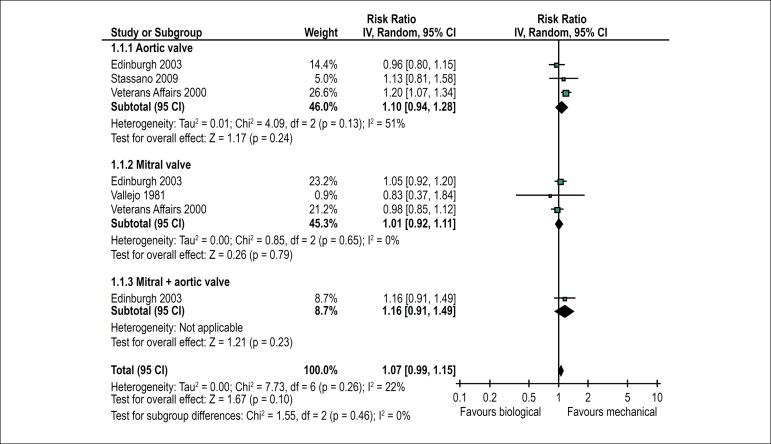
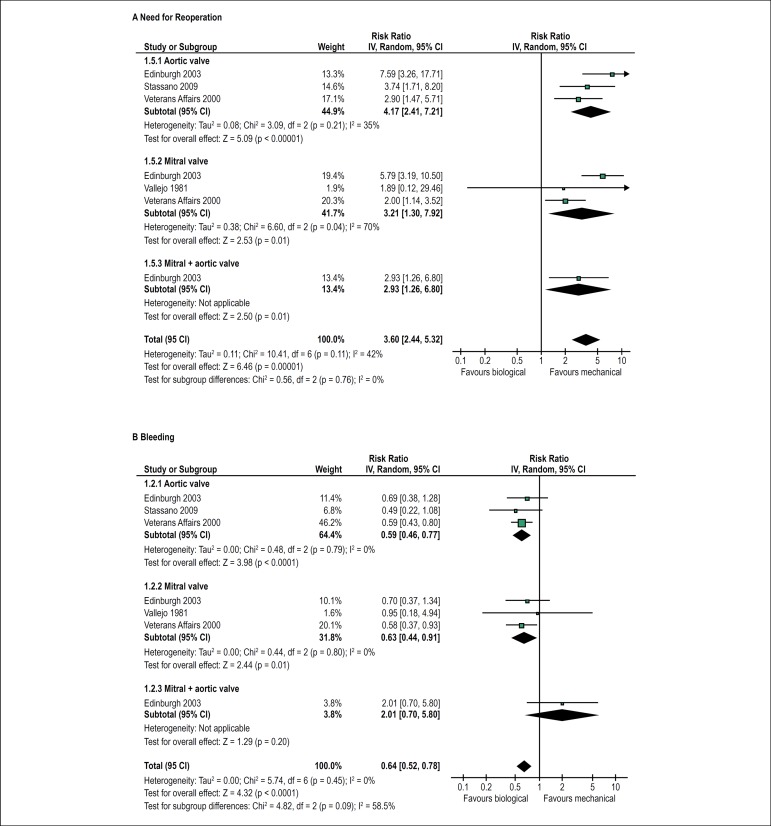
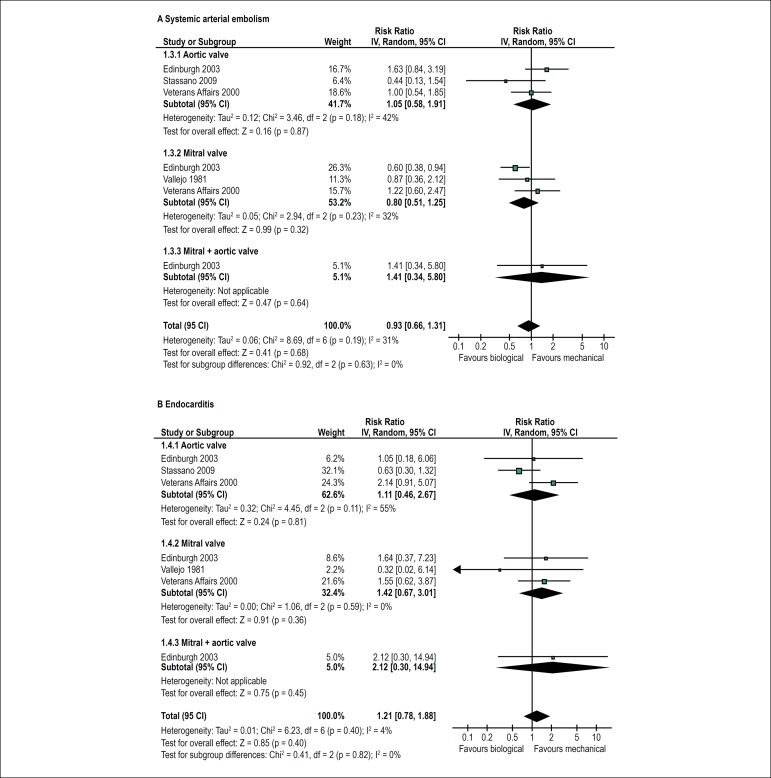
Results: A total of four RCTs were included in the meta-analyses (1,528 patients) with follow up ranging from 2 to 20 years. Three used old generation mechanical and biological prostheses, and one used contemporary prostheses. No significant difference in mortality was found between BP and MP patients (risk ratio (RR = 1.07; 95% CI 0.99-1.15). The risk of bleeding was significantly lower in BP patients than MP patients (RR = 0.64; 95% CI 0.52-0.78); however, reoperations were significantly more frequent in BP patients (RR = 3.60; 95% CI 2.44-5.32). There were no statistically significant differences between BP and MP patients with respect to systemic arterial embolisms and infective endocarditis (RR = 0.93; 95% CI 0.66-1.31, RR = 1.21; CI95% 0.78-1.88, respectively). Results in the trials with modern and old prostheses were similar.
Conclusions: The mortality rate and the risk of thromboembolic events and endocarditis were similar between BP and MP patients. The risk of bleeding was approximately one third lower for BP patients than for MP patients, while the risk of reoperations was more than three times higher for BP patients.
Conflict of interest statement
No potential conflict of interest relevant to this article was reported.
Figures
Comment in
-
How to Choose the Right Valve Prosthesis for My Patient?Arq Bras Cardiol. 2019 Mar;112(3):302-303. doi: 10.5935/abc.20190026. Arq Bras Cardiol. 2019. PMID: 30916193 Free PMC article. No abstract available.
References
-
- Pibarot P, Dumesnil JG. Prosthetic heart valves: selection of the optimal prosthesis and long-term management. Circulation. 2009;19(7):1034–1048. - PubMed
-
- Bonow RO, Carabello B, de Leon AC, Henry EL, Fedderly BJ, Freed MD, et al. Guidelines for the management of patients with valvular heart disease executive summary a report of the American College of Cardiology/American Heart Association Task Force on Practice Guidelines (Committee on Management of Patients With Valvular Heart Disease) Circulation. 1998;98(18):1949–1984. - PubMed
-
- Vahanian A, Baumgartner H, Bax J, Butchart E, Dion R, Filippatos G, et al. Guidelines on the management of valvular heart disease: The task force on the management of valvular heart disease of the European Society of Cardiology. Eur Heart J. 2007;28(2):230–268. - PubMed
-
- Dagenais F, Cartier P, Voisine P, Desaulniers D, Perron J, Baillot R, et al. Which biologic valve should we select for the 45- to 65-year-old age group requiring aortic valve replacement? J Thorac Cardiovasc Surg. 2005;129(5):1041–1049. - PubMed
Publication types
MeSH terms
LinkOut - more resources
Full Text Sources
Medical