


Mobile Phone-Based Use of the Photoplethysmography Technique to Detect Atrial Fibrillation in Primary Care: Diagnostic Accuracy Study of the FibriCheck App
- PMID: 30916656
- PMCID: PMC6456825
- DOI: 10.2196/12284
Mobile Phone-Based Use of the Photoplethysmography Technique to Detect Atrial Fibrillation in Primary Care: Diagnostic Accuracy Study of the FibriCheck App
Abstract
Background: Mobile phone apps using photoplethysmography (PPG) technology through their built-in camera are becoming an attractive alternative for atrial fibrillation (AF) screening because of their low cost, convenience, and broad accessibility. However, some important questions concerning their diagnostic accuracy remain to be answered.
Objective: This study tested the diagnostic accuracy of the FibriCheck AF algorithm for the detection of AF on the basis of mobile phone PPG and single-lead electrocardiography (ECG) signals.
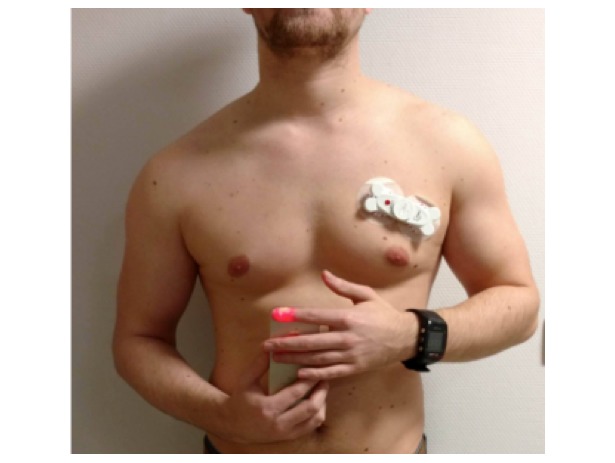
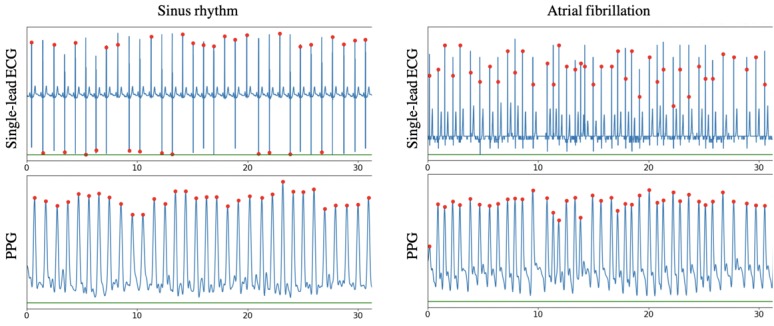
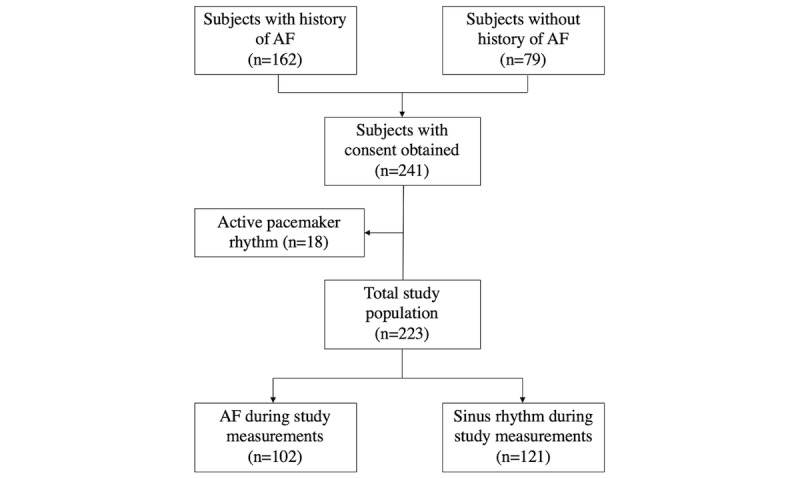
Methods: A convenience sample of patients aged 65 years and above, with or without a known history of AF, was recruited from 17 primary care facilities. Patients with an active pacemaker rhythm were excluded. A PPG signal was obtained with the rear camera of an iPhone 5S. Simultaneously, a single‑lead ECG was registered using a dermal patch with a wireless connection to the same mobile phone. PPG and single-lead ECG signals were analyzed using the FibriCheck AF algorithm. At the same time, a 12‑lead ECG was obtained and interpreted offline by independent cardiologists to determine the presence of AF.
Results: A total of 45.7% (102/223) subjects were having AF. PPG signal quality was sufficient for analysis in 93% and single‑lead ECG quality was sufficient in 94% of the participants. After removing insufficient quality measurements, the sensitivity and specificity were 96% (95% CI 89%-99%) and 97% (95% CI 91%-99%) for the PPG signal versus 95% (95% CI 88%-98%) and 97% (95% CI 91%-99%) for the single‑lead ECG, respectively. False-positive results were mainly because of premature ectopic beats. PPG and single‑lead ECG techniques yielded adequate signal quality in 196 subjects and a similar diagnosis in 98.0% (192/196) subjects.
Conclusions: The FibriCheck AF algorithm can accurately detect AF on the basis of mobile phone PPG and single-lead ECG signals in a primary care convenience sample.
Keywords: algorithm; atrial fibrillation; electrocardiography; mobile phone; photoplethysmography.
©Tine Proesmans, Christophe Mortelmans, Ruth Van Haelst, Frederik Verbrugge, Pieter Vandervoort, Bert Vaes. Originally published in JMIR Mhealth and Uhealth (http://mhealth.jmir.org), 27.03.2019.
Conflict of interest statement
Conflicts of Interest: None declared.
Figures
References
-
- Chugh SS, Roth GA, Gillum RF, Mensah GA. Global burden of atrial fibrillation in developed and developing nations. Glob Heart. 2014 Mar;9(1):113–9. doi: 10.1016/j.gheart.2014.01.004. https://linkinghub.elsevier.com/retrieve/pii/S2211-8160(14)00016-7 S2211-8160(14)00016-7 - DOI - PubMed
-
- Vanbeselaere V, Truyers C, Elli S, Buntinx F, De Witte H, Degryse J, Henrard S, Vaes B. Association between atrial fibrillation, anticoagulation, risk of cerebrovascular events and multimorbidity in general practice: a registry-based study. BMC Cardiovasc Disord. 2016 Mar 28;16:61. doi: 10.1186/s12872-016-0235-1. https://bmccardiovascdisord.biomedcentral.com/articles/10.1186/s12872-01... 10.1186/s12872-016-0235-1 - DOI - PMC - PubMed
-
- Hart RG, Pearce LA, Aguilar MI. Meta-analysis: antithrombotic therapy to prevent stroke in patients who have nonvalvular atrial fibrillation. Ann Intern Med. 2007 Jun 19;146(12):857–67.146/12/857 - PubMed
-
- Furberg CD, Psaty BM, Manolio TA, Gardin JM, Smith VE, Rautaharju PM. Prevalence of atrial fibrillation in elderly subjects (the Cardiovascular Health Study) Am J Cardiol. 1994 Aug 01;74(3):236–41.0002-9149(94)90363-8 - PubMed
MeSH terms
LinkOut - more resources
Full Text Sources
Medical
