


The utility of prognostic indices, early events, and histological subtypes on predicting outcomes in non-follicular indolent B-cell lymphomas
- PMID: 30916801
- PMCID: PMC7137349
- DOI: 10.1002/ajh.25473
The utility of prognostic indices, early events, and histological subtypes on predicting outcomes in non-follicular indolent B-cell lymphomas
Abstract
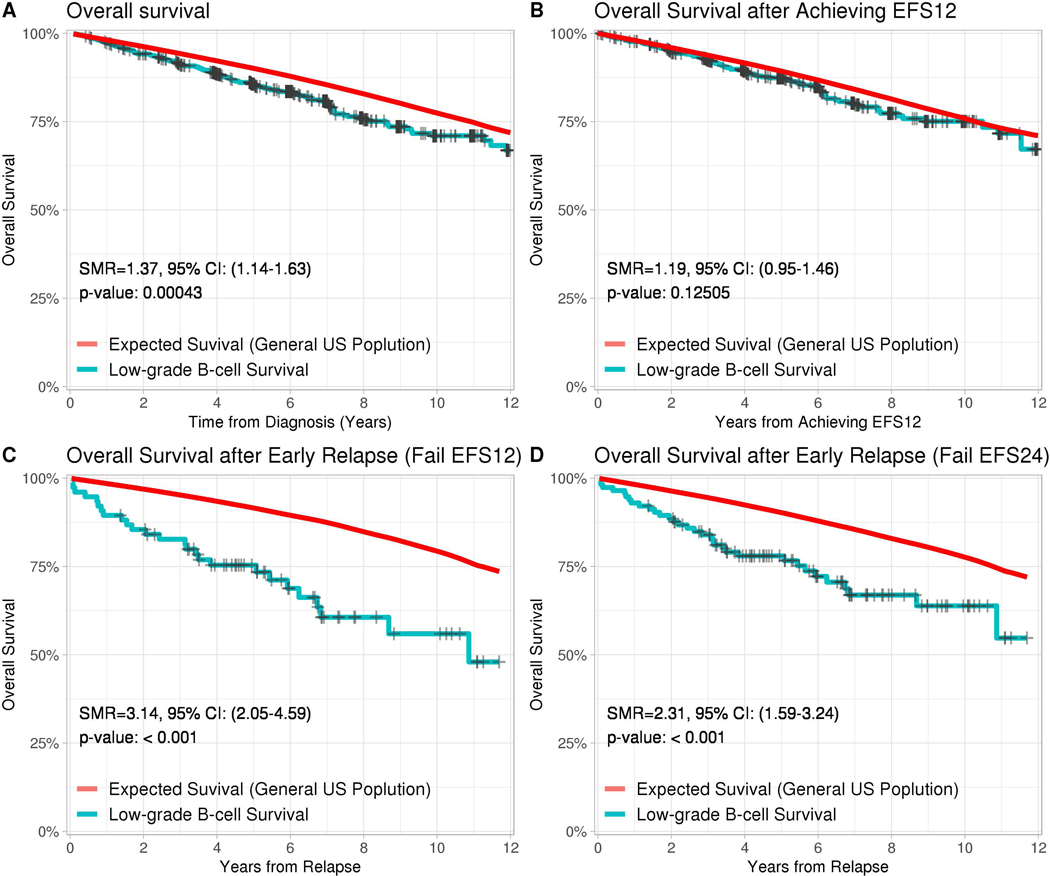
Indolent B-cell lymphomas other than follicular lymphoma account for up to 10% of all B-cell neoplasms. While they typically follow a slowly progressive course, some patients experience rapid progression and early mortality. Prognostic scoring systems have not been adopted, hindering the ability of clinicians or researchers to predict outcomes, or risk-stratify patients during clinical trials. To address this, we evaluated the utility of existing prognostic indices and novel, early disease-related outcomes, to predict subsequent long term survival. Baseline characteristics and outcomes data were generated from a longitudinal cohort study that prospectively enrolled 632 patients newly diagnosed with marginal zone lymphoma, lymphoplasmacytic lymphomas, or B-cell lymphomas not otherwise specified, beginning in 2002. The International Prognostic Index (IPI), Follicular Lymphoma International Prognostic Index (FLIPI), and MALT International prognostic index (MALT-IPI) demonstrated c-statistics that ranged from 0.593-0.612 for event-free survival (EFS), and 0.683-0.714 for overall survival (OS). Patients who attained event-free survival at 12 months (EFS12) experienced similar mortality to the US general population (standardized mortality ratio [SMR] 1.19; 95% CI 0.95-1.46). Patients who did not attain EFS12 had subsequent worse morality (SMR 3.14 (95% CI 2.05-4.59). The MALT-IPI demonstrated utility in predicting subsequent long-term outcomes among patients with non-follicular indolent B-cell lymphomas. This index should be used by clinicians giving guidance to patients at the time of initial diagnosis, and risk stratification during clinical studies. The divergent long-term outcomes experienced by patients who do or do not attain EFS12 suggest there exists a subset of patients who harbor high-risk disease. Future research efforts should focus on methods to identify these patients at the time of diagnosis, in order to enable risk-tailored therapy.
© 2019 Wiley Periodicals, Inc.
Conflict of interest statement
The authors have no conflicts of interest to disclose.
Figures

References
-
- A clinical evaluation of the International Lymphoma Study Group classification of non-Hodgkin’s lymphoma. The Non-Hodgkin’s Lymphoma Classification Project. Blood, 1997. 89(11): p. 3909–18. - PubMed
-
- Solal-Celigny P, et al., Follicular lymphoma international prognostic index. Blood, 2004. 104(5): p. 1258–65. - PubMed
-
- Hoster E, et al., A new prognostic index (MIPI) for patients with advanced-stage mantle cell lymphoma. Blood, 2008. 111(2): p. 558–65. - PubMed
-
- International, C.L.L.I.P.I.w.g., An international prognostic index for patients with chronic lymphocytic leukaemia (CLL-IPI): a meta-analysis of individual patient data. Lancet Oncol, 2016. 17(6): p. 779–790. - PubMed
Publication types
MeSH terms
Grants and funding
LinkOut - more resources
Full Text Sources