Review
. 2020 Jan 15;14(1):20-29.
doi: 10.5009/gnl18486.

Cell Death and Liver Disease

Affiliations
Review

Cell Death and Liver Disease

Satoka Aizawa et al. Gut Liver. .

Abstract

Cell death is now reclassified into several types based on the mechanisms and morphologic phenotype. Understanding of such classifications offers insights into the pathogenesis of liver disease, as well as diagnostic or therapeutic implications. Apoptosis is recognized relatively easily due to its unique morphology, but lytic cell death may occur in the form of accidental necrosis, mitochondria permeability transition-driven necrosis, necroptosis, pyroptosis, ferroptosis, and parthanatos. The cell may be engulfed by neighboring cells due to a loss of integrin signaling or cancer cell competition by entosis, a type of cell death. The classification also includes mechanistically termed cell death such as autophagy-dependent cell death and lysosome-dependent cell death. These different types of cell death may occur uniquely in certain liver diseases but may coexist in the evolution of the disease. They occur in parenchymal and non-parenchymal liver cells, as well as inflammatory cells, causing distinct pathologic consequences. This review briefly covers the recently revised classifications of cell death and discusses their relevance to liver diseases of different etiologies.

Keywords: Apoptosis; Ferroptosis; Mitochondria permeability transition-driven necrosis; Necroptosis; Pyroptosis.


Conflict of interest statement

CONFLICTS OF INTEREST

No potential conflict of interest relevant to this article was reported.

Figures
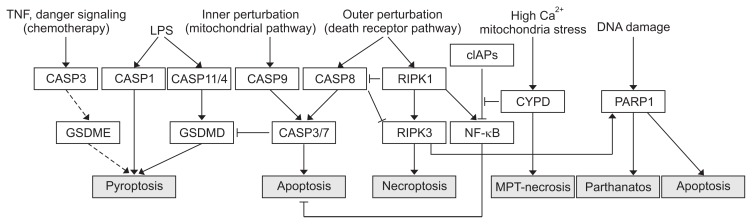
Fig. 1
Fig. 1
A schematic diagram depicting the cross-regulations of different cell death pathways. Solid arrows represent activating interactions, while T-shaped lines represent inhibitory interactions. Hypothesized interactions are represented by dashed line. TNF, tumor necrosis factor; CASP, caspase; GSDME, gasdermin-E; LPS, lipopolysaccharide; RIPK, receptor interacting protein kinase; cIAPs, cellular inhibitor of apoptosis proteins; NF, nuclear factor; CYPD, cyclophilin D; MPT-necrosis, mitochondrial permeability transition necrosis; PARP1, poly (ADP-ribose) polymerase 1.

References

    1. Galluzzi L, Vitale I, Aaronson SA, et al. Molecular mechanisms of cell death: recommendations of the Nomenclature Committee on Cell Death 2018. Cell Death Differ. 2018;25:486–541. doi: 10.1038/s41418-017-0012-4. - DOI - PMC - PubMed
    1. Wang S, Pacher P, De Lisle RC, Huang H, Ding WX. A mechanistic review of cell death in alcohol-induced liver injury. Alcohol Clin Exp Res. 2016;40:1215–1223. doi: 10.1111/acer.13078. - DOI - PMC - PubMed
    1. Luedde T, Kaplowitz N, Schwabe RF. Cell death and cell death responses in liver disease: mechanisms and clinical relevance. Gastroenterology. 2014;147:765–783. doi: 10.1053/j.gastro.2014.07.018. - DOI - PMC - PubMed
    1. Canbay A, Feldstein AE, Higuchi H, et al. Kupffer cell engulfment of apoptotic bodies stimulates death ligand and cytokine expression. Hepatology. 2003;38:1188–1198. doi: 10.1053/jhep.2003.50472. - DOI - PubMed
    1. Canbay A, Higuchi H, Bronk SF, Taniai M, Sebo TJ, Gores GJ. Fas enhances fibrogenesis in the bile duct ligated mouse: a link between apoptosis and fibrosis. Gastroenterology. 2002;123:1323–1330. doi: 10.1053/gast.2002.35953. - DOI - PubMed