. 2019 Mar 27;20(1):65.
doi: 10.1186/s13059-019-1670-y.

Alevin efficiently estimates accurate gene abundances from dscRNA-seq data

Affiliations

Alevin efficiently estimates accurate gene abundances from dscRNA-seq data

Avi Srivastava et al. Genome Biol. .

Abstract

We introduce alevin, a fast end-to-end pipeline to process droplet-based single-cell RNA sequencing data, performing cell barcode detection, read mapping, unique molecular identifier (UMI) deduplication, gene count estimation, and cell barcode whitelisting. Alevin's approach to UMI deduplication considers transcript-level constraints on the molecules from which UMIs may have arisen and accounts for both gene-unique reads and reads that multimap between genes. This addresses the inherent bias in existing tools which discard gene-ambiguous reads and improves the accuracy of gene abundance estimates. Alevin is considerably faster, typically eight times, than existing gene quantification approaches, while also using less memory.

Keywords: Cellular barcode; Quantification; Single-cell RNA-seq; UMI deduplication.


Conflict of interest statement

Ethics approval and consent to participate

Not applicable.

Competing interests

R.P. is a co-founder of Ocean Genomics, Inc. The other authors declare that they have no competing interests.

Publisher’s Note

Springer Nature remains neutral with regard to jurisdictional claims in published maps and institutional affiliations.

Figures

Fig. 1
Fig. 1
Overview of the alevin pipeline. The input to the pipeline are sample-demultiplexed FASTQ files, and there are several steps, outlined here, that are required to process this data and obtain per-cell gene-level quantification estimates. The first step is cell barcode (CB) whitelisting using their frequencies. Barcodes neighboring whitelisted barcodes are then associated with (collapsed into) their whitelisted counterparts. Reads from whitelisted CBs are mapped to the transcriptome, and the UMI-transcript equivalence classes are generated. Each equivalence class contains a set of transcripts, the UMIs that are associated with the reads that map to each class and the read count for each UMI. This information is used to construct a parsimonious UMI graph (PUG) where each node represents a UMI-transcript equivalence class and nodes are connected based on the associated read counts. The UMI deduplication algorithm then attempts to find a minimal set of transcripts that cover the graph (where each consistently labeled connected component—each monochromatic arborescence—is associated with a distinct pre-PCR molecule). In this way, each node is assigned a transcript label and, in turn, an associated gene label. Reads associated with arborescences that could be consistently labeled by multiple genes are divided amongst these possible loci probabilistically based on an expectation-maximization algorithm. Finally, optionally, and if not provided with high-quality CB whitelist externally, an intelligent whitelisting procedure finalizes a list of high-quality CBs using a naïve Bayes classifier to differentiate between high- and low-quality cells
Fig. 2
Fig. 2
a This figure illustrates examples of various classes of UMI collisions and which method(s) would be able to correctly resolve the origin of the multimapping reads in each scenario. These cases are shown top to bottom in order of their likelihood. b A simulated example demonstrates how treating equivalence classes individually during UMI deduplication can lead to under-collapsing of UMIs compared to gene-level methods (especially in protocols where the majority of cDNA amplification occurs prior to fragmentation). In the first row, both methods report correctly two UMIs. In the second row, there are two fragmented molecules aligned against two transcripts from the same gene. The alevin deduplication algorithm will attempt to choose the minimum number of transcripts required to explain the read mappings and hence correctly detect the UMI counts. The equivalence class method will over-estimate the gene count
Fig. 3
Fig. 3
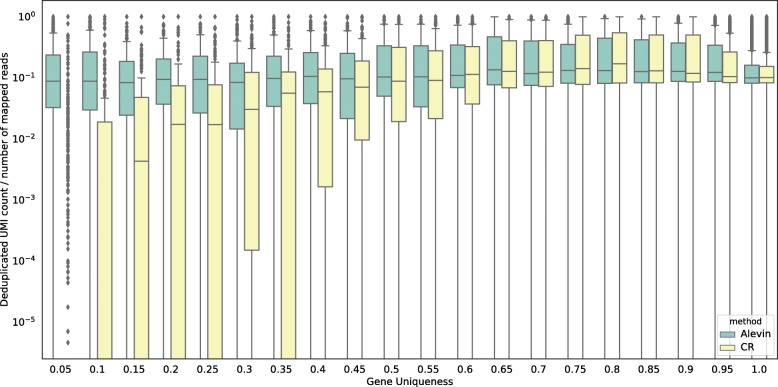
The ratio of the final number of deduplicated UMIs against the number of initial reads for both alevin and Cell Ranger (on the human PBMC 4k dataset) stratified by gene-level sequence uniqueness. The genes are divided into 20 equal sized bins, and the x-axis represents the maximum gene uniqueness in each bin. The plotted ratio for genes that have high sequence similarity with other genes is strongly biased when using Cell Ranger. This is because Cell Ranger will discard a majority (or all) of the reads originating from these genes since they will most likely map to multiple positions across various genes. Alevin, on the other hand, will attempt to accurately assign these reads to their gene of origin. This plot also demonstrates that alevin does not over-count UMIs, which would be the case if deduplication was done at the level of equivalence classes
Fig. 4
Fig. 4
a The Spearman correlation between quantification estimates (summed across all cells) from different scRNA-seq methods against bulk data from the mouse neuronal and human PBMC datasets, stratified by gene sequence uniqueness. The bar plot on the top of each figure shows the percentage of genes in each bin that have unique read evidence. Tier 1 is the set of genes with only uniquely mapping reads. Tier 2 is genes that have ambiguously mapping reads, but are connected to unique read evidence that can be used to resolve the multimapping reads. Tier 3 is genes that are completely ambiguous. Note that all methods perform very similarly on genes from tier 1, but the performance of alevin is much better for the other tiers. b Comparison of various methods used to process Drop-seq data from mouse retina with 4k cells. The Spearman correlation is calculated against bulk quantification estimates predicted using Bowtie2 and RSEM on data from the same cell type
Fig. 5
Fig. 5
Expression of the Hba and Hbb genes as predicted by alevin and Cell Ranger in mouse neuronal cells. The title of each plot is the name of the gene and its k-mer uniqueness ratio. Note that Cell Ranger systematically under-estimates the expression of these genes compared to alevin. This bias is greater for the Hba genes, which have a lower uniqueness ratio, and therefore, a greater number of multimapping reads
Fig. 6
Fig. 6
Expression of the YIPF6 gene (which has a high uniqueness ratio) as predicted by alevin and Cell Ranger in the PBMC8k data
Fig. 7
Fig. 7
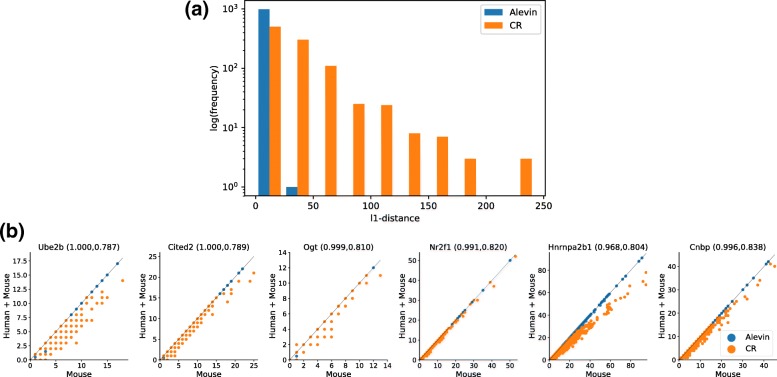
a Histogram of the 1 distance between the quantification estimates of tools on the mouse neuron 900 data, when run using different references for quantification (just mouse versus mouse and human). Results are presented for both alevin and Cell Ranger. Since, in reality, all reads are expected to originate from mouse, deviations from quantifications under the only mouse reference signify misestimation—often due to the introduction of sequence-similar genes in the human genome. Alevin is able to resolve this ambiguity well, while Cell Ranger instead discards such reads, leading to different quantification estimates under the two references. b Counts for the topmost genes that have high sequence homology between human and mouse but are sequence unique in the mouse reference. The title of each plot is the gene name along with the sequence uniqueness ratio under just the mouse reference and under the joint reference. Hence, the Cell Ranger counts decrease across cells when the gene uniqueness decreases. Note that these genes were filtered such that they have > 100 count difference for either alevin or Cell Ranger when summed across all cells
Fig. 8
Fig. 8
The time and memory performance of the different pipelines on the five datasets. Alevin requires significantly less time and memory than the other pipelines. Note that for Cell Ranger, the memory plotted is the lower bound, which is the size of the index and the actual memory usage can be much higher

References

    1. Macosko EZ. Basu A. Satija R. Nemesh J. Shekhar K. Goldman M et al. Highly parallel genome-wide expression profiling of individual cells using nanoliter droplets. Cell. 2015;161(5):1202–14. doi: 10.1016/j.cell.2015.05.002. - DOI - PMC - PubMed
    1. Klein AM. Mazutis L. Akartuna I. Tallapragada N. Veres A. Li V et al. Droplet barcoding for single-cell transcriptomics applied to embryonic stem cells. Cell. 2015;161(5):1187–201. doi: 10.1016/j.cell.2015.04.044. - DOI - PMC - PubMed
    1. Zheng GX, Terry JM, Belgrader P, Ryvkin P, Bent ZW, Wilson R, et al. Massively parallel digital transcriptional profiling of single cells. Nat Commun. 2017;8:14049. doi: 10.1038/ncomms14049. - DOI - PMC - PubMed
    1. Svensson V, Natarajan KN, Ly LH, Miragaia RJ, Labalette C, Macaulay IC, et al. Power analysis of single-cell RNA-sequencing experiments. Nat Methods. 2017;14(4):381. doi: 10.1038/nmeth.4220. - DOI - PMC - PubMed
    1. Smith T, Heger A, Sudbery I. UMI-tools: modeling sequencing errors in Unique Molecular Identifiers to improve quantification accuracy. Genome Res. 2017;27(3):491–9. doi: 10.1101/gr.209601.116. - DOI - PMC - PubMed

Publication types