. 2019 May 29;93(12):e00023-19.
doi: 10.1128/JVI.00023-19. Print 2019 Jun 15.

High-Throughput Screening and Identification of Potent Broad-Spectrum Inhibitors of Coronaviruses

Affiliations

High-Throughput Screening and Identification of Potent Broad-Spectrum Inhibitors of Coronaviruses

Liang Shen et al. J Virol. .

Abstract

Coronaviruses (CoVs) act as cross-species viruses and have the potential to spread rapidly into new host species and cause epidemic diseases. Despite the severe public health threat of severe acute respiratory syndrome coronavirus and Middle East respiratory syndrome CoV (MERS-CoV), there are currently no drugs available for their treatment; therefore, broad-spectrum inhibitors of emerging and endemic CoVs are urgently needed. To search for effective inhibitory agents, we performed high-throughput screening (HTS) of a 2,000-compound library of approved drugs and pharmacologically active compounds using the established genetically engineered human CoV OC43 (HCoV-OC43) strain expressing Renilla luciferase (rOC43-ns2Del-Rluc) and validated the inhibitors using multiple genetically distinct CoVs in vitro We screened 56 hits from the HTS data and validated 36 compounds in vitro using wild-type HCoV-OC43. Furthermore, we identified seven compounds (lycorine, emetine, monensin sodium, mycophenolate mofetil, mycophenolic acid, phenazopyridine, and pyrvinium pamoate) as broad-spectrum inhibitors according to their strong inhibition of replication by four CoVs in vitro at low-micromolar concentrations. Additionally, we found that emetine blocked MERS-CoV entry according to pseudovirus entry assays and that lycorine protected BALB/c mice against HCoV-OC43-induced lethality by decreasing viral load in the central nervous system. This represents the first demonstration of in vivo real-time bioluminescence imaging to monitor the effect of lycorine on the spread and distribution of HCoV-OC43 in a mouse model. These results offer critical information supporting the development of an effective therapeutic strategy against CoV infection.IMPORTANCE Currently, there is no approved therapy to treat coronavirus infection; therefore, broad-spectrum inhibitors of emerging and endemic CoVs are needed. Based on our high-throughput screening assay using a compound library, we identified seven compounds with broad-spectrum efficacy against the replication of four CoVs in vitro Additionally, one compound (lycorine) was found to protect BALB/c mice against HCoV-OC43-induced lethality by decreasing viral load in the central nervous system. This inhibitor might offer promising therapeutic possibilities for combatting novel CoV infections in the future.

Keywords: Coronaviruses; bioluminescence imaging; broad-spectrum; high-throughput screening; inhibitor; mice.


Figures

FIG 1
FIG 1
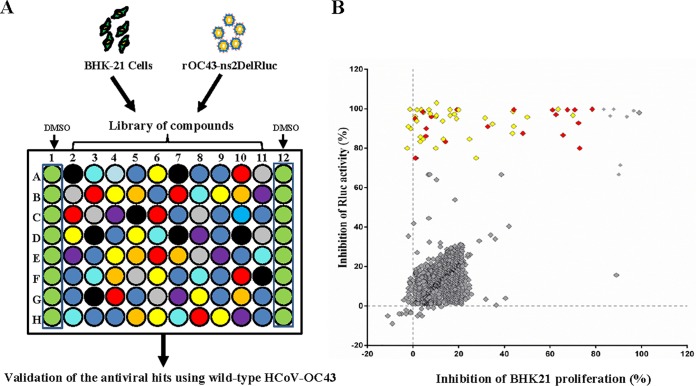
Screening for anti-HCoV-OC43 compounds. (A) Schematic of the HTS assay. BHK-21 cells were seeded in 96-well plates, and after a 24-h incubation (∼10,000 cells/well), the medium was replaced with 94 μl DMEM supplemented with 3% FBS. The cells were treated in triplicate with 1 μl of each compound (diluted in DMSO) at a final concentration of 10 μM. After 1 h, 5 μl of rOC43-ns2Del-Rluc was added, and the cells were cultured for an additional 72 h, after which Rluc activity, represented as relative light units (RLUs), was measured. Screened compounds were confirmed using HCoV-OC43-WT. (B) Overview of HTS and the confirmation assay. All compounds and their corresponding activity are represented by squares. The percentage inhibition of Rluc activity of rOC43-ns2Del-Rluc is displayed along the vertical axis versus the percentage inhibition of BHK-21 proliferation displayed along the horizontal axis. Compounds exhibiting >70% inhibition of Rluc activity and <80% cytotoxicity were considered effective inhibitors of rOC43-ns2Del-Rluc and are displayed in red and yellow (yellow squares represent the compounds screened in the HTS using rOC43-ns2Del-Rluc and confirmed using HCoV-OC43-WT), with the ineffective compounds displayed in gray. Data represent the mean ± standard deviation of the results of three replicates. The screening assay was repeated at least three times.
FIG 2
FIG 2
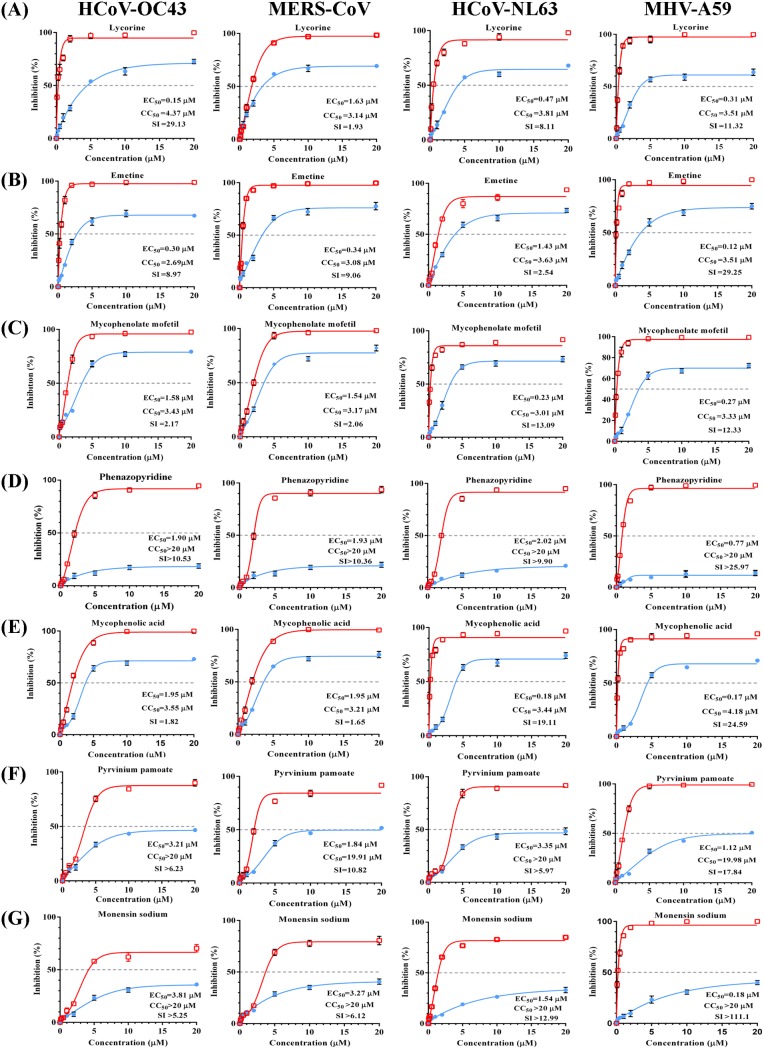
Dose-response curves for seven broad-spectrum inhibitors of four types of CoVs in vitro. BHK-21, Vero E6, LLC-MK2, or DBT cells were infected with HCoV-OC43-WT, MERS-CoV, HCoV-NL63, or MHV-A59 at an MOI of 0.01, respectively, and treated for 72 h with eight doses (0.1, 0.25, 0.5, 1, 2, 5, 10, or 20 μM) of lycorine (A), emetine (B), mycophenolate mofetil (C), phenazopyridine (D), mycophenolic acid (E), pyrvinium pamoate (F), or monensin sodium (G). At 72 h postinfection, the cell culture supernatants were subjected to a viral load assay, and cell lysates were assessed for cytotoxicity. Percent inhibition was calculated as follows: inhibition of viral load (%) = 100% − [viral load (titers or copies) of each CoV in the compound-treated cells/viral load of DMSO-treated control cells]. Inhibition is shown in red, and cytotoxicity is shown in blue. EC50 values and SI (CC50/EC50) are shown. Data represent the mean ± standard deviation (error bars) of the results of three independent experiments.
FIG 3
FIG 3
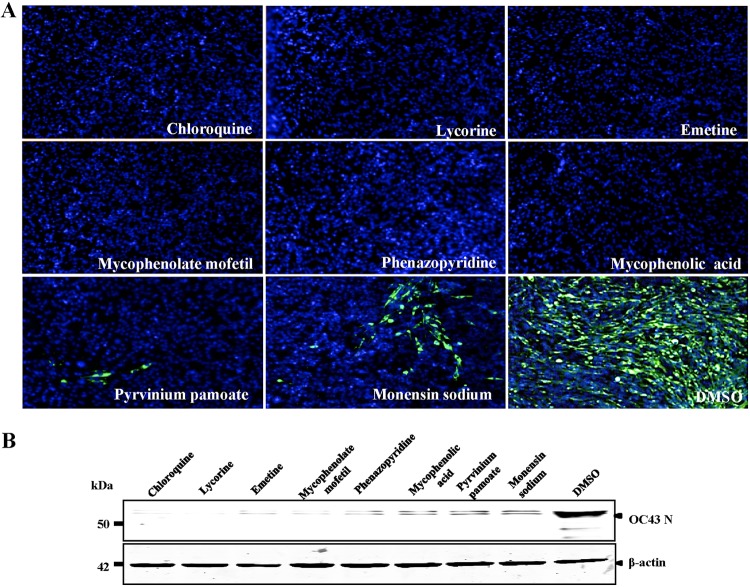
Confirmation of anti-CoV activity by IFA and Western blot analysis. (A) IFA of the HCoV-OC43 nucleocapsid (N) protein in inhibitor-treated BHK-21 cells. BHK-21 cells in 96-well plates were infected with HCoV-OC43-WT (MOI = 0.01) in the presence of 10 μM the indicated inhibitors, with chloroquine and DMSO used as the positive and negative controls, respectively. At 72 h postinfection, the cells were analyzed by IFA for N protein (green) expression. Nuclei (blue) were stained with DAPI. (B) The effect of the inhibitors on N protein synthesis by HCoV-OC43-WT was determined by Western blot analysis. BHK-21 cells in 12-well plates were infected with HCoV-OC43-WT (MOI = 0.01) in the presence of 10 μM the indicated inhibitors, with chloroquine and DMSO used as the positive and negative controls, respectively. At 72 h postinfection, cells were analyzed by Western blotting using antibodies against HCoV-OC43 N protein and β-actin.
FIG 4
FIG 4
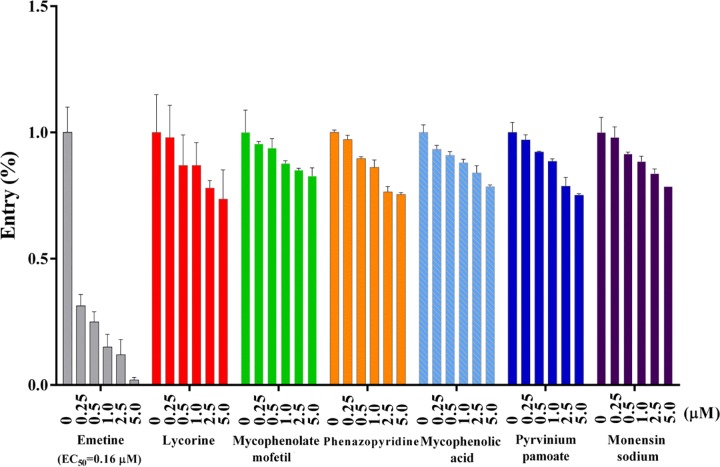
Emetine strongly inhibits MERS-CoV entry. DPP4-expressing Huh7.5 cells were cultured with 200 TCID50 pseudotyped MERS-CoV in the presence of serial concentrations of individual inhibitors. The percentage of viral entry was calculated by measuring the luciferase expression of the inhibitor-treated cells relative to that in DMSO-treated cells. Data represent the mean ± standard deviation of the results of three replicates.
FIG 5
FIG 5
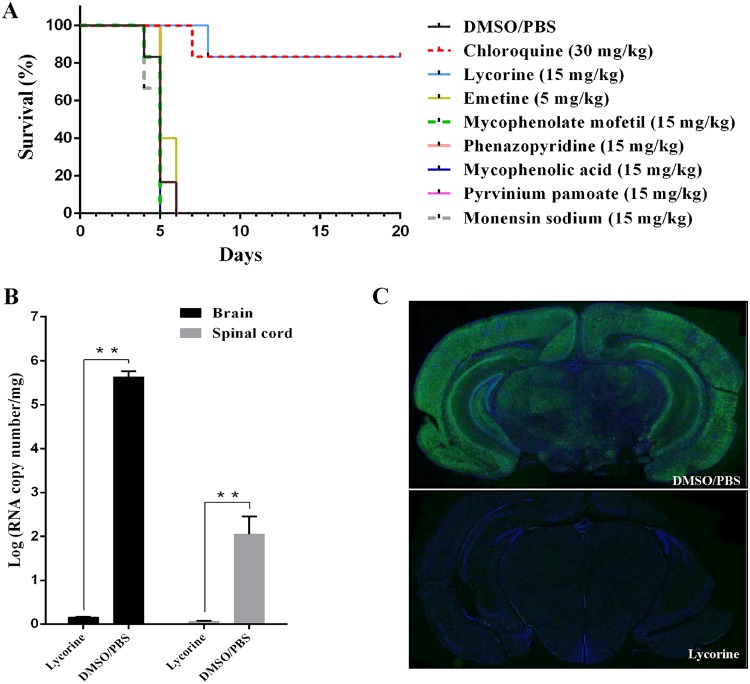
Lycorine protects mice against HCoV-OC43 infection. (A) Kaplan-Meier survival curves of mice >20 days after intranasal inoculation of HCoV-OC43, followed by treatment with the indicated inhibitors (n =6/group). Inhibitor doses and regimens were selected based on their acute toxicity (emetine was used at 5 mg/kg, chloroquine was used at 30 mg/kg, and the other inhibitors were used at 15 mg/kg). (B) Viral loads in the mouse brain and spinal cord treated with lycorine. Twelve-day-old female BALB/c mice were inoculated via the intranasal route with 100 TCID50 HCoV-OC43-WT and treated with lycorine or DMSO control for 3 days. At 72 h postinfection, viral loads in the mouse brain and spinal cord were determined by qRT-PCR. Data represent the mean ± standard deviation (error bars) of the results of three independent experiments. (C) IHC analyses of brain tissue from mice treated with lycorine. Twelve-day-old female BALB/c mice were inoculated via the intranasal route with 100 TCID50 HCoV-OC43-WT and treated with lycorine or DMSO control for 3 days. Mouse brain coronal sections were stained for HCoV-OC43 N (green) and nuclei (blue).
FIG 6
FIG 6
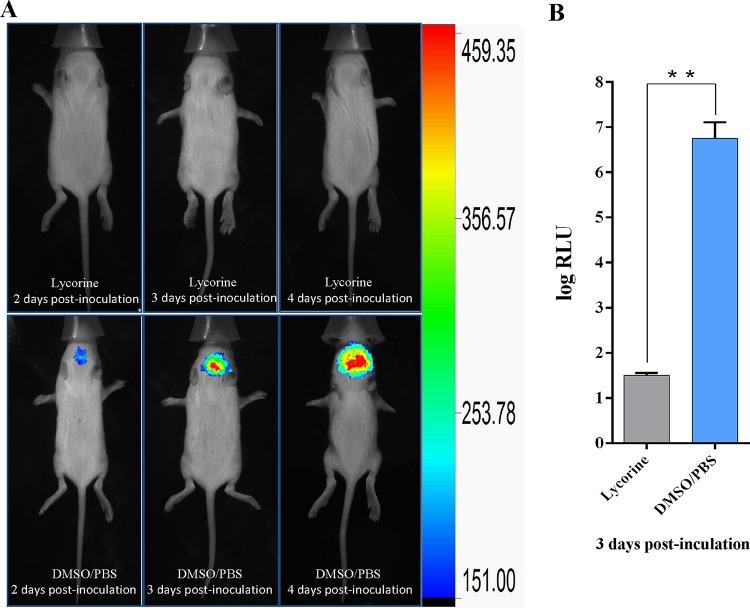
Lycorine inhibits the spread of rOC43-ns2Del-Rluc in the mouse brain. (A) Representative dorsal images of 12-day-old female BALB/c mice administered 15 mg/kg lycorine in DMSO-PBS or DMSO-PBS alone daily after inoculation with rOC43-ns2Del-Rluc. At 2, 3, and 4 days postinoculation, mice were processed for BLI, with the results are displayed as a heat map. (B) Rluc activity of rOC43-ns2Del-Rluc in the mouse brain at 72 h postinoculation. Data represent the mean ± standard deviation (error bars) of the results of three independent experiments. **, P < 0.01.

References

    1. Saberi A, Gulyaeva AA, Brubacher JL, Newmark PA, Gorbalenya AE. 2018. A planarian nidovirus expands the limits of RNA genome size. PLoS Pathog 14:e1007314. doi: 10.1371/journal.ppat.1007314. - DOI - PMC - PubMed
    1. Woo PC, Lau SK, Huang Y, Yuen KY. 2009. Coronavirus diversity, phylogeny and interspecies jumping. Exp Biol Med (Maywood) 234:1117–1127. doi: 10.3181/0903-MR-94. - DOI - PubMed
    1. Zaki AM, van Boheemen S, Bestebroer TM, Osterhaus AD, Fouchier RA. 2012. Isolation of a novel coronavirus from a man with pneumonia in Saudi Arabia. N Engl J Med 367:1814–1820. doi: 10.1056/NEJMoa1211721. - DOI - PubMed
    1. Eckerle LD, Becker MM, Halpin RA, Li K, Venter E, Lu X, Scherbakova S, Graham RL, Baric RS, Stockwell TB, Spiro DJ, Denison MR. 2010. Infidelity of SARS-CoV Nsp14-exonuclease mutant virus replication is revealed by complete genome sequencing. PLoS Pathog 6:e1000896. doi: 10.1371/journal.ppat.1000896. - DOI - PMC - PubMed
    1. Pyrc K, Dijkman R, Deng L, Jebbink MF, Ross HA, Berkhout B, van der Hoek L. 2006. Mosaic structure of human coronavirus NL63, one thousand years of evolution. J Mol Biol 364:964–973. doi: 10.1016/j.jmb.2006.09.074. - DOI - PMC - PubMed

Publication types

MeSH terms

LinkOut - more resources