. 2019 May 29;93(12):e00225-19.
doi: 10.1128/JVI.00225-19. Print 2019 Jun 15.

Identification of CP77 as the Third Orthopoxvirus SAMD9 and SAMD9L Inhibitor with Unique Specificity for a Rodent SAMD9L

Affiliations

Identification of CP77 as the Third Orthopoxvirus SAMD9 and SAMD9L Inhibitor with Unique Specificity for a Rodent SAMD9L

Fushun Zhang et al. J Virol. .

Abstract

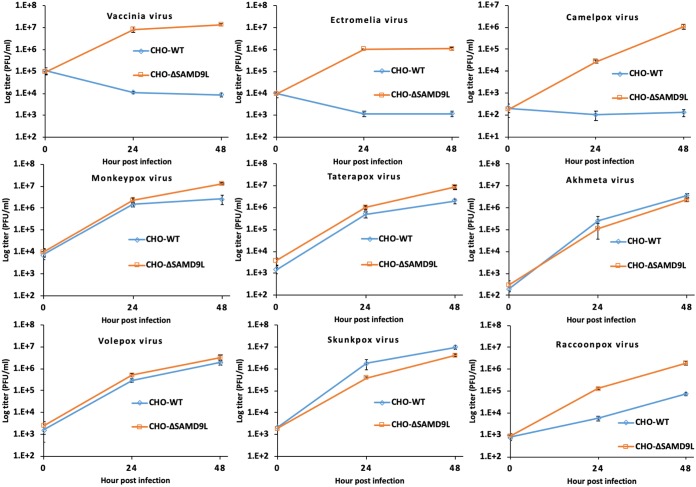
Orthopoxviruses (OPXVs) have a broad host range in mammalian cells, but Chinese hamster ovary (CHO) cells are nonpermissive for vaccinia virus (VACV). Here, we revealed a species-specific difference in host restriction factor SAMD9L as the cause for the restriction and identified orthopoxvirus CP77 as a unique inhibitor capable of antagonizing Chinese hamster SAMD9L (chSAMD9L). Two known VACV inhibitors of SAMD9 and SAMD9L (SAMD9&L), K1 and C7, can bind human and mouse SAMD9&L, but neither can bind chSAMD9L. Clustered regularly interspaced short palindromic repeat (CRISPR)-Cas9 knockout of chSAMD9L from CHO cells removed the restriction for VACV, while ectopic expression of chSAMD9L imposed the restriction for VACV in a human cell line, demonstrating that chSAMD9L is a potent restriction factor for VACV. In contrast to K1 and C7, cowpox virus CP77 can bind chSAMD9L and rescue VACV replication in cells expressing chSAMD9L, indicating that CP77 is yet another SAMD9L inhibitor but has a unique specificity for chSAMD9L. Binding studies showed that the N-terminal 382 amino acids of CP77 were sufficient for binding chSAMD9L and that both K1 and CP77 target a common internal region of SAMD9L. Growth studies with nearly all OPXV species showed that the ability of OPXVs to antagonize chSAMD9L correlates with CP77 gene status and that a functional CP77 ortholog was maintained in many OPXVs, including monkeypox virus. Our data suggest that a species-specific difference in rodent SAMD9L poses a barrier for cross-species OPXV infection and that OPXVs have evolved three SAMD9&L inhibitors with different specificities to overcome this barrier.IMPORTANCE Several OPXV species, including monkeypox virus and cowpox virus, cause zoonotic infection in humans. They are believed to use wild rodents as the reservoir or intermediate hosts, but the host or viral factors that are important for OPXV host range in rodents are unknown. Here, we showed that the abortive replication of several OPXV species in a Chinese hamster cell line was caused by a species-specific difference in the host antiviral factor SAMD9L, suggesting that SAMD9L divergence in different rodent species poses a barrier for cross-species OPXV infection. While the Chinese hamster SAMD9L could not be inhibited by two previously identified OPXV inhibitors of human and mouse SAMD9&L, it can be inhibited by cowpox virus CP77, indicating that OPXVs encode three SAMD9&L inhibitors with different specificities. Our data suggest that OPXV host range in broad rodent species depends on three SAMD9&L inhibitors with different specificities.

Keywords: host range; host restriction factor; poxvirus; vaccinia virus.


Figures

FIG 1
FIG 1
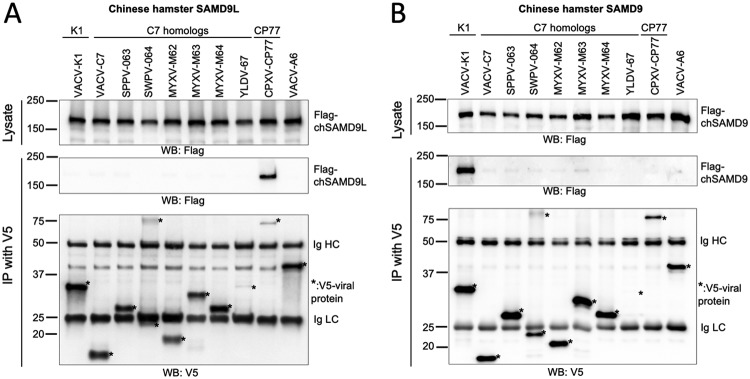
Only CPXV CP77 can bind Chinese hamster SAMD9L, while only VACV K1 can bind Chinese hamster SAMD9. 293FT cells were transfected with a plasmid expressing Flag-tagged chSAMD9L (A) or chSAMD9 (B) and infected with a panel of vK1C7-derived VACVs that expressed different V5-tagged viral proteins. A virus expressing VACV-A6, a viral protein involved in viral assembly, was used as a negative control. The cell lysates were immunoprecipitated with anti-V5 antibody. Epitope-tagged proteins in the cell lysate and precipitate were detected with anti-Flag or anti-V5 antibody in Western blotting (WB). The heavy and light chains of the precipitated antibody (Ig HC and LC) served as loading controls. *, V5-tagged proteins.
FIG 2
FIG 2
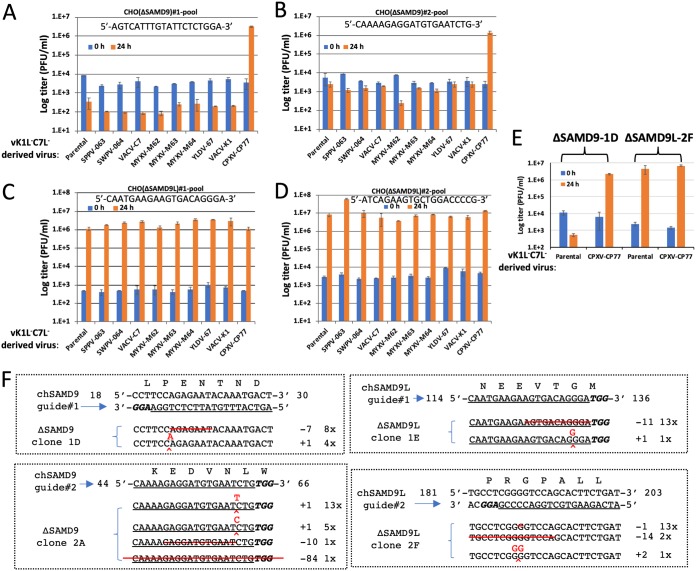
The restriction of VACV by CHO cells can be abolished by knocking out chSAMD9L. (A to D) CHO cells were transduced with lentiviral vectors expressing Cas9 and a guide sequence targeting either chSAMD9 (A and B) or chSAMD9L (C and D). For each gene, two independent KOs with different guide sequences (1 [A and C] and 2 [B and D]) were performed, and the KO cell pools were infected with the panel of vK1C7-derived VACVs at a multiplicity of infection (MOI) of 1 PFU/cell. Viral titers at 0 and 24 h postinfection (hpi) were measured by plaque assay in Vero cells. (E) Several KO cell clones were isolated from the cell pools. Infection studies were performed on the cell clones, and the results were similar to those shown in panels A to D. Representative data with the ΔSAMD9-1D clone and the ΔSAMD9L-2F clone are shown. (F) The genotypes of the cell clones were determined by sequencing. The guide sequence is underlined, and the protospacer-adjacent motif (PAM) sequence is in bold italics. The starting and ending positions of the guide in the ORF and the encoded amino acid sequence are also shown. Shown below the target are the genomic sequences from cell clones. Red lines, deletions; ^, insertion. The numbers after the + and − denote the number of indels, and the number before the “x” denotes the number of times the sequence was detected from a total of 10 to 20 cloned PCR products.
FIG 3
FIG 3
The block in viral protein synthesis in CHO cells can be abolished by knocking out chSAMD9L. BSC40 cells and the parental and ΔSAMD9L (Δ9L, 2F clone) CHO cells were infected with VACVs that expressed a luciferase reporter under the control of either the synthetic early/late (E/L) promoter or the late p11 promoter in the presence or absence of AraC. The cells were lysed after either 8 h (A) or 24 h (B) of infection, and luciferase (LUC) activities were measured.
FIG 4
FIG 4
Expression of chSAMD9L in human cells is sufficient for recapitulating the poxvirus restriction property of CHO cells. (A) A stable human BT20 cell line with inducible expression of chSAMD9L was established via lentiviral transduction. The cell line (i-chSAMD9L) was cultured with medium containing the indicated concentration of doxycycline (Dox). The levels of chSAMD9L and the control HSP70 protein in the cell lysates were determined by Western blotting. (B) The i-chSAMD9L cells were untreated or treated with 1 μg/ml Dox. The cells were then infected with the panel of vK1C7-derived VACVs. Viral titers at 0 and 24 hpi were measured by plaque assay in Vero cells.
FIG 5
FIG 5
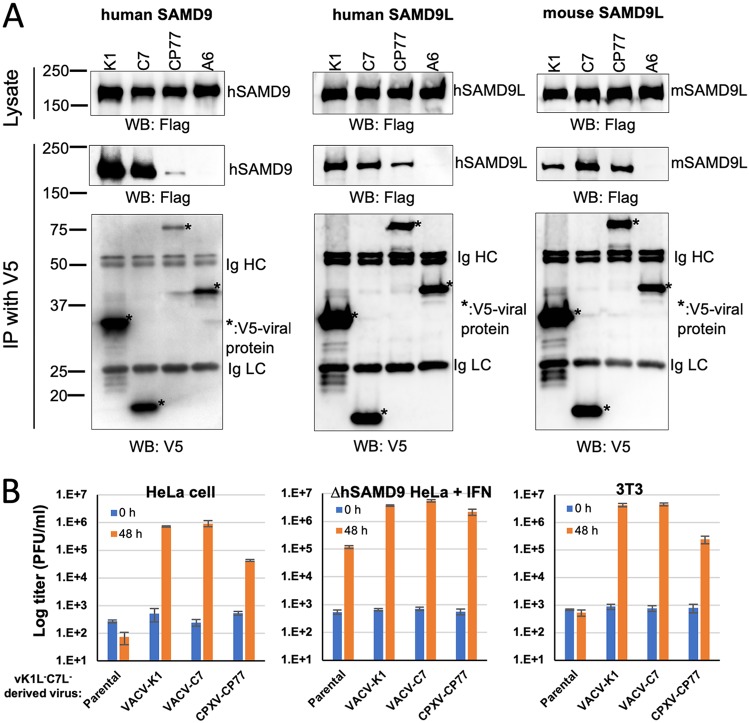
CP77 is an inhibitor of hSAMD9, hSAMD9L, and mSAMD9L. (A) 293FT cells were transfected with a plasmid expressing Flag-tagged hSAMD9, hSAMD9L, or mSAMD9L and infected with VACVs that expressed different V5-tagged viral proteins. Immunoprecipitation and detection were performed as described for Fig. 1 (B) HeLa, ΔhSAMD9 HeLa, or 3T3 cells were infected with the indicated viruses, and viral growth was determined by measuring viral titers at 0 and 48 hpi. ΔhSAMD9 HeLa cell were pretreated with IFN-β (100 U/ml) for 24 h prior to the infection.
FIG 6
FIG 6
K1 and CP77 target a common internal region of SAMD9&L. (A) Schematics of the predicted SAMD9&L domain architecture and the SAMD9&L truncation with only the NTPase-TPR domain. (B and C) 293FT cells were transfected with a plasmid expressing the putative NTPase and TPR domains of SAMD9&L (aa 607 to 1172 for hSAMD9, aa 598 to 1172 for mSAMD9L, and aa 594 to 1172 for chSAMD9L) and infected with VACV expressing C7, K1, or CP77. Coimmunoprecipitation and Western blotting were performed as described for Fig. 1 The two K1 substitution mutations (S2C-2 or S1-mut6) were previously shown to disrupt K1 host range function in human cells (20).
FIG 7
FIG 7
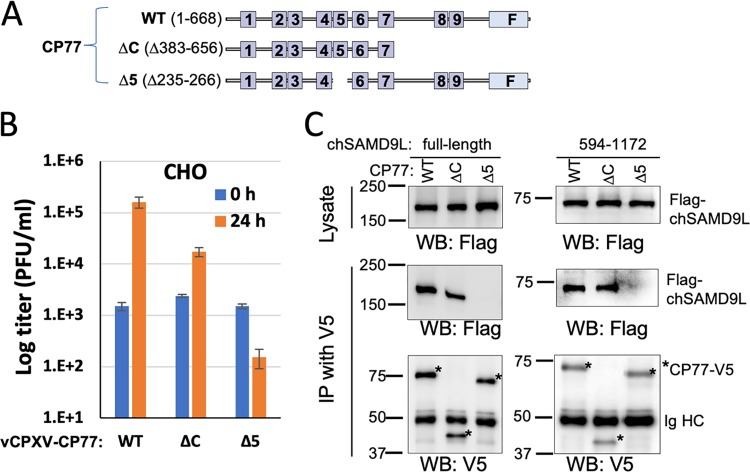
The N-terminal 382 aa of CP77 are sufficient for binding to chSAMD9L. (A) Schematics of different CP77 constructs. Ankyrin repeats are shown as boxes and numbered. The C-terminal F-box is indicated by “F.” ΔC, deletion of aa 383 to 656 (maintaining the N-terminal seven ankyrin repeats); Δ5, deletion of aa 235 to 266 (ankyrin repeat 5). (B) CHO cells were infected with vK1C7-derived VACV expressing either WT or mutated CP77. Viral growth was determined as described for Fig. 2. (C) Full-length chSAMD9L and aa 594 to 1172 of chSAMD9L were subjected to coimmunoprecipitation with either WT or mutated CP77 as described for Fig. 1.
FIG 8
FIG 8
The orthopoxvirus host range in CHO cells corresponds to their CP77 gene status. Parental (CHO-WT) and ΔSAMD9L (CHO-ΔSAMD9L) CHO cells were infected with the indicated orthopoxvirus species. Viral titers at 0, 24, and 48 hpi were measured by plaque assay on Vero cells.

References

    1. Moss B. 2013. Poxviridae, p 2129–2159. In Knipe DM, Howley PM (ed), Fields virology, 6th ed, vol 2 Lippincott Williams & Wilkins, Philadelphia, PA.
    1. Damon IK. 2013. Poxviruses, p 2160–2184. In Knipe DM, Howley PM (ed), Fields virology, 6th ed, vol 2 Lippincott Williams & Wilkins, Philadelphia, PA.
    1. Parker S, Nuara A, Buller RM, Schultz DA. 2007. Human monkeypox: an emerging zoonotic disease. Future Microbiol 2:17–34. doi:10.2217/17460913.2.1.17. - DOI - PubMed
    1. Durski KN, McCollum AM, Nakazawa Y, Petersen BW, Reynolds MG, Briand S, Djingarey MH, Olson V, Damon IK, Khalakdina A. 2018. Emergence of Monkeypox—West and Central Africa, 1970-2017. MMWR Morb Mortal Wkly Rep 67:306–310. doi:10.15585/mmwr.mm6710a5. - DOI - PMC - PubMed
    1. Megid J, Borges IA, Abrahao JS, Trindade GS, Appolinario CM, Ribeiro MG, Allendorf SD, Antunes JM, Silva-Fernandes AT, Kroon EG. 2012. Vaccinia virus zoonotic infection, Sao Paulo State, Brazil. Emerg Infect Dis 18:189–191. doi:10.3201/eid1801.110692. - DOI - PMC - PubMed

Publication types

MeSH terms

Substances

LinkOut - more resources