


GPRC5D is a target for the immunotherapy of multiple myeloma with rationally designed CAR T cells
- PMID: 30918115
- PMCID: PMC7508042
- DOI: 10.1126/scitranslmed.aau7746
GPRC5D is a target for the immunotherapy of multiple myeloma with rationally designed CAR T cells
Abstract
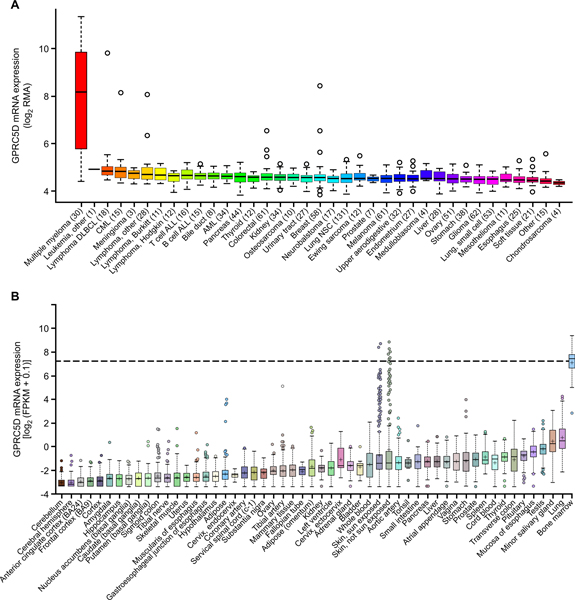
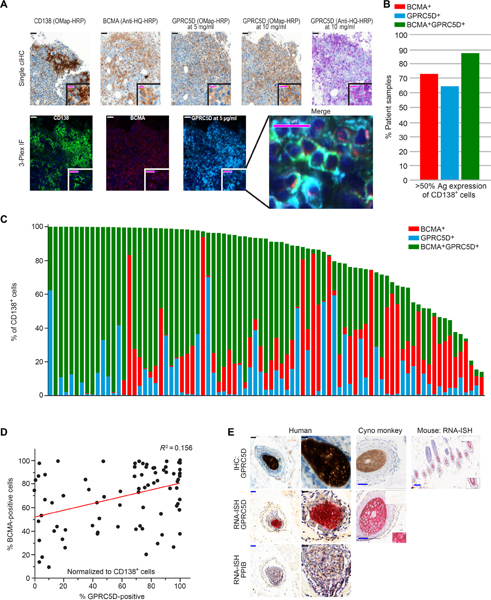
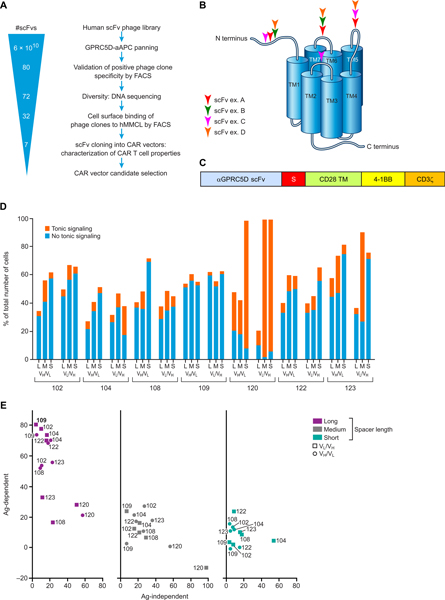
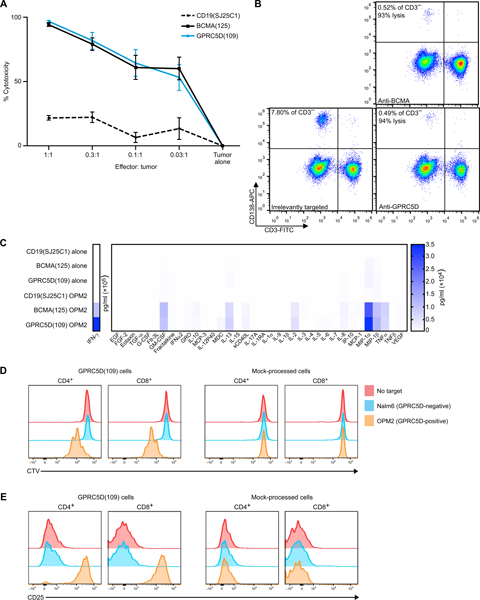
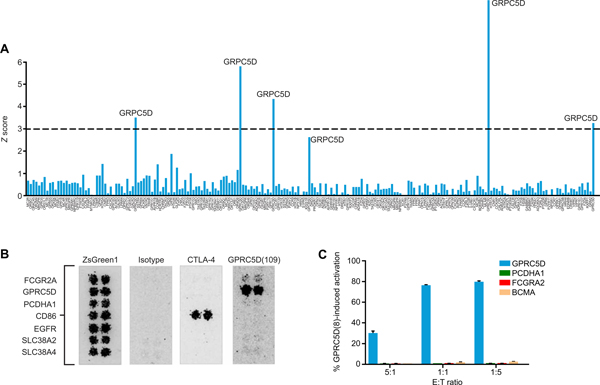
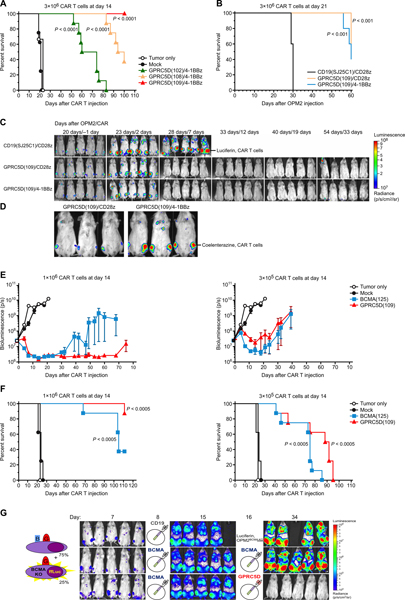
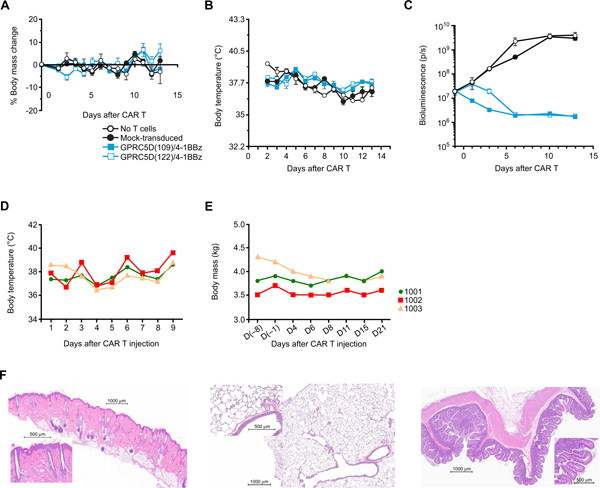
Early clinical results of chimeric antigen receptor (CAR) T cell therapy targeting B cell maturation antigen (BCMA) for multiple myeloma (MM) appear promising, but relapses associated with residual low-to-negative BCMA-expressing MM cells have been reported, necessitating identification of additional targets. The orphan G protein-coupled receptor, class C group 5 member D (GPRC5D), normally expressed only in the hair follicle, was previously identified as expressed by mRNA in marrow aspirates from patients with MM, but confirmation of protein expression remained elusive. Using quantitative immunofluorescence, we determined that GPRC5D protein is expressed on CD138+ MM cells from primary marrow samples with a distribution that was similar to, but independent of, BCMA. Panning a human B cell-derived phage display library identified seven GPRC5D-specific single-chain variable fragments (scFvs). Incorporation of these into multiple CAR formats yielded 42 different constructs, which were screened for antigen-specific and antigen-independent (tonic) signaling using a Nur77-based reporter system. Nur77 reporter screen results were confirmed in vivo using a marrow-tropic MM xenograft in mice. CAR T cells incorporating GPRC5D-targeted scFv clone 109 eradicated MM and enabled long-term survival, including in a BCMA antigen escape model. GPRC5D(109) is specific for GPRC5D and resulted in MM cell line and primary MM cytotoxicity, cytokine release, and in vivo activity comparable to anti-BCMA CAR T cells. Murine and cynomolgus cross-reactive CAR T cells did not cause alopecia or other signs of GPRC5D-mediated toxicity in these species. Thus, GPRC5D(109) CAR T cell therapy shows potential for the treatment of advanced MM irrespective of previous BCMA-targeted therapy.
Copyright © 2019 The Authors, some rights reserved; exclusive licensee American Association for the Advancement of Science. No claim to original U.S. Government Works.
Figures
References
-
- Kantarjian H, Stein A, Gökbuget N, Fielding AK, Schuh AC, Ribera J-M, Wei A, Dombret H, Foà R, Bassan R, Arslan Ö, Sanz MA, Bergeron J, Demirkan F, Lech-Maranda E, Rambaldi A, Thomas X, Horst H-A, Brüggemann M, Klapper W, Wood BL, Fleishman A, Nagorsen D, Holland C, Zimmerman Z, Topp MS, Blinatumomab versus chemotherapy for advanced acute lymphoblastic leukemia. N. Engl. J. Med 376, 836–847 (2017). - PMC - PubMed
-
- Davila ML, Riviere I, Wang X, Bartido S, Park J, Curran K, Chung SS, Stefanski J, Borquez-Ojeda O, Olszewska M, Qu J, Wasielewska T, He Q, Fink M, Shinglot H, Youssif M, Satter M, Wang Y, Hosey J, Quintanilla H, Halton E, Bernal Y, Bouhassira DCG, Arcila ME, Gonen M, Roboz GJ, Maslak P, Douer D, Frattini MG, Giralt S, Sadelain M, Brentjens R, Efficacy and toxicity management of 19–28z CAR T cell therapy in B cell acute lymphoblastic leukemia. Sci. Transl. Med 6, 224ra25 (2014). - PMC - PubMed
-
- Maude SL, Laetsch TW, Buechner J, Rives S, Boyer M, Bittencourt H, Bader P, Verneris MR, Stefanski HE, Myers GD, Qayed M, De Moerloose B, Hiramatsu H, Schlis K, Davis KL, Martin PL, Nemecek ER, Yanik GA, Peters C, Baruchel A, Boissel N, Mechinaud F, Balduzzi A, Krueger J, June CH, Levine BL, Wood P, Taran T, Leung M, Mueller KT, Zhang Y, Sen K, Lebwohl D, Pulsipher MA, Grupp SA, Tisagenlecleucel in children and young adults with B-cell lymphoblastic leukemia. N. Engl. J. Med 378, 439–448 (2018). - PMC - PubMed
-
- Lee DW, Kochenderfer JN, Stetler-Stevenson M, Cui YK, Delbrook C, Feldman SA, Fry TJ, Orentas R, Sabatino M, Shah NN, Steinberg SM, Stroncek D, Tschernia N, Yuan C, Zhang H, Zhang L, Rosenberg SA, Wayne AS, Mackall CL, T cells expressing CD19 chimeric antigen receptors for acute lymphoblastic leukaemia in children and young adults: A phase 1 dose-escalation trial. Lancet 385, 517–528 (2015). - PMC - PubMed
Publication types
MeSH terms
Substances
Grants and funding
LinkOut - more resources
Full Text Sources
Other Literature Sources
Medical
Research Materials
