Prevalence of Autoimmune Gastritis in Individuals Undergoing Medical Checkups in Japan
- PMID: 30918182
- PMCID: PMC6663548
- DOI: 10.2169/internalmedicine.2292-18
Prevalence of Autoimmune Gastritis in Individuals Undergoing Medical Checkups in Japan
Abstract
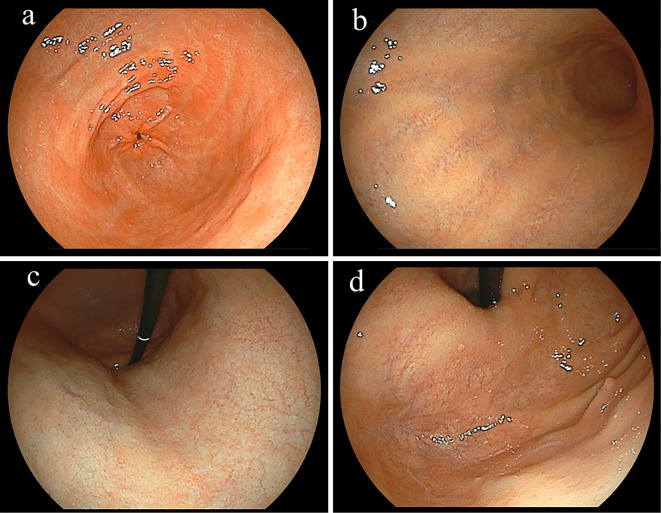
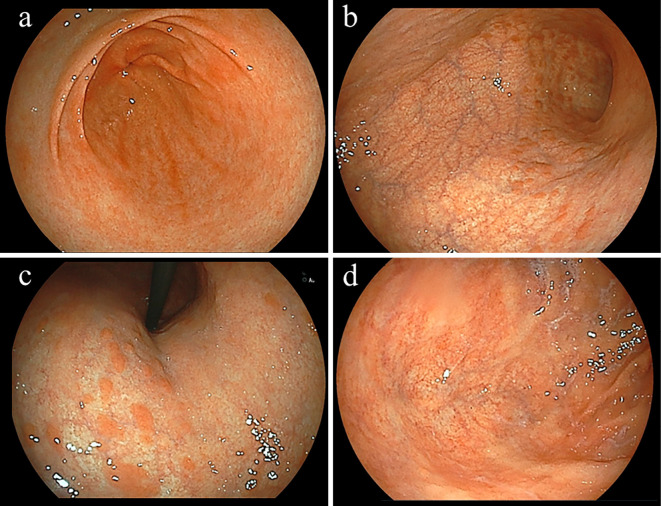
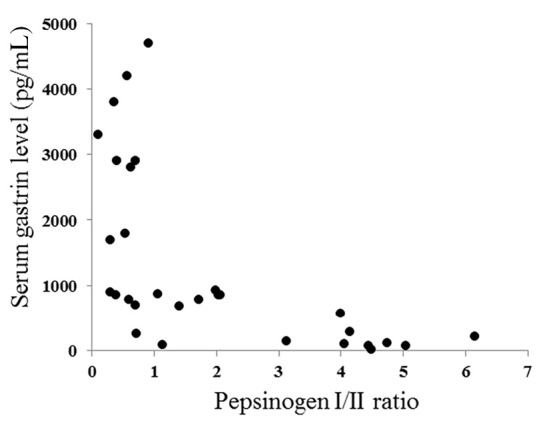
Objective Based on both endoscopic findings and serum auto-antibody levels, we determined the prevalence of autoimmune gastritis (AIG), which has not been previously reported, in individuals who underwent health checkup examinations in Japan. Methods At total of 6,739 subjects (4,288 males, 2,451 females; mean age 52.1 years) underwent an upper gastrointestinal endoscopic examination as part of an annual medical checkup. Those suspected to have AIG based on endoscopic evidence of proximal-predominant gastric mucosal atrophy were further examined for the presence of anti-parietal cells and anti-intrinsic factor antibodies, with a final diagnosis of AIG made in cases found to be positive for either or both of those factors. Results Of the 6,739 examined subjects, 46 were suspected to have AIG based on the endoscopic findings, of whom 33 were finally diagnosed with AIG, for an overall prevalence 0.49% (females 0.65%, males 0.40%). Seven with AIG also had thyroid disease, including Hashimoto's and Basedow disease, while none with AIG showed anemia in blood test findings. The prevalence of AIG was not different regardless of the H. pylori infection status (negative, positive, post-eradicated). Conclusion In individuals who underwent an upper gastrointestinal endoscopic examination as part of an annual checkup in Japan, the prevalence of AIG was 0.49%. We concluded that it is not uncommon for asymptomatic and healthy individuals to have AIG, and propose that additional studies are needed to clarify its prevalence as well as to establish the criteria used for diagnosis.
Keywords: Helicobacter pylori; anti-intrinsic factor antibody; anti-parietal cells antibody; autoimmune gastritis; gastrin.
Conflict of interest statement
Figures
References
-
- Strickland RG, Mackay IR. A reappraisal of the nature and significance of chronic atrophic gastritis. Am J Dig Dis 18: 426-440, 1973. - PubMed
-
- Toh BH. Diagnosis and classification of autoimmune gastritis. Autoimmun Rev 13: 459-462, 2014. - PubMed
-
- Irvine WJ, Cullen DR, Mawhinney H. Natural history of autoimmune achlorhydric atrophic gastritis. A 1-15-year follow-up study. Lancet 2: 482-485, 1974. - PubMed
-
- Toh BH, van Driel IR, Gleeson PA. Pernicious anemia. N Engl J Med 337: 1441-1448, 1997. - PubMed