


Clinical exome sequencing in 509 Middle Eastern families with suspected Mendelian diseases: The Qatari experience
- PMID: 30919572
- PMCID: PMC6916397
- DOI: 10.1002/ajmg.a.61126
Clinical exome sequencing in 509 Middle Eastern families with suspected Mendelian diseases: The Qatari experience
Abstract
Background: Clinical exome sequencing (CES) is rapidly becoming the diagnostic test of choice in patients with suspected Mendelian diseases especially those that are heterogeneous in etiology and clinical presentation. Reporting large CES series can inform guidelines on best practices for test utilization, and improves accuracy of variant interpretation through clinically-oriented data sharing.
Methods: This is a retrospective series of 509 probands from Qatar who underwent singleton or trio CES either as a reflex or naïve (first-tier) test from April 2014 to December 2016 for various clinical indications.
Results: The CES diagnostic yield for the overall cohort was 48.3% (n = 246). Dual molecular diagnoses were observed in 2.1% of cases; nearly all of whom (91%) were consanguineous. We report compelling variants in 11 genes with no established Mendelian phenotypes. Unlike reflex-WES, naïve WES was associated with a significantly shorter diagnostic time (3 months vs. 18 months, p < 0.0001).
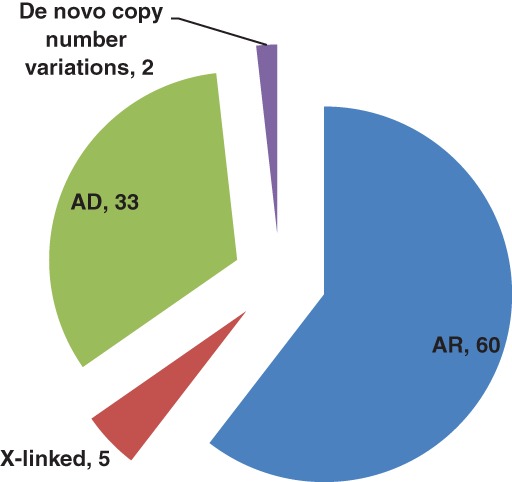
Conclusion: Middle Eastern patients tend to have a higher yield from CES than outbred populations, which has important implications in test choice especially early in the diagnostic process. The relatively high diagnostic rate is likely related to the predominance of recessive diagnoses (60%) since consanguinity and positive family history were strong predictors of a positive CES.
Keywords: Arab; Mendelian diseases; Middle East; Qatar; clinical exome sequencing; consanguinity.
© 2019 The Authors. American Journal of Medical Genetics Part A published by Wiley Periodicals, Inc.
Conflict of interest statement
The authors declare that there are no conflict of interest.
Figures
References
-
- Alfares, A. , Alfadhel, M. , Wani, T. , Alsahli, S. , Alluhaydan, I. , Al Mutairi, F. , … Zada, A. A. P. (2017). A multicenter clinical exome study in unselected cohorts from a consanguineous population of Saudi Arabia demonstrated a high diagnostic yield. Molecular Genetics and Metabolism, 121(2), 91–95. 10.1016/j.ymgme.2017.04.002 - DOI - PubMed
-
- Alfares, A. , Aloraini, T. , Al Subaie, L. , Alissa, A. , Al Qudsi, A. , Alahmad, A. , … Alfadhel, M. (2018). Whole‐genome sequencing offers additional but limited clinical utility compared with reanalysis of whole‐exome sequencing. Genetics in Medicine, 20, 1328–1333. 10.1038/gim.2018.41 - DOI - PubMed
-
- Anazi, S. , Maddirevula, S. , Faqeih, E. , Alsedairy, H. , Alzahrani, F. , Shamseldin, H. E. , … Alkuraya, F. S. (2017). Clinical genomics expands the morbid genome of intellectual disability and offers a high diagnostic yield. Molecular Psychiatry, 22(4), 615–624. 10.1038/mp.2016.113 - DOI - PubMed
-
- Charng, W.‐L. , Karaca, E. , Akdemir, C. , Zeynep, G. , Tomasz, A. , Mehmed, M. , … Lupski, J. R. (2016). Exome sequencing in mostly consanguineous Arab families with neurologic disease provides a high potential molecular diagnosis rate. BMC Medical Genomics, 9, 42 10.1186/s12920-016-0208-3 - DOI - PMC - PubMed
MeSH terms
LinkOut - more resources
Full Text Sources
Medical
Miscellaneous
