


Rheologic and Physicochemical Properties Used to Differentiate Injectable Hyaluronic Acid Filler Products
- PMID: 30921116
- PMCID: PMC7597953
- DOI: 10.1097/PRS.0000000000005429
Rheologic and Physicochemical Properties Used to Differentiate Injectable Hyaluronic Acid Filler Products
Abstract
Background: Injectable hyaluronic acid fillers are routinely used for correction of soft-tissue volume loss and facial rejuvenation. Product differentiation has primarily been based on the rheologic parameter known as elastic modulus (G'), although other physicochemical properties are being explored to characterize potential product performance. As clinical data regarding product performance are lacking, the practical experience of injectors provides a valuable bridge in the knowledge gap between product rheologic data and product use.
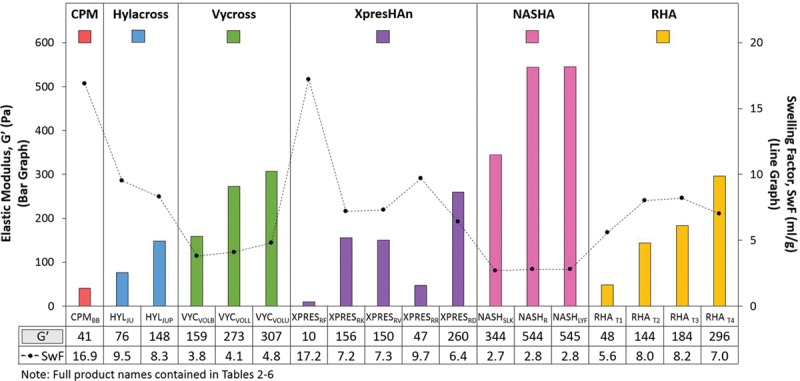
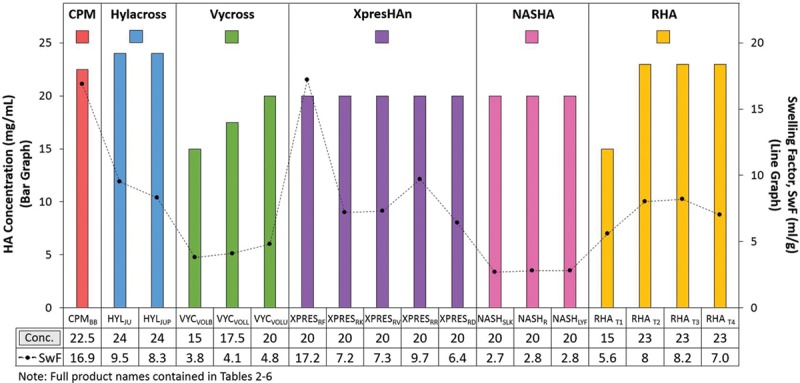
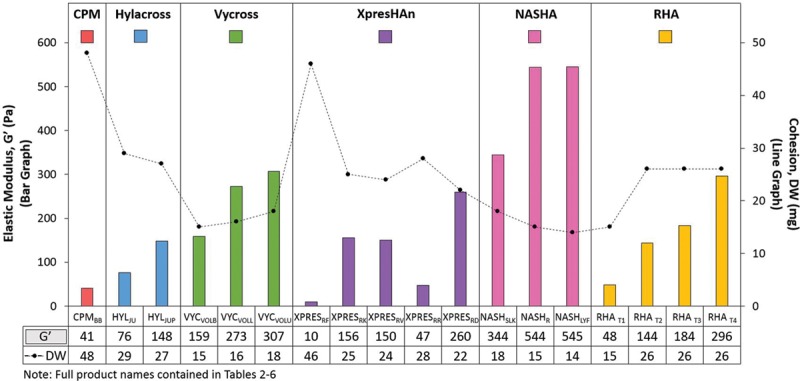
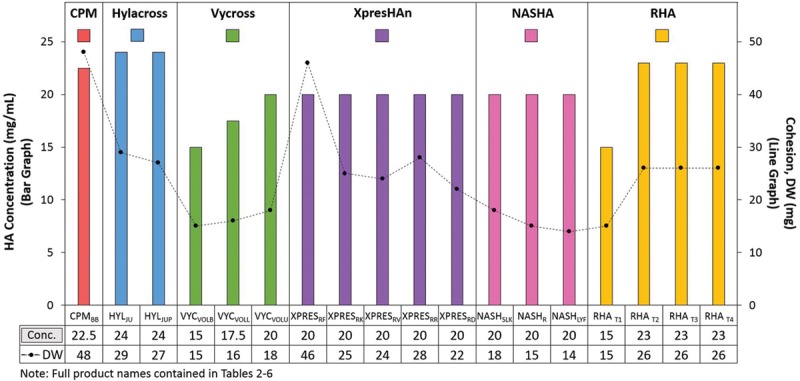
Methods: Rheologic and physicochemical measurements (swelling factor and cohesion) were collected for 18 products. To observe the impact of G' and hyaluronic acid concentration on swelling factor and cohesion, proportional relationships were evaluated. Contributing authors were queried regarding their G'-based selection of products when considering skin quality, degree of correction, injection depth, and anatomical location.
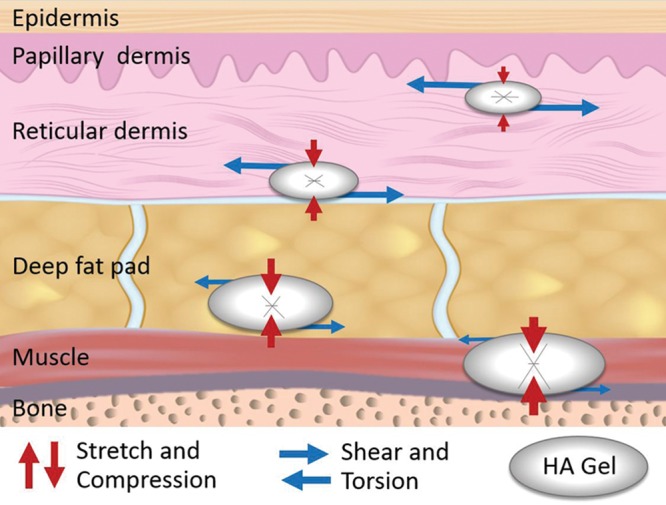
Results: Relationships were observable between G' and swelling factor and G' and cohesion only when limited to products manufactured by the same crosslinking technology and the same concentration. No relationship between isolated hyaluronic acid concentration and swelling factor or cohesion was apparent. Although rheological parameters and the assumptions of ex vivo data translating to in vivo performance are oftentimes not completely aligned, in the clinical experience of the authors, in general, higher G' products are better suited for thicker skin and deeper injection planes, whereas lower G' products are better for more superficial planes, although exceptions to these trends are also made based on technical experience.
Conclusions: While rheologic and physicochemical characteristics can vary widely between products and the methods and measurements of these parameters are often difficult to correlate, G' represents a useful and consistent parameter for product differentiation. Understanding how to select products based on G' is valuable knowledge for customizing injection plans and contributes to an optimal aesthetic outcome.
Figures
References
-
- International Society of Aesthetic Plastic Surgery. ISAPS global statistics. Available at: http.www.isaps.org/news/isaps-global-statistics. Accessed February 1, 2019. - PubMed
-
- Micheels P, Sarazin D, Tran C, Salomon D. Effect of different crosslinking technologies on hyaluronic acid behavior: A visual and microscopic study of seven hyaluronic acid gels. J Drugs Dermatol. 2016;15:600–606. - PubMed
-
- Öhrlund JÅ, Edsman KL. The myth of the “biphasic” hyaluronic acid filler. Dermatol Surg. 2015;41(Suppl 1):S358–S364. - PubMed
-
- Borrell M, Leslie DB, Tezel A. Lift capabilities of hyaluronic acid fillers. J Cosmet Laser Ther. 2011;13:21–27. - PubMed
-
- Lorenc ZP, Fagien S, Flynn TC, Waldorf HA. Clinical application and assessment of Belotero: A roundtable discussion. Plast Reconstr Surg. 2013;132(XXXSuppl 2):69S–76S. - PubMed
MeSH terms
Substances
LinkOut - more resources
Full Text Sources
Other Literature Sources
Research Materials
Miscellaneous
