


Molecular identification and epidemiological comparison of Cryptosporidium spp. among different pig breeds in Tibet and Henan, China
- PMID: 30922311
- PMCID: PMC6438020
- DOI: 10.1186/s12917-019-1847-3
Molecular identification and epidemiological comparison of Cryptosporidium spp. among different pig breeds in Tibet and Henan, China
Abstract
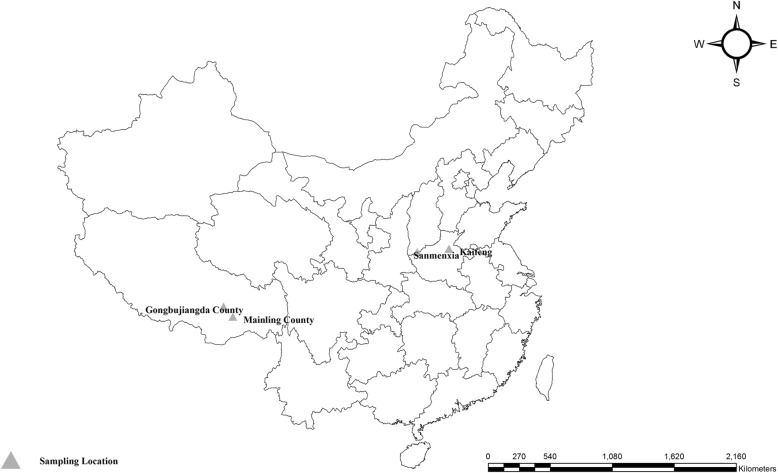
Background: Cryptosporidium spp. are important zoonotic pathogens infecting a wide range of vertebrate hosts, and causing moderate to severe diarrhea in humans. Cryptosporidium infections are frequently reported in humans and animals worldwide, but little research has been done on local pig breeds such as Tibetan pigs and Yunan Black pigs and imported pig breeds such as Landrace pigs in China. Therefore, a total of 1089 pig fecal samples from four intensive farms in four areas of China, including Tibetan pigs from Gongbujiangda County (n = 180) and Mainling County (n = 434), Tibet, Yunan Black pigs from Sanmenxia, Henan Province (n = 246), and Landrace pigs from Kaifeng, Henan Province (n = 229), and were screened for the presence of Cryptosporidium with microscopy and nested PCR amplification of the small subunit rRNA gene.
Results: The total infection rate of Cryptosporidium in 1089 fecal samples of three different pig breeds was 2.11% (23/1089), and the infection rates of Tibetan pigs, Yunan Black pigs, and Landrace pigs were 0.49% (3/614), 0.41% (1/246), and 8.30% (19/229), respectively. The prevalence of Cryptosporidium infection was significantly higher in weaned piglets (1-2 months) (4.36%, 21/482) than in younger and older age groups (p < 0.01). Sequence analysis of positive samples revealed that there was no mixed infection in our study population, which included 12 cases of C. suis mono-infections (52.17%, 12/23) and 11 cases of C. scrofarum mono-infections (47.83%, 11/23). C. suis was identified in one pre-weaned piglet (< 1 month) and 11 weaned piglets (1-2 months), while C. scrofarum was only detected in 10 weaned piglets (1-2 months) and one finished pig (> 2 months).
Conclusions: This is the first report on the identification of Cryptosporidium spp. in Tibetan pigs, and our findings also elucidate the occurrence and distribution of Cryptosporidium in three different pig breeds in Tibet and Henan, China. More molecular epidemiological studies are required to better clarify the prevalence and public health significance of Cryptosporidium in different pigs.
Keywords: China; Cryptosporidium; Pig; Zoonotic.
Conflict of interest statement
Ethics approval
This study was performed in accordance with the Chinese Laboratory Animal Administration Act of 1988. Before the experiments, the research protocol was reviewed and approved by the Research Ethics Committee of Henan Agricultural University. Permission was obtained from all managers of the study pig farms before the fecal samples were collected.
Consent for publication
Not applicable.
Competing interests
The authors declare that they have no competing interests.
Publisher’s Note
Springer Nature remains neutral with regard to jurisdictional claims in published maps and institutional affiliations.
Figures
References
-
- Kváč M, Kestřánová M, Pinková M, Květoňová D, Kalinová J, Wagnerová P, Kotková M, Vítovec J, Ditrich O, McEvoy J, Stenger B, Sak B. Cryptosporidium scrofarum n. Sp. (Apicomplexa: Cryptosporidiidae) in domestic pigs (Sus scrofa) Vet Parasitol. 2013;191:218–227. doi: 10.1016/j.vetpar.2012.09.005. - DOI - PMC - PubMed
Publication types
MeSH terms
Substances
Grants and funding
- 31330079/National Natural Science Foundation of China
- 31672548/National Natural Science Foundation of China
- 2017YFD0501305/National Key Research and Development Program of China
- 2017YFD0500400/National Key Research and Development Program of China
- 2016YFD0500707/National Key Research and Development Program of China
LinkOut - more resources
Full Text Sources
Medical
Miscellaneous
