


Wound Healing In Surgery for Trauma (WHIST): statistical analysis plan for a randomised controlled trial comparing standard wound management with negative pressure wound therapy
- PMID: 30922364
- PMCID: PMC6438006
- DOI: 10.1186/s13063-019-3282-y
Wound Healing In Surgery for Trauma (WHIST): statistical analysis plan for a randomised controlled trial comparing standard wound management with negative pressure wound therapy
Abstract
Background: In the context of major trauma, the rate of wound infection in surgical incisions created during fracture fixation amongst patients with closed high-energy injuries is high. One of the factors which may reduce the risk of surgical site infection is the type of dressing applied over the closed incision. The WHIST trial evaluates the effects of negative-pressure wound therapy (NPWT) compared with standard dressings.
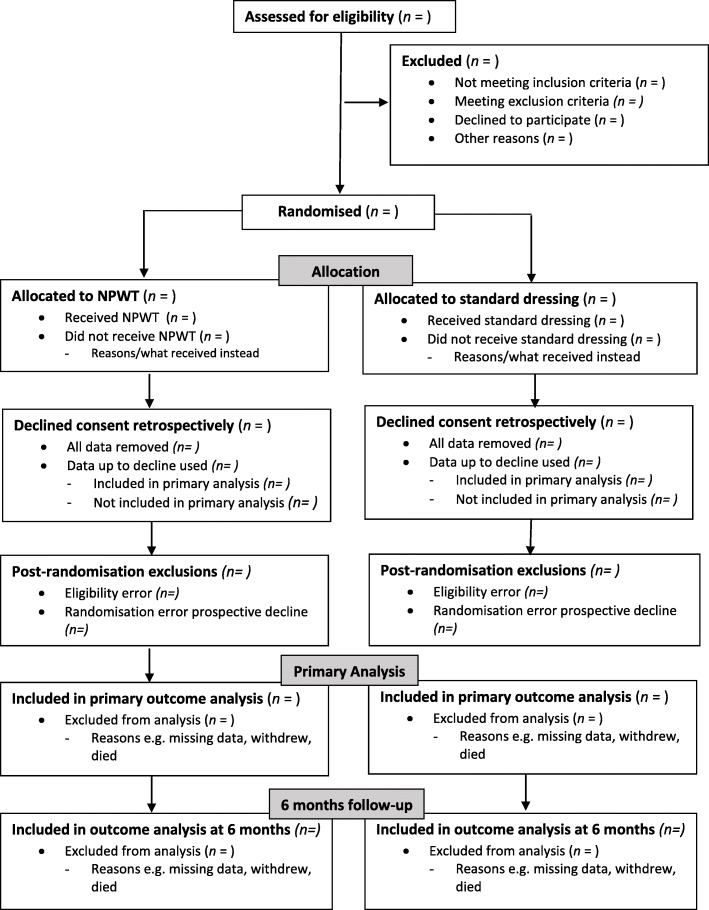
Methods/design: The WHIST trial is a multicentre, parallel group, randomised controlled trial. The primary outcome is the rate of deep surgical site infection at 30 days after major trauma. Secondary outcomes are measured at 3 and 6 months post-randomisation and include the Disability Rating Index, the EuroQoL EQ-5D-5 L, the Doleur Neuropathique Questionnaire, a patient-reported scar assessment, and record of complications. The analysis approaches for the primary and secondary outcomes are described here, as are the descriptive statistics which will be reported. The full WHIST protocol has already been published.
Discussion: This paper provides details of the planned statistical analyses for this trial and will reduce the risks of outcome reporting bias and data driven results.
Trial registration: International Standard Randomised Controlled Trials database, ISRCTN12702354 . Registered on 9 December 2015.
Keywords: Lower extremity trauma; Negative pressure wound therapy; Randomised controlled trial; Statistical analysis plan; Surgical site infection.
Conflict of interest statement
Ethics approval and consent to participate
This study was approved by the Research Ethic Committee on 16th February 2016 (reference 16/WM/0006). The University of Oxford is the sponsor. The trial is registered with the International Standard Randomised Controlled Trials database ISRCTN reference number 12702354.
Consent for publication
Not applicable.
Competing interests
MC is a member of the UK NIHR HTA General Board. All other authors declare that they have no competing interests.
Publisher’s Note
Springer Nature remains neutral with regard to jurisdictional claims in published maps and institutional affiliations.
Figures
References
-
- National Institute for Health and Care Excellence. Major trauma: Service delivery (NICE Guideline 40). 2016. Available at: https://www.nice.org.uk/guidance/ng40/evidence/full-guideline-pdf-231325.... Accessed 22 Mar 2019. - PubMed
-
- Stokel EA, Sadasivan KK. Tibial plateau fractures: standardized evaluation of operative results. Orthopedics. 1991;14(3):263–270. - PubMed
-
- Stannard J, Martin S. Tibial plateau fractures. In: Stannard J, Schmidt A, Kregor P, editors. Surgical treatment of orthopaedic trauma. edn. New York: Thieme; 2007. pp. 715–741.
-
- Mallik A, Covall D, Whitelaw G. Internal versus external fixation of bicondylar tibial plateau fractures. Orthop Rev. 1992;21(12):1433–1436. - PubMed
-
- Koval KJ, Helfet DL. Tibial plateau fractures: evaluation and treatment. J Am Acad Orthop Surg. 1995;3(2):86–94. - PubMed
Publication types
MeSH terms
Grants and funding
LinkOut - more resources
Full Text Sources
Medical
