Review
. 2019 Mar 29;39(1):13.
doi: 10.1186/s40880-019-0361-0.

Mucinous colorectal adenocarcinoma: clinical pathology and treatment options

Affiliations
Review

Mucinous colorectal adenocarcinoma: clinical pathology and treatment options

Cong Luo et al. Cancer Commun (Lond). .

Abstract

Mucinous colorectal adenocarcinoma is a distinct subtype of colorectal cancer (CRC) characterized by the presence of abundant extracellular mucin which accounts for at least 50% of the tumor volume. Mucinous colorectal adenocarcinoma is found in 10%-20% of CRC patients and occurs more commonly in female and younger patients. Moreover, mucinous colorectal adenocarcinoma is more frequently located in the proximal colon and diagnosed at an advanced stage. Based on its molecular context, mucinous colorectal adenocarcinoma is associated with the overexpression of mucin 2 (MUC2) and mucin 5AC (MUC5AC) proteins. At the same time, it shows higher mutation rates in the fundamental genes of the RAS/MAPK and PI3K/Akt/mTOR pathways. Mucinous colorectal adenocarcinoma also shows higher rates of microsatellite instability (MSI) than non-mucinous colorectal adenocarcinoma which might correlate it with Lynch syndrome and the CpG island methylator phenotype. The prognosis of mucinous colorectal adenocarcinoma as to non-mucinous colorectal adenocarcinoma is debatable. Further, the impaired responses of mucinous colorectal adenocarcinoma to palliative or adjuvant chemotherapy warrant more studies to be performed for a specialized treatment for these patients. In this review, we discuss the molecular background and histopathology of mucinous colorectal adenocarcinoma, and provide an update on its prognosis and therapeutics from recent literatures.

Keywords: Adenocarcinoma; Colorectal cancer; Hyperthermic intraperitoneal chemotherapy; Immunotherapy; Lynch syndrome; MUC2; MUC5AC; Microsatellite instability; Mucinous carcinoma; Targeted molecular therapy.


Conflict of interest statement

The authors declare that they have no competing interests.

Figures
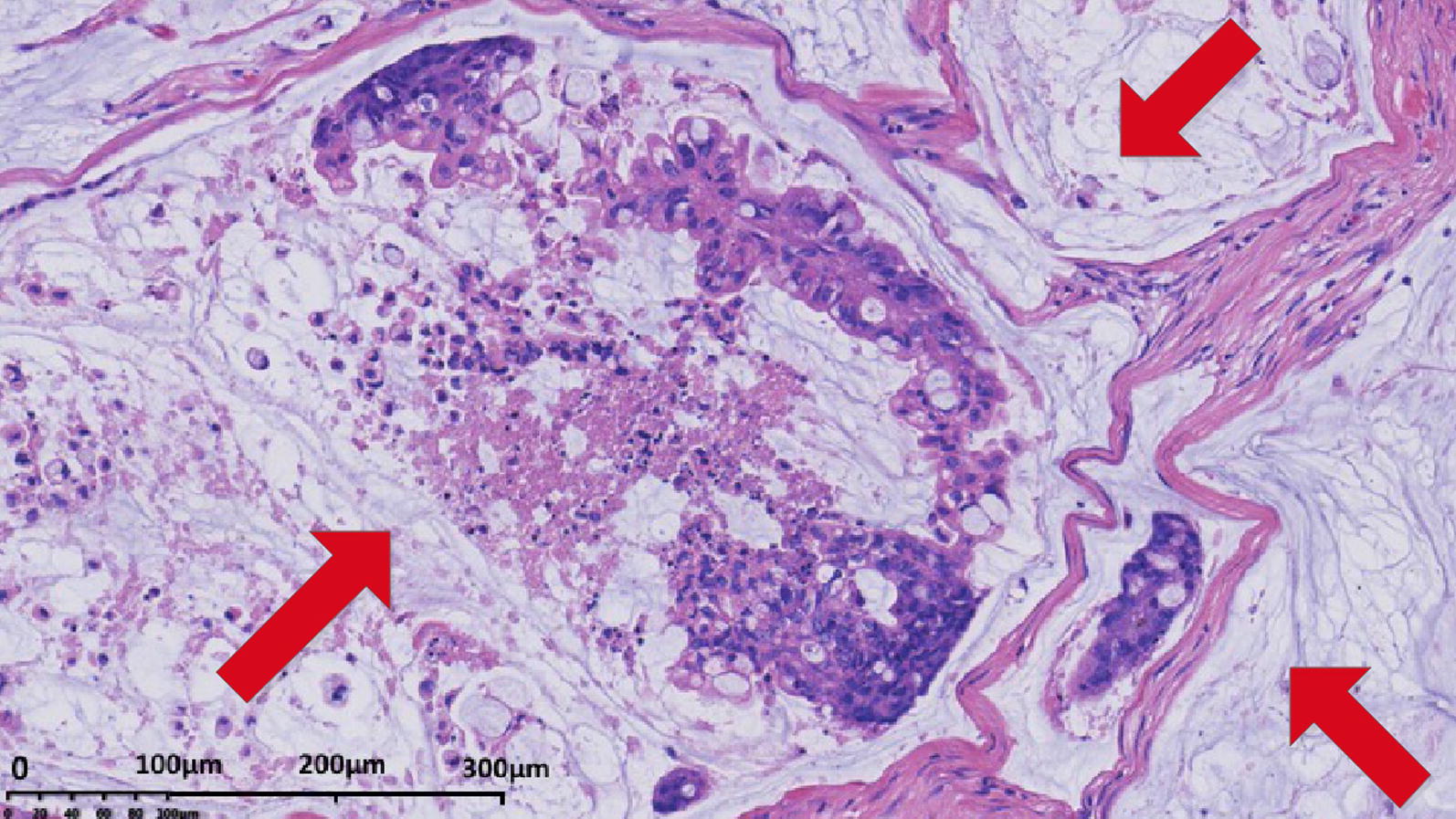
Fig. 1
Fig. 1
Histopathology of mucinous colorectal adenocarcinoma. H&E stained tissue section from a 53-year-old female patient initially diagnosed with mucinous colorectal adenocarcinoma showing abundant extracellular mucin (red arrows) within the tumor complex. Original magnification, ×20
Fig. 2
Fig. 2
Magnetic resonance images showed an ulcerative mucinous colorectal adenocarcinoma (5.5 × 3.0 × 2.5 cm) located in the transverse colon 55 cm from the anus in a 53-year-old female patient. The patient was diagnosed as mucinous colorectal adenocarcinoma staged T4N2M1 with liver and abdominal metastases. She received 3 cycles of XELOX (capecitabine plus oxaliplatin) chemotherapy, a palliative surgery, 5 cycles of XELOX chemotherapy and capecitabine maintenance therapy for 5 months till present. a The axial T2-weighted imaging showed a significantly more intense signal on mucin pools (red arrow) than normal muscle. b In the axial T1-weighted image, the mucinous component (red arrow) showed similar signal intensity as to normal muscle
Fig. 3
Fig. 3
Computer tomography image obtained from a 53-year-old female patient with a mucinous colorectal adenocarcinoma (5.5 × 3.0 × 2.5 cm) located in the transverse colon 55 cm from the anus. No significant enhancement compared with normal muscle in the arterial phase was observed. The patient was diagnosed as mucinous colorectal adenocarcinoma staged T4N2M1 with liver and abdominal metastases. She received 3 cycles of XELOX (capecitabine plus oxaliplatin) chemotherapy, a palliative surgery, 5 cycles of XELOX chemotherapy, and capecitabine maintenance therapy for 5 months till present

References

    1. Haggar FA, Boushey RP. Colorectal cancer epidemiology: incidence, mortality, survival, and risk factors. Clin Colon Rectal Surg. 2009;22(4):191–197. doi: 10.1055/s-0029-1242458. - DOI - PMC - PubMed
    1. Bosman FT, Carneiro F, Hruban RH, Theise ND. WHO classification of tumours of the digestive system. 4. Geneva: World Health Organization Classification of Tumours; 2010.
    1. Glasgow SC, Yu J, Carvalho LP, Shannon WD, Fleshman JW, McLeod HL. Unfavourable expression of pharmacologic markers in mucinous colorectal cancer. Br J Canc. 2005;92(2):259–264. doi: 10.1038/sj.bjc.6602330. - DOI - PMC - PubMed
    1. Leopoldo S, Lorena B, Cinzia A, Gabriella DC, Luciana BA, Renato C, et al. Two subtypes of mucinous adenocarcinoma of the colorectum: clinicopathological and genetic features. Ann Surg Oncol. 2008;15(5):1429–1439. doi: 10.1245/s10434-007-9757-1. - DOI - PubMed
    1. Hugen N, van Beek JJP, de Wilt JHW, Nagtegaal ID. Insight into mucinous colorectal carcinoma: clues from etiology. Ann Surg Oncol. 2014;21(9):2963–2970. doi: 10.1245/s10434-014-3706-6. - DOI - PubMed

Publication types

MeSH terms
