


Escalation of Pyrethroid Resistance in the Malaria Vector Anopheles funestus Induces a Loss of Efficacy of Piperonyl Butoxide-Based Insecticide-Treated Nets in Mozambique
- PMID: 30923819
- PMCID: PMC6603977
- DOI: 10.1093/infdis/jiz139
Escalation of Pyrethroid Resistance in the Malaria Vector Anopheles funestus Induces a Loss of Efficacy of Piperonyl Butoxide-Based Insecticide-Treated Nets in Mozambique
Abstract
Background: Insecticide resistance poses a serious threat to insecticide-based interventions in Africa. There is a fear that resistance escalation could jeopardize malaria control efforts. Monitoring of cases of aggravation of resistance intensity and its impact on the efficacy of control tools is crucial to predict consequences of resistance.
Methods: The resistance levels of an Anopheles funestus population from Palmeira, southern Mozambique, were characterized and their impact on the efficacy of various insecticide-treated nets established.
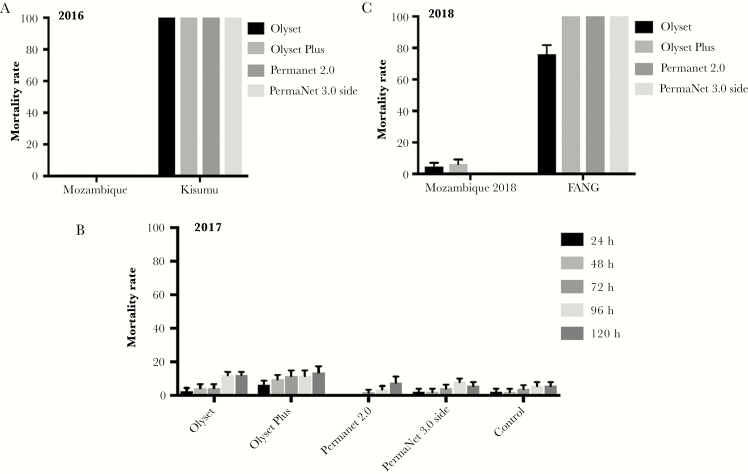
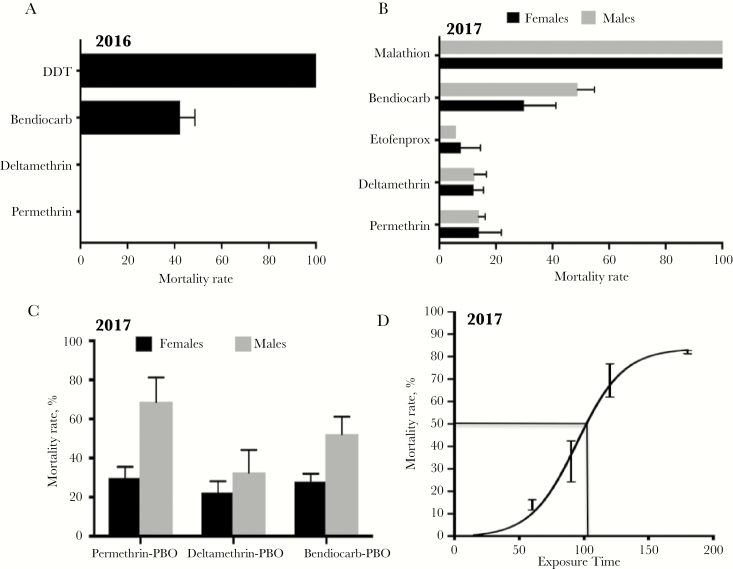
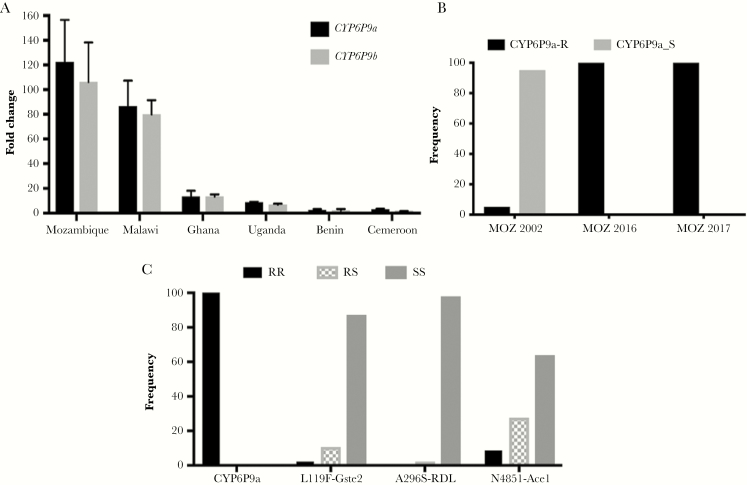
Results: A dramatic loss of efficacy of all long-lasting insecticidal nets (LLINs), including piperonyl butoxide (PBO)-based nets (Olyset Plus), was observed. This An. funestus population consistently (2016, 2017, and 2018) exhibited a high degree of pyrethroid resistance. Molecular analyses revealed that this resistance escalation was associated with a massive overexpression of the duplicated cytochrome P450 genes CYP6P9a and CYP6P9b, and also the fixation of the resistance CYP6P9a_R allele in this population in 2016 (100%) in contrast to 2002 (5%). However, the low recovery of susceptibility after PBO synergist assay suggests that other resistance mechanisms could be involved.
Conclusions: The loss of efficacy of pyrethroid-based LLINs with and without PBO is a concern for the effectiveness of insecticide-based interventions, and action should be taken to prevent the spread of such super-resistance.
Keywords: An. funestus; Mozambique; cytochrome P450; insecticide resistance; long-lasting insecticidal nets; malaria; metabolic resistance; vector control.
© The Author(s) 2019. Published by Oxford University Press for the Infectious Diseases Society of America.
Figures
References
-
- World Health Organization (WHO). World malaria report 2016. Geneva, Switzerland: WHO, 2016.
-
- World Health Organization (WHO). World malaria report 2018. Geneva, Switzerland: WHO, 2018.
-
- World Health Organization (WHO). Global plan for insecticide resistance management in malaria vectors. Geneva. Switzerland: WHO, 2012.
Publication types
MeSH terms
Substances
Grants and funding
LinkOut - more resources
Full Text Sources
Other Literature Sources
Medical
