


NKG2D Polymorphism in Melanoma Patients from Southeastern Spain
- PMID: 30925758
- PMCID: PMC6521179
- DOI: 10.3390/cancers11040438
NKG2D Polymorphism in Melanoma Patients from Southeastern Spain
Abstract
Background: Natural killer (NK) and CD8+ T cells are involved in the immune response against melanoma. C-Type lectin-like NK cell receptors are located in the Natural Killer Complex (NKC) region 12p13.2-p12.3 and play a critical role in regulating the activity of NK and CD8+ T cells. An association between polymorphisms in the NKC region, including the NKG2D gene and NKG2A promoter, and the risk of cancer has been previously described. The aim of this study was to analyze the association of polymorphisms in the NKC region with cutaneous melanoma in patients from southeastern Spain.
Methods: Seven single-nucleotide polymorphisms (SNPs) in the NKG2D gene (NKC3,4,7,9,10,11,12), and one SNP in the NKG2A promoter (NKC17) were genotyped by a TaqMan 5' Nuclease Assay in 233 melanoma patients and 200 matched healthy controls.
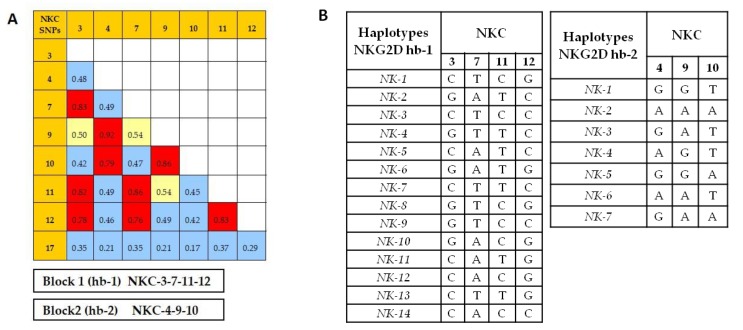
Results: A linkage disequilibrium analysis of the SNPs performed in the NKC region revealed two blocks of haplotypes (Hb-1 and Hb-2) with 14 and seven different haplotype subtypes, respectively. The third most frequent haplotype from the block Hb-2-NK3 (CAT haplotype)-was significantly more frequent on melanoma patients than on healthy controls (p = 0.00009, Pc = 0.0006). No further associations were found when NKC SNPs were considered independently.
Conclusions: Our results suggest an association between NKG2D polymorphisms and the risk of cutaneous malignant melanoma.
Keywords: Melanoma; NK cell; NKG2A; NKG2D; gene polymorphism.
Conflict of interest statement
The authors declare no conflicts of interest.
Figures
References
-
- Rastrelli M., Tropea S., Rossi C.R., Alaibac M. Melanoma: Epidemiology, Risk Factors, Pathogenesis, Diagnosis and Classification. In Vivo. 2014;28:1005–1012. - PubMed
LinkOut - more resources
Full Text Sources
Research Materials
Miscellaneous
