Review
. 2019 Mar 30;18(1):60.
doi: 10.1186/s12943-019-0974-6.

Synergistic effect of immune checkpoint blockade and anti-angiogenesis in cancer treatment

Affiliations
Review

Synergistic effect of immune checkpoint blockade and anti-angiogenesis in cancer treatment

Ming Yi et al. Mol Cancer. .

Abstract

Immune checkpoint inhibitor (ICI) activates host's anti-tumor immune response by blocking negative regulatory immune signals. A series of clinical trials showed that ICI could effectively induce tumor regression in a subset of advanced cancer patients. In clinical practice, a main concerning for choosing ICI is the low response rate. Even though multiple predictive biomarkers such as PD-L1 expression, mismatch-repair deficiency, and status of tumor infiltrating lymphocytes have been adopted for patient selection, frequent resistance to ICI monotherapy has not been completely resolved. However, some recent studies indicated that ICI resistance could be alleviated by combination therapy with anti-angiogenesis treatment. Actually, anti-angiogenesis therapy not only prunes blood vessel which is essential to cancer growth and metastasis, but also reprograms the tumor immune microenvironment. Preclinical studies demonstrated that the efficacy of combination therapy of ICI and anti-angiogenesis was superior to monotherapy. In mice model, combination therapy could effectively increase the ratio of anti-tumor/pro-tumor immune cell and decrease the expression of multiple immune checkpoints more than PD-1. Based on exciting results from preclinical studies, many clinical trials were deployed to investigate the synergistic effect of the combination therapy and acquired promising outcome. This review summarized the latest understanding of ICI combined anti-angiogenesis therapy and highlighted the advances of relevant clinical trials.

Keywords: Anti-angiogenesis; CTLA-4; Immune checkpoint inhibitor; PD-1; PD-L1; TKI; Tumor immune microenvironment; VEGF.


Conflict of interest statement

Ethics approval and consent to participate

Not applicable.

Consent for publication

Not applicable.

Competing interests

The authors declare that they have no competing interests.

Publisher’s Note

Springer Nature remains neutral with regard to jurisdictional claims in published maps and institutional affiliations.

Figures
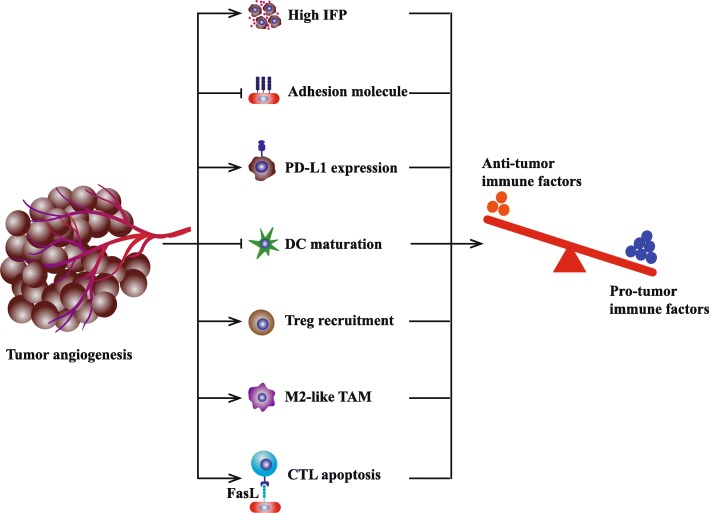
Fig. 1
Fig. 1
Tumor angiogenesis induces the formation of immunosuppressive tumor microenvironment. Firstly, leaky nascent vessels and loose pericyte coverage result in high interstitial fluid pressure (IFP) which means greater pressure difference to overcome for T cell infiltration. Secondly, neo-vasculatures tend to lack some adhesion molecules for example vasculature cell adhesion molecule-1 (VCAM-1). Thirdly, hypoxia upregulates some inhibitory signals for anti-tumor immune response such as PD-L1, indoleamine 2, 3-dioxygenase (IDO), interleukin-6 (IL-6), and interleukin-10 (IL-10) . In addition, circulating VEGF impedes the maturation and function of dendritic cell (DC). Besides, tumor hypoxia induces upregulation of chemokine (C-C motif) ligand-22 and chemokine (C-C motif) ligand-28, which recruit Treg into tumor [36, 37]. Moreover, hypoxic tumor microenvironment promotes the polarization of tumor-associated macrophage (TAM) to M2-like phenotype. Lastly, the expression of Fas ligand (FasL) on tumor endothelial barrier selectively eliminates effector CD8+ T cells rather than Treg, due to the high expression of cellular FLICE-inhibitory protein (c-FLIP) expression on Treg. In summary, angiogenesis render accumulating pro-tumor immune cells and decreasing anti-tumor immune cells, inducing the formation of immunosuppressive tumor microenvironment
Fig. 2
Fig. 2
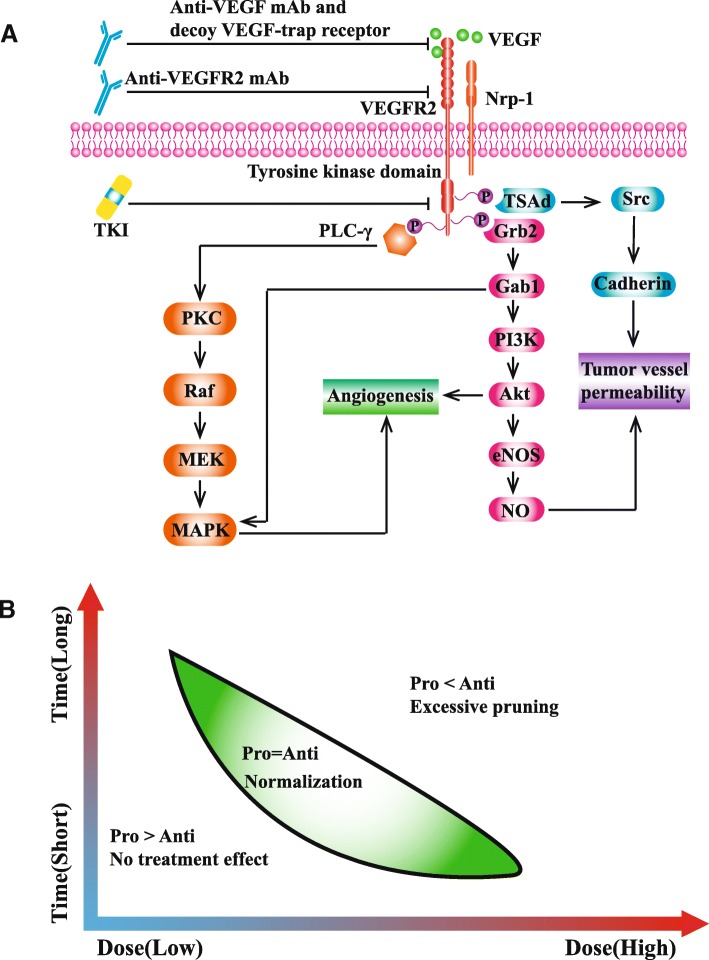
a Main angiogenesis pathways and anti-angiogenesis agents. VEGF-VEGFR2 promotes the proliferation and migration of endothelial cell primarily by activating downstream PLCγ-PKC-Raf-MAPK and Grb2-Gab1-MAPK/PI3K-Akt signaling pathways. In addition, VEGF-VEGFR2 could increase vascular permeability by activating VEGFR2–TSAd–Src-cadherin and PI3K–Akt–eNOS–NO signaling pathways. Anti-angiogenesis agents consist of three types: (I) anti-VEGF monoclonal antibody (mAb) such as bevacizumab and decoy VEGF-trap receptor such as aflibercept; (II) anti-VEGFR2 mAb (ramucirumab); (III) VEGFR tyrosine kinase inhibitor (TKI). b Normalization window of anti-angiogenesis treatment. When pro-angiogenic (pro) factors balance with anti-angiogenic (anti) factors, abnormal tumor vessels transform into normal-like phenotype (green). Vessel normalization is a transient status changing along with the time and dose of treatment
Fig. 3
Fig. 3
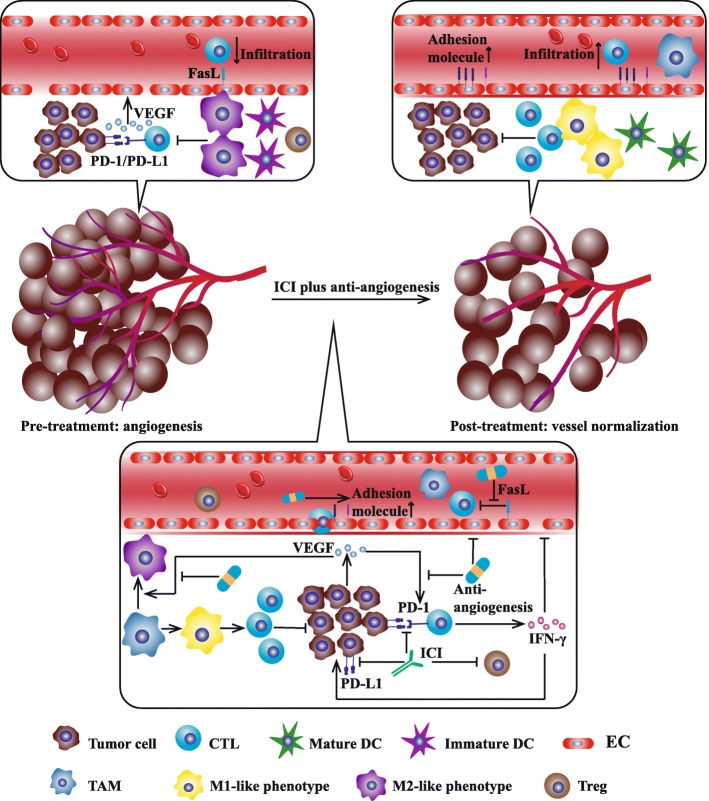
Mutual regulation of tumor vessel normalization and immune microenvironment reprogramming. Tumor angiogenesis leads to an immunosuppressive microenvironment by decreasing the ratio of anti-tumor/pro-tumor immune cell and undermining the function of cytotoxic T lymphocyte (CTL). Anti-angiogenesis induces tumor vessel normalization and improves blood perfusion. Alleviated hypoxia decreases PD-L1 expression on tumor cell while blocked VEGF signal downregulates immune checkpoint expression (e.g. PD-1) on CTL. In the meanwhile, activated immune response-derived inflammatory factors such as interferon-γ (IFN-γ) promotes vessel normalization and regression. Interaction between vessel normalization and immune microenvironment reprogramming could be regulated by anti-angiogenesis agents (bevacizumab or VEGFR-TKI such as axitinib, sorafenib, sunitinib, and vatalanib) and ICI (especially anti-PD-1/PD-L1 mAb). After combination therapy, immunosuppressive microenvironment is transformed to immunosupportive microenvironment which possesses increased CTL, M1-like phonotype macrophage, adhesion molecule, mature dendritic cell (DC), and decreased regulatory T cell (Treg). Abbreviations: TAM, tumor associated macrophage; EC, endothelial cell

References

    1. Topalian SL, Drake CG, Pardoll DM. Targeting the PD-1/B7-H1(PD-L1) pathway to activate anti-tumor immunity. Curr Opin Immunol. 2012;24:207–212. doi: 10.1016/j.coi.2011.12.009. - DOI - PMC - PubMed
    1. Lipson EJ, Drake CG. Ipilimumab: an anti-CTLA-4 antibody for metastatic melanoma. Clin Cancer Res. 2011;17:6958–6962. doi: 10.1158/1078-0432.CCR-11-1595. - DOI - PMC - PubMed
    1. Long J, Lin J, Wang A, Wu L, Zheng Y, Yang X, et al. PD-1/PD-L blockade in gastrointestinal cancers: lessons learned and the road toward precision immunotherapy. J Hematol Oncol. 2017;10:146. doi: 10.1186/s13045-017-0511-2. - DOI - PMC - PubMed
    1. Wang J, Yuan R, Song W, Sun J, Liu D, Li Z. PD-1, PD-L1 (B7-H1) and tumor-site immune modulation therapy: the historical perspective. J Hematol Oncol. 2017;10:34. doi: 10.1186/s13045-017-0403-5. - DOI - PMC - PubMed
    1. Kythreotou A, Siddique A, Mauri FA, Bower M, Pinato DJ. PD-L1. J Clin Pathol. 2018;71:189–194. doi: 10.1136/jclinpath-2017-204853. - DOI - PubMed

Publication types

MeSH terms