Proteomic test for anti-PD-1 checkpoint blockade treatment of metastatic melanoma with and without BRAF mutations
- PMID: 30925943
- PMCID: PMC6440152
- DOI: 10.1186/s40425-019-0569-1
Proteomic test for anti-PD-1 checkpoint blockade treatment of metastatic melanoma with and without BRAF mutations
Abstract
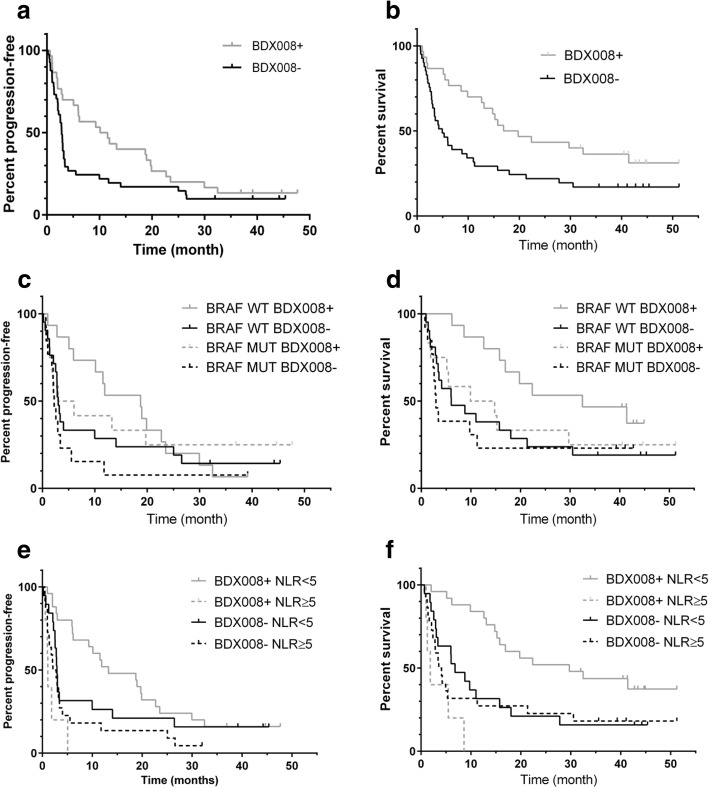
The therapeutic landscape in metastatic melanoma has changed dramatically in the last decade, with the success of immune checkpoint inhibitors resulting in durable responses for a large number of patients. For patients with BRAF mutations, combinations of BRAF and MEK inhibitors demonstrated response rates and benefit comparable to those from immune checkpoint inhibitors, providing the rationale for sequential treatment with targeted and immunotherapies and raising the question of optimal treatment sequencing.Biomarkers for the selection of anti-PD-1 therapy in BRAF wild type (BRAF WT) and in BRAF mutated (BRAF MUT) patients help development of alternative treatments for patients unlikely to benefit, and might lead to better understanding of the interaction of checkpoint inhibition and targeted therapy. In this paper we evaluate the performance of a previously developed serum proteomic test, BDX008, in metastatic melanoma patients treated with anti-PD-1 agents and investigate the role of BRAF mutation status. BDX008, a pre-treatment proteomic test associated with acute phase reactants, wound healing and complement activation, stratifies patients into two groups, BDX008+ and BDX008-, with better and worse outcomes on immunotherapy.Serum samples were available from 71 patients treated with anti-PD1 inhibitors; 25 patients had BRAF mutations, 39 were wild type. Overall, BDX008+ patients had significantly better overall survival (OS) (HR = 0.50, P = 0.016) and a trend for better progression-free survival (PFS) (HR = 0.61, P = 0.060) than BDX008- patients. BDX008 classification was statistically significant in the analyses adjusted for mutation status, LDH, and line of treatment (P = 0.009 for OS and 0.031 for PFS). BRAF WT BDX008+ patients had markedly long median OS of 32.5 months and 53% landmark 2 years survival, with statistically significantly superior OS as compared to BDX008- patients (HR = 0.41, P = 0.032). The difference between BDX008+ and BDX008- in PFS in BRAF WT patients and in OS and PFS in BRAF MUT patients did not reach statistical significance, though numerically was consistent with overall results. The test demonstrated significant interaction with neutrophil-to-lymphocyte ratio (NLR) (PFS P = 0.041, OS P = 0.004). BDX008 as a biomarker selecting for benefit from immune checkpoint blockade, especially in patients with wild type BRAF and in subgroups with low NLR, warrants further evaluation.
Keywords: Anti-PD-1; BRAF mutations; Immunotherapy; Melanoma; Nivolumab; Pembrolizumab; Proteomic test.
Conflict of interest statement
Ethics approval and consent to participate
The study was approved by the Ethics Committee of the Istituto Nazionale Tumori IRCCS Fondazione “G. Pascale” with registration number 35/16 and all patients signed informed consent for the use of biological samples for research purposes.
Consent for publication
Not applicable.
Competing interests
P.A: Consulting or Advisory Role for BMS, Roche-Genentech, MSD, Array, Novartis, Merck Serono, Pierre Fabre, Incyte, Genmab, Newlink Genetics, Medimmune, AstraZeneca, Syndax, Sun Pharma, Sanofi, Idera, Ultimovacs; Research funds from BMS, Roche-Genentech, Array; Travel support by MSD.
A.G.: Consulting or Advisory Role for BMS, MSD, Novartis; Travel support by BMS, MSD, Merck Serono, Roche.
HR, JR, JG, KM, SA, CO are or were full time employees of Biodesix and have/had stock options of the company.
Other authors declare that they have no competing interests.
Publisher’s Note
Springer Nature remains neutral with regard to jurisdictional claims in published maps and institutional affiliations.
Figures
References
-
- Dummer R, Ascierto PA, Gogas HJ, et al. Overall survival in patients with BRAF-mutant melanoma receiving encorafenib plus binimetinib versus vemurafenib or encorafenib (COLUMBUS): a multicentre, open-label, randomised, phase 3 trial. Lancet Oncol. 2018;19:1315–1327. doi: 10.1016/S1470-2045(18)30497-2. - DOI - PubMed
-
- Hodi FS, Chiarion-Sileni V, Gonzalez R, et al. Nivolumab plus ipilimumab or nivolumab alone versus ipilimumab alone in advanced melanoma (CheckMate 067): 4-year outcomes of a multicentre, randomised, phase 3 trial. Lancet Oncol. 2018. - PubMed
Publication types
MeSH terms
Substances
LinkOut - more resources
Full Text Sources
Medical
Research Materials