. 2019 Mar 29;9(1):5346.
doi: 10.1038/s41598-019-41784-z.

Optimal control of the transport of Bose-Einstein condensates with atom chips

Affiliations

Optimal control of the transport of Bose-Einstein condensates with atom chips

S Amri et al. Sci Rep. .

Abstract

Using Optimal Control Theory (OCT), we design fast ramps for the controlled transport of Bose-Einstein condensates with atom chips' magnetic traps. These ramps are engineered in the context of precision atom interferometry experiments and support transport over large distances, typically of the order of 1 mm, i.e. about 1,000 times the size of the atomic clouds, yet with durations not exceeding 200 ms. We show that with such transport durations of the order of the trap period, one can recover the ground state of the final trap at the end of the transport. The performance of the OCT procedure is compared to that of a Shortcut-To-Adiabaticity (STA) protocol and the respective advantages/disadvantages of the OCT treatment over the STA one are discussed.


Conflict of interest statement

The authors declare no competing interests.

Figures
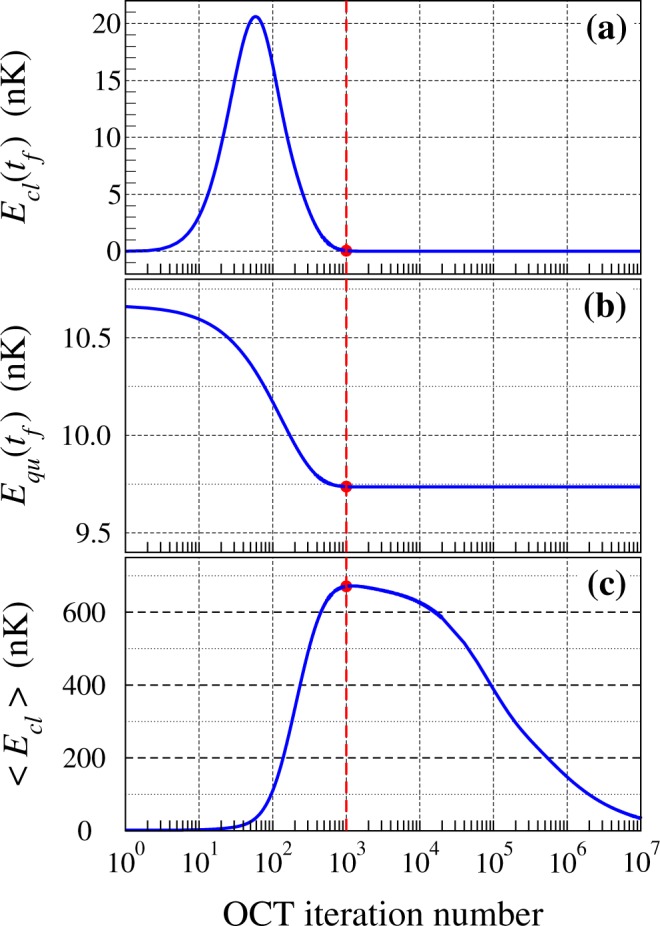
Figure 1
Figure 1
Example of convergence of the different cost functionals as a function of the optimal control theory iteration number: (a) Final classical energy in nK, (b) Final quantum energy in nK, (c) Average classical energy in nK. See text for details.
Figure 2
Figure 2
Comparison of different optimization procedures. Shortcut-to-adiabaticity (STA): dotted blue line, classical optimal control (cl-OCT): dashed green line, quantum optimal control (qu-OCT): solid red line. (a) Bias magnetic field in Gauss as a function of time, (b) Position offset [zA(t) − z0(t)] in μm as a function of time, (c) Velocity offset [vA(t)z˙0(t)] in μm/ms as a function of time, (df) Size dynamics of the condensate along the three coordinates x, y and z in μm as a function of time. The duration of the transport is tf = 150 ms. See text for details.
Figure 3
Figure 3
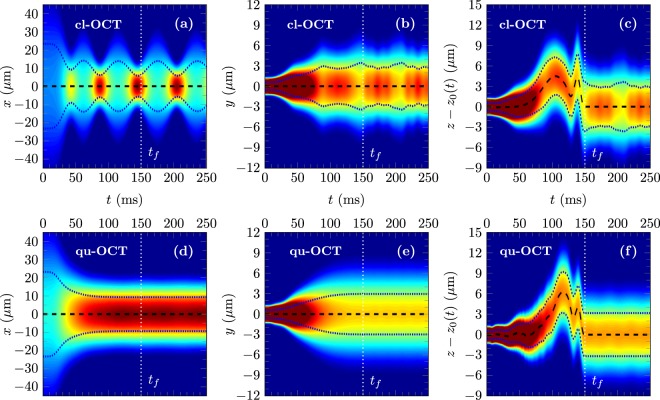
Condensate dynamics in the x, y and z directions using the cl-OCT ramp (upper line) and the qu-OCT ramp (lower line) shown in Fig. 2. The transport duration is tf = 150 ms. The average atomic density, solution of the time-dependent Gross-Pitaevskii equation, is shown as a function of time and position: (a) and (d) Px(x, t), (b) and (e) Py(y, t), (c) and (f) Pz(z, t). The black dashed lines show the expected center of mass trajectory. The dotted blue lines highlight the expected width dynamics according to the scaling approach. The dotted vertical white lines mark the time of the end of the transport. The total atom number is N = 105. See text for details.
Figure 4
Figure 4
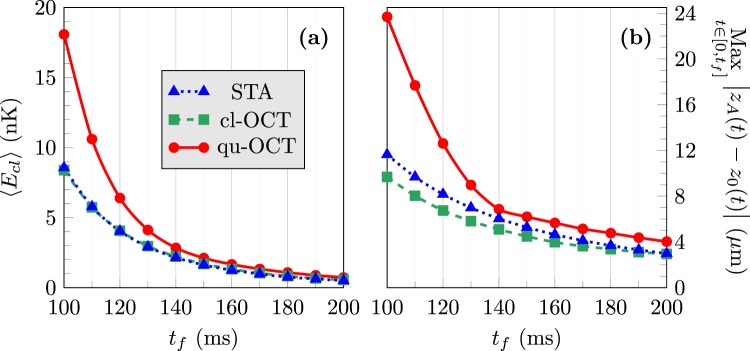
Influence of the transport duration tf on: (a) the average translational energy 〈Ecl〉 of the condensate and (b) the maximum position offset |zA − z0| during the transport. Shortcut-to-adiabaticity (STA): dotted blue line, classical optimal control (cl-OCT): dashed green line, quantum optimal control (qu-OCT): solid red line. The weight parameters λ1, λ2 and λ3 are the same as those used in Fig. 2. See text for details.
Figure 5
Figure 5
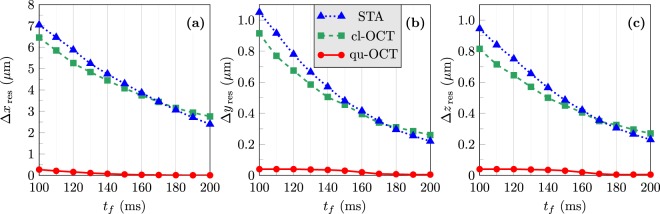
Residual oscillation amplitudes in the size dynamics after transport in the (a) x, (b) y and (c) z directions, as a function of the transport duration tf  . Shortcut-to-adiabaticity (STA): dotted blue line, classical optimal control (cl-OCT): dashed green line, quantum optimal control (qu-OCT): solid red line. The weight parameters λ1, λ2 and λ3 are the same as those used in Fig. 2. See text for details.

References

    1. Will CM. The confrontation between general relativity and experiment. Living Rev. Relativity. 2014;17:4. doi: 10.12942/lrr-2014-4. - DOI - PMC - PubMed
    1. Touboul P, et al. Microscope mission: First results of a space test of the equivalence principle. Phys. Rev. Lett. 2017;119:231101. doi: 10.1103/PhysRevLett.119.231101. - DOI - PubMed
    1. Hartwig J, et al. Testing the universality of free fall with rubidium and ytterbium in a very large baseline atom interferometer. New J. Phys. 2015;17:035011. doi: 10.1088/1367-2630/17/3/035011. - DOI
    1. Dickerson SM, Hogan JM, Sugarbaker A, Johnson DMS, Kasevich MA. Multiaxis inertial sensing with long-time point source atom interferometry. Phys. Rev. Lett. 2013;111:083001. doi: 10.1103/PhysRevLett.111.083001. - DOI - PubMed
    1. Altin PA, et al. Precision atomic gravimeter based on Bragg diffraction. New J. Phys. 2013;15:023009. doi: 10.1088/1367-2630/15/2/023009. - DOI