


Abdominal skeletal muscle mass as a predictor of mortality in Japanese patients undergoing left ventricular assist device implantation
- PMID: 30929311
- PMCID: PMC6487708
- DOI: 10.1002/ehf2.12429
Abdominal skeletal muscle mass as a predictor of mortality in Japanese patients undergoing left ventricular assist device implantation
Abstract
Aims: We assessed preoperative muscle wasting in patients undergoing left ventricular assist device (LVAD) implantations using abdominal skeletal muscle images on computed tomography (CT) and explored the associations between the preoperative muscle wasting and clinical outcomes after LVAD implantation.
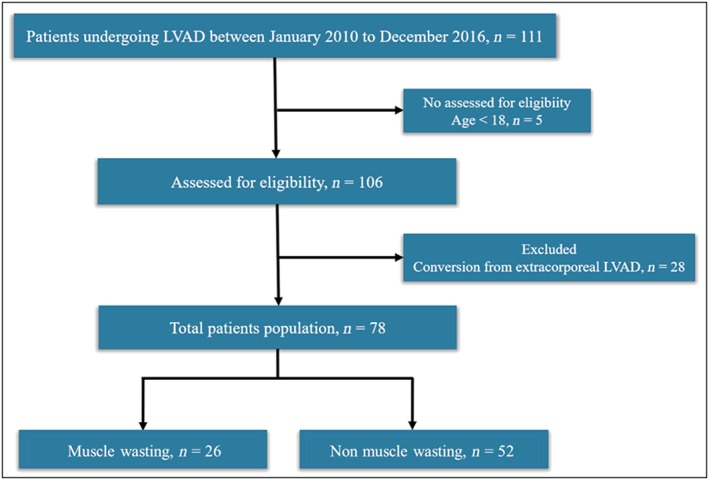
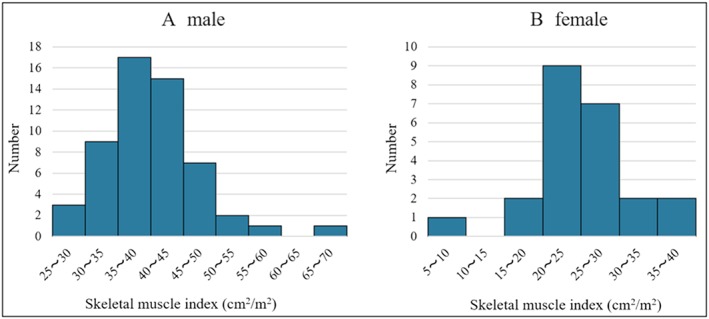
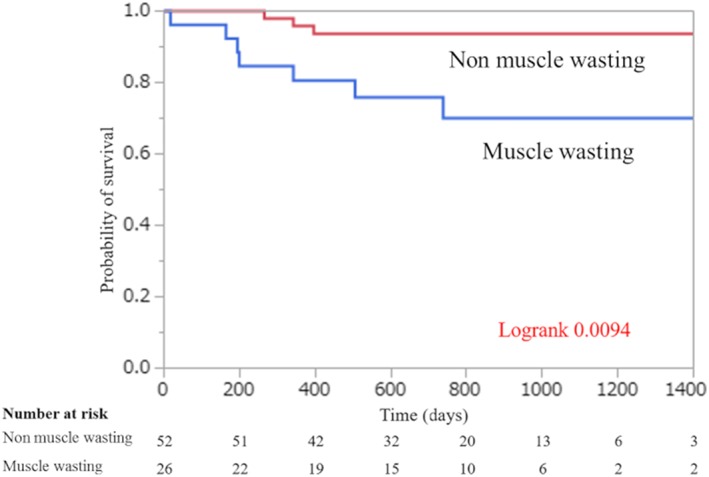
Methods and results: We retrospectively examined the records of 111 patients who underwent continuous-flow LVAD implantations as bridge-to-transplant therapy from January 2010 to December 2016 at our institution. After 33 patients were excluded, the study cohort consisted of 78 individuals. CT images used to calculate the skeletal muscle index (SMI) at the third lumbar vertebra level were obtained before the LVAD implantation procedures. Patients were classified as having muscle wasting if their SMI fell into the lowest gender-based tertile. The median SMI for the study patients was 37.6 cm2 /m2 . The SMI cut-off values for the lowest tertiles were 36.7 cm2 /m2 for men and 28.2 cm2 /m2 for women, resulting in 26 patients (33.3%) with muscle wasting in this study. During the mean follow-up of 738 ± 379 days, there were 10 deaths (12.8% mortality). Seven of the 26 patients with muscle wasting (26.9%) died, and 3 of the 52 patients without muscle wasting (5.8%) died. The times to all-cause mortality were significantly different between patients with and without muscle wasting (P = 0.0094). Muscle wasting was found to be associated with mortality in univariate and multivariate Cox analyses (hazard ratio: 4.32; 95% CI: 1.19-20.2).
Conclusions: Preoperative muscle wasting was associated with a higher mortality in patients with LVAD. Assessment of the abdominal skeletal muscle area on CT prior to LVAD implantation can help predict mortality.
Keywords: Computed tomography; Heart failure; Left ventricular assist device; Sarcopenia; Skeletal muscle index.
© 2019 The Authors. ESC Heart Failure published by John Wiley & Sons Ltd on behalf of the European Society of Cardiology.
Conflict of interest statement
None declared.
Figures
References
-
- Writing Group Members , Mozaffarian D, Benjamin EJ, Go AS, Arnett DK, Blaha MJ, Cushman M, Das SR, de Ferranti S, Després JP, Fullerton HJ, Howard VJ, Huffman MD, Isasi CR, Jiménez MC, Judd SE, Kissela BM, Lichtman JH, Lisabeth LD, Liu S, Mackey RH, Magid DJ, McGuire DK, Mohler ER 3rd, Moy CS, Muntner P, Mussolino ME, Nasir K, Neumar RW, Nichol G, Palaniappan L, Pandey DK, Reeves MJ, Rodriguez CJ, Rosamond W, Sorlie PD, Stein J, Towfighi A, Turan TN, Virani SS, Woo D, Yeh RW, Turner MB, American Heart Association Statistics Committee , Stroke Statistics Subcommittee . Executive summary: heart disease and stroke statistics—2016 update: a report from the American Heart Association. Circulation 2016; 133: 447–454. - PubMed
-
- Farrar DJ, Holman WR, McBride LR, Kormos RL, Icenogle TB, Hendry PJ, Moore CH, Loisance DY, El‐Banayosy A, Frazier H. Long‐term follow‐up of Thoratec ventricular assist device bridge‐to‐recovery patients successfully removed from support after recovery of ventricular function. J Heart Lung Transplant 2002; 21: 516–521. - PubMed
-
- Miller LW, Pagani FD, Russell SD, John R, Boyle AJ, Aaronson KD, Conte JV, Naka Y, Mancini D, Delgado RM, MacGillivray TE, Farrar DJ, Frazier OH. Use of a continuous‐flow device in patients awaiting heart transplantation. N Engl J Med 2007; 357: 885–896. - PubMed
-
- Slaughter MS, Rogers JG, Milano CA, Russell SD, Conte JV, Feldman D, Sun B, Tatooles AJ, Delgado RM 3rd, Long JW, Wozniak TC, Ghumman W, Farrar DJ, Frazier OH, Investigators HMII. Advanced heart failure treated with continuous‐flow left ventricular assist device. N Engl J Med 2009; 361: 2241–2251. - PubMed
-
- Kiernan MS, Sundareswaran KS, Pham DT, Kapur NK, Pereira NL, Strueber M, Farrar DJ, DeNofrio D, Rogers JG. Preoperative determinants of quality of life and functional capacity response to left ventricular assist device therapy. J Card Fail 2016; 22: 797–805. - PubMed
Publication types
MeSH terms
Substances
LinkOut - more resources
Full Text Sources
Medical
