


Noninferior Outcome After Breast-Conserving Treatment Compared to Mastectomy in Breast Cancer Patients With Four or More Positive Lymph Nodes
- PMID: 30931256
- PMCID: PMC6423330
- DOI: 10.3389/fonc.2019.00143
Noninferior Outcome After Breast-Conserving Treatment Compared to Mastectomy in Breast Cancer Patients With Four or More Positive Lymph Nodes
Abstract
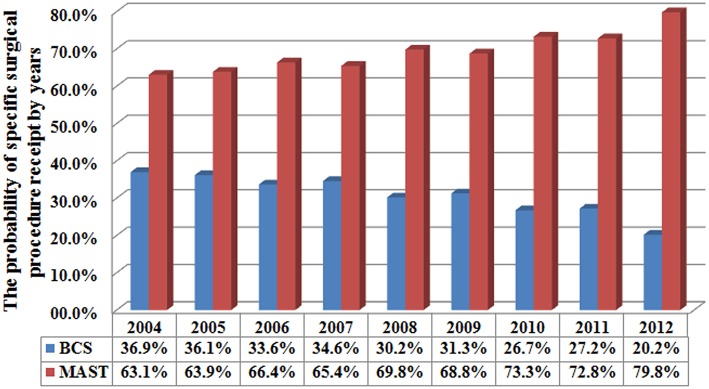
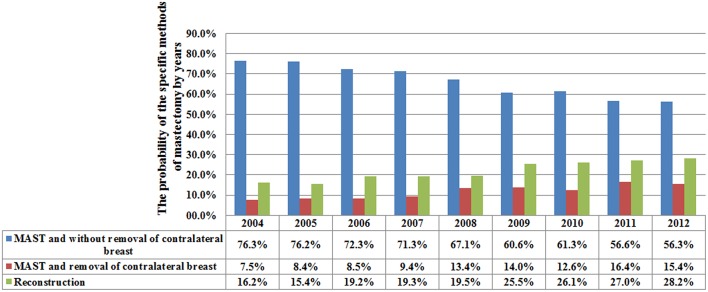
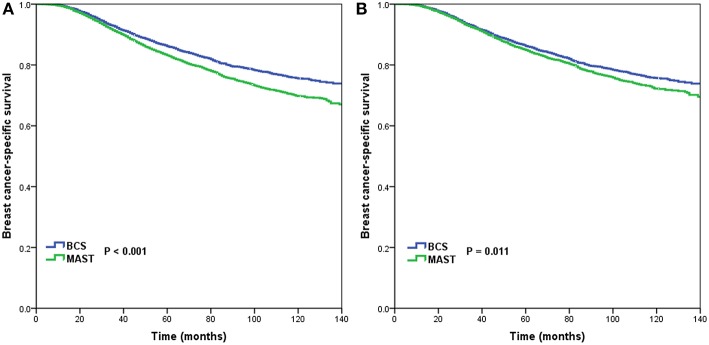
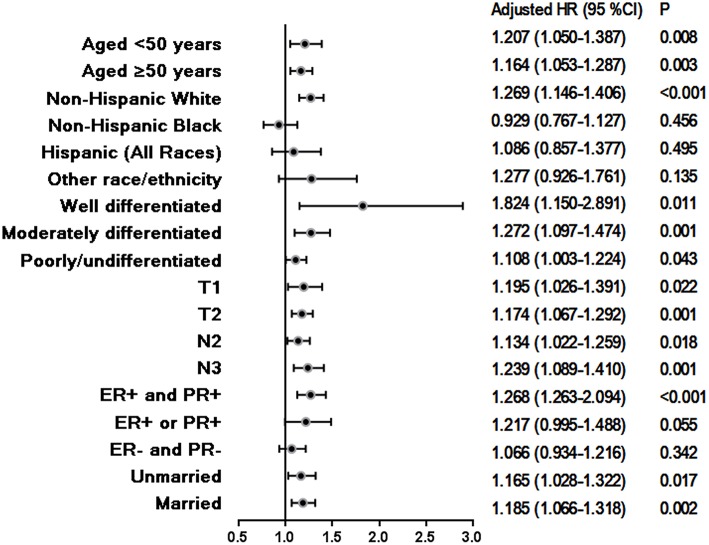
Introduction: We conducted a non-inferiority analysis using real-world data to compare the survival outcomes of stage T1-2N2-3 (tumor size ≤5 cm and four or more node metastases) breast cancer after breast-conserving surgery (BCS) and mastectomy (MAST). Methods: The study included patients with stage T1-2N2-3 invasive breast carcinoma from the Surveillance, Epidemiology, and End Results program, who underwent BCS or MAST between 2004 and 2012, along with both radiotherapy and chemotherapy. The statistical analyses used included the chi-squared test, multivariate Cox proportional hazards models, and propensity score matching (PSM). Results: The study population comprised 13,263 patients, including 4,787 (36.1%) and 8,476 (63.9%) patients who were treated with BCS and MAST, respectively. Patients with younger age and advanced stage were more likely to have received MAST. The probability of receiving MAST increased over the years, while the probability of BCS decreased (p < 0.001). The 5-year breast cancer-specific survival (BCSS) was 86.1% in the BCS cohort compared to 83.1% in the MAST cohort (p < 0.001). Surgical procedure was an independent prognostic factor for BCSS. Patients who received MAST had worse BCSS than those treated with BCS (hazard ratio = 1.179, 95% confidence interval = 1.087-1.278, p < 0.001). These results remained significant after stratification by age, tumor grade, T stage, N stage as well as marital status. Similar results were obtained after PSM. Conclusions: BCS resulted in noninferior outcome than MAST in patients with T1-2/N2-3 invasive breast carcinoma. BCS may therefore be an optimal treatment option when both treatment options are feasible and appropriate.
Keywords: breast conserving treatment; invasive breast cancer; mastectomy; node positive; radiotherapy.
Figures
References
-
- Peng Z, Wei J, Lu X, Zheng H, Zhong X, Gao W, et al. . Treatment and survival patterns of Chinese patients diagnosed with breast cancer between 2005 and 2009 in Southwest China: an observational, population-based cohort study. Medicine. (2016) 95:e3865. 10.1097/MD.0000000000003865 - DOI - PMC - PubMed
LinkOut - more resources
Full Text Sources
Miscellaneous
